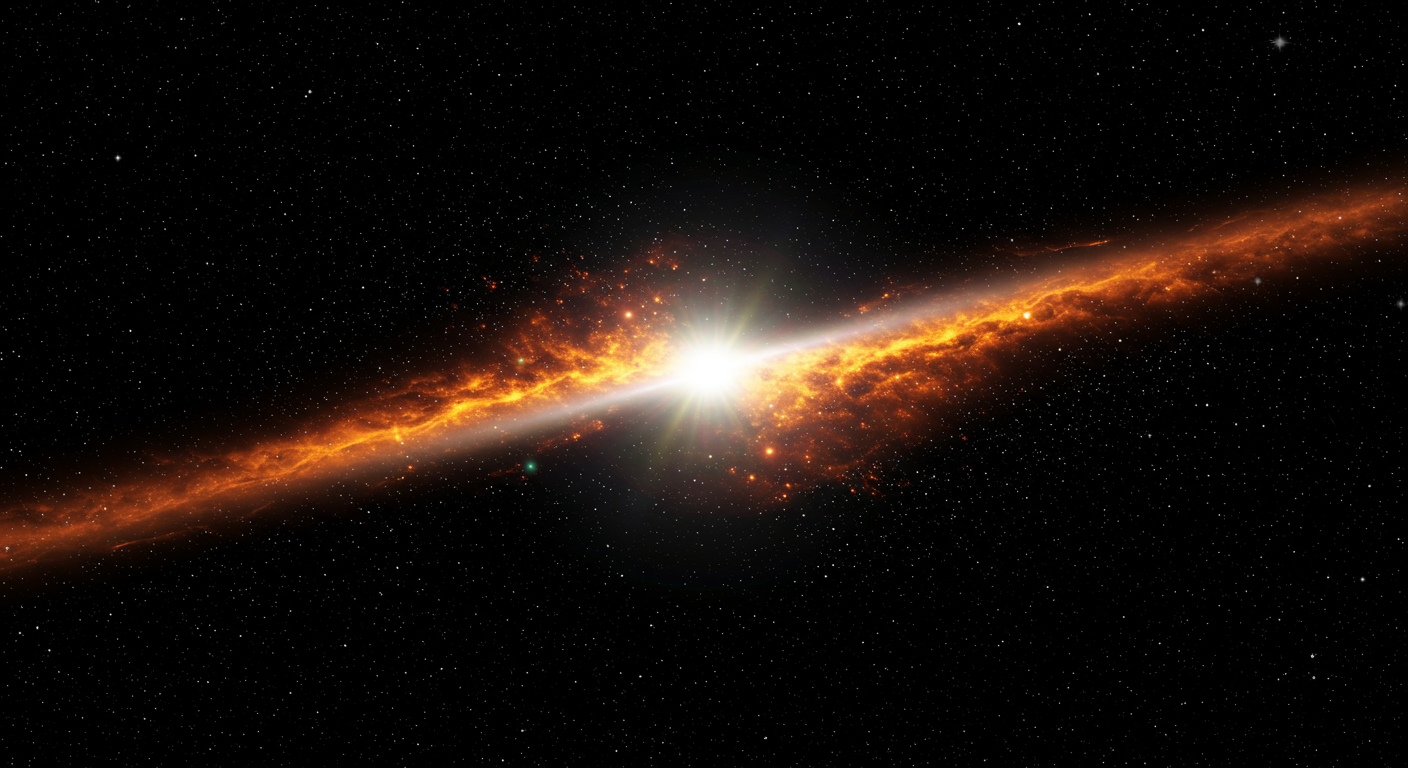
Astronomers have captured the first direct evidence of a massive, multi-temperature plasma eruption from a young star that mirrors the behavior of our own sun in its infancy. The observations of the star, known as EK Draconis, provide a window into the turbulent environment of the early solar system, suggesting that frequent and violent stellar storms may have profoundly shaped the atmospheres of the nascent planets, including Earth. This breakthrough offers crucial data for understanding not only how our world evolved but also the conditions that might foster or hinder life on planets orbiting other stars.
The study, which combined the power of the Hubble Space Telescope with ground-based observatories, successfully tracked a colossal outburst of charged particles, known as a coronal mass ejection (CME), from EK Draconis. For the first time, researchers detected both the intensely hot, fast-moving plasma leading the eruption and the cooler, slower gas trailing behind. This detailed, two-part structure confirms long-held theories about the violent nature of young suns and provides a tangible model for the powerful space weather that once dominated our solar system, potentially stripping away primordial atmospheres while also delivering the chemical precursors for life.
A Stellar Proxy for the Young Sun
To understand the sun’s chaotic youth, scientists require a suitable analogue—a nearby star that is currently in a similar stage of stellar evolution. EK Draconis, located approximately 111 light-years from Earth in the constellation Draco, fits this role perfectly. It is a G-type main-sequence star, the same classification as our sun, but is only 50 to 125 million years old, providing a snapshot of how our sun likely behaved shortly after the planets formed. Previous studies had indicated that stars like EK Draconis are far more magnetically active than their mature counterparts, producing “superflares” that dwarf any solar flare observed in modern history.
While these powerful flares have been documented, observing the associated CMEs has been a significant challenge. Scientists long suspected that young stars frequently launched immense clouds of plasma, but detecting them and, more importantly, measuring their properties has been difficult. Until this study, only the cooler components of such eruptions had been sporadically detected using ground-based telescopes. The hotter, more energetic plasma, which carries the bulk of the ejection’s force, remained elusive, leaving a critical gap in understanding the true power of these stellar tantrums.
Observing a Cosmic Eruption
The success of this research hinged on a meticulously coordinated international effort that synchronized observations across multiple wavelengths. An international team of astronomers, with key contributions from Kyoto University, utilized the Hubble Space Telescope to capture far-ultraviolet emissions. This space-based perspective was crucial for detecting the signature of extremely hot plasma, which is invisible to most ground-based instruments. Hubble’s sensitivity to these emissions allowed the researchers to track the leading edge of the CME as it blasted away from EK Draconis.
Simultaneously, three separate ground-based observatories across Japan and Korea focused on the star. These telescopes monitored the hydrogen-alpha spectral line, a specific wavelength of red light emitted by cooler hydrogen gas. This dual approach enabled the team to reconstruct the entire event in real time, capturing both the hot and cool phases of the eruption as they unfolded. This multi-messenger approach provided the first complete, multi-temperature view of a CME from a young solar analogue.
Two Phases of Ejection
The combined observations revealed a dramatic, two-stage event. First, Hubble detected a massive burst of plasma heated to 100,000 Kelvin rocketing into space at speeds between 300 and 550 kilometers per second. This was the initial, high-energy component that scientists had long predicted but never directly seen. Approximately 10 minutes later, the ground-based telescopes picked up the signal of a much cooler gas, measured at around 10,000 Kelvin, moving outward at a more leisurely pace of 70 kilometers per second. This sequence confirms that the CME structure on young stars is similar to that of our sun’s CMEs, but on a far grander and more energetic scale.
Implications for Early Planetary Atmospheres
The discovery that young sun-like stars unleash such powerful, multi-component CMEs has profound implications for the formation and evolution of planets. The early sun’s frequent storms would have relentlessly battered the inner planets, including a young Earth, Mars, and Venus. The high-energy particles carried by the hot, fast-moving plasma could have generated powerful shocks capable of eroding or even completely stripping away the primordial atmospheres of these worlds. This process may explain why Mars, which had a weaker magnetic field, is the arid world it is today.
However, this stellar violence may also have been a creative force. The same energetic particles that eroded atmospheres could have also triggered chemical reactions. These reactions might have helped form complex molecules, such as greenhouse gases that warmed the early Earth or the very biomolecules that served as the building blocks for life. By providing a clearer picture of this harsh but potentially life-giving environment, the study of EK Draconis helps scientists refine models of planetary habitability and the precise conditions needed for life to emerge.
A Collaborative Scientific Achievement
This research stands as a testament to the power of international scientific collaboration. The project required the seamless integration of data from space- and ground-based facilities operated by teams in the United States, Japan, and Korea. Lead researcher Kosuke Namekata of Kyoto University noted that the shared goal of scientific discovery united the diverse team, allowing them to achieve a result that would have been impossible with a single observatory. By combining different observational techniques, the astronomers were able to assemble a complete picture of a complex stellar event occurring light-years away.
The findings provide a solid observational foundation for theories about the sun’s early activity and its influence on our solar system. As researchers continue to study stars like EK Draconis, they can build more accurate models of the space weather conditions that prevailed billions of years ago. This knowledge is not only key to piecing together the history of our own planet but will also guide the search for habitable exoplanets orbiting other stars, helping astronomers identify the worlds where life might have the best chance to take hold.