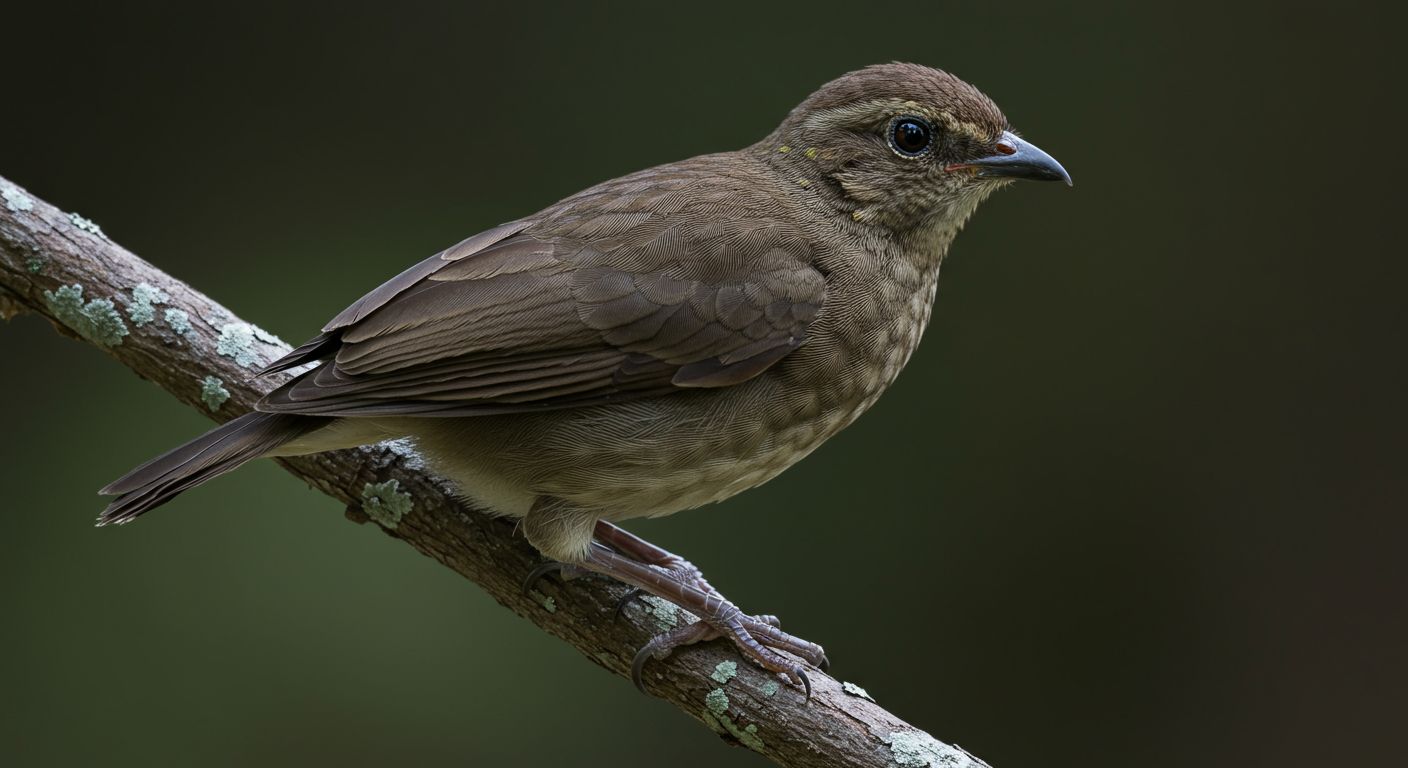
A tiny foot bone unearthed in Central Otago has revealed that New Zealand was once home to a relative of the bowerbird, a family of songbirds known for their uniquely elaborate courtship rituals. The fossil, dated to between 14 and 19 million years ago, provides the first evidence that these birds ever lived outside of Australia and New Guinea, where their modern relatives are found today. The discovery adds an entirely new and unexpected family to the country’s prehistoric avian roster and offers a deeper understanding of the ancient biodiversity that once thrived on the islands.
The new species, named Aevipertidus gracilis, was identified by an international team of researchers from the University of Otago, the Museum of New Zealand Te Papa Tongarewa, and the University of Cambridge. Found in the rich fossil beds of St Bathans, the bone belonged to a bird significantly smaller and more slender than any living bowerbird, weighing an estimated 33 grams, comparable to a modern bellbird. This finding not only pushes back the known geographic range of this charismatic bird family but also underscores the unique evolutionary path of New Zealand’s fauna during the Miocene epoch, a period of significant geological and biological change.
A Miniature Marvel From a Lost Lake
The discovery was made at the St Bathans fossil site, a location renowned for preserving a detailed record of life from a vast, ancient body of water known as Lake Manuherikia. This prehistoric lake system, which existed 14 to 19 million years ago, supported a diverse ecosystem, and its sediments have yielded thousands of bird fossils over the years. While larger birds like ducks are well-represented in the fossil record, the delicate bones of smaller birds, especially passerines or songbirds, are far rarer and more difficult to study.
The St Bathans Bowerbird
The specific fossil that led to this discovery is a foot bone measuring just 3 centimeters long. Despite its small size, its features clearly aligned with those of the bowerbird family. The new species was formally named Aevipertidus gracilis, a name that translates to “the gracile one from a lost age,” reflecting its slender build and its existence in a long-vanished time and place. Analysis of the bone revealed that this ancient bowerbird was the smallest known member of its family. Most modern bowerbirds are robust birds, weighing between 62 and 265 grams. At an estimated 33 grams, Aevipertidus gracilis was a much more delicate creature, though it possessed notably long feet for its size.
Advanced Tools Reveal Ancient Secrets
Identifying such a significant find from a minuscule bone fragment was made possible by modern analytical technology. The study of tiny fossil bones presents immense challenges; they are difficult to find in the field and their features are often too small to analyze with the naked eye. Traditional paleontological methods often focus on larger, more complete skeletons, leaving the history of smaller animals largely unexplored.
Micro-CT Scanning Technology
To overcome these obstacles, the research team employed micro-CT scanning. This non-destructive imaging technique allowed them to create highly detailed 3D digital models of the fossil. By comparing these intricate models with the bones of a wide array of other passerines, the scientists could confidently identify the hallmarks of a bowerbird. Lead author Elizabeth Steell of the University of Cambridge noted that the team wasn’t searching for a bowerbird specifically but that the bone’s distinctive shape quickly made it clear they had found a species no longer present in New Zealand. This technological approach was critical in unlocking the secrets held within the tiny bone and inferring the bird’s body mass and overall shape from a single fragment.
Connecting to a Charismatic Family
Bowerbirds are world-famous for their remarkable and complex courtship behavior, widely publicized in nature documentaries by Sir David Attenborough. Instead of relying on bright plumage or elaborate songs alone, male bowerbirds construct and decorate intricate structures, called bowers, to attract mates. These bowers can range from simple clearings to elaborate, arched avenues of twigs. The males meticulously decorate their structures with brightly colored objects found in their environment, such as fruits, leaves, flowers, and even human-made items like pieces of plastic. Females visit multiple bowers and judge the males on the quality of their constructions before selecting a mate.
Clues in the Bone
While it is impossible to know the exact behavior of Aevipertidus gracilis, its anatomy offers intriguing clues. The analysis suggested its foot shape was most similar to the group of modern bowerbirds that build “avenue” bowers, such as the flame bowerbird. This raises the possibility that this ancient, smaller relative may have engaged in similar displays, performing elaborate rituals to attract a mate millions of years ago in the forests of ancient New Zealand. Though its plumage and specific behaviors remain a matter of speculation, the connection provides a fascinating glimpse into the deep evolutionary roots of one of nature’s most creative courtship displays.
Rewriting New Zealand’s Avian History
The presence of a bowerbird in ancient New Zealand fundamentally alters the scientific understanding of the region’s historical biodiversity. It adds a completely new songbird family to the country’s fossil record and demonstrates that Zealandia was once home to lineages that have long since vanished from the islands. This discovery places the St Bathans bowerbird alongside other iconic ancient New Zealand passerines—such as the ancestors of the huia, kōkako, and mohua—whose predecessors colonized the landmass millions of years ago.
This finding is part of a broader field of conservation palaeobiology, which uses the fossil record to understand long-term patterns of evolution and extinction. The history of New Zealand’s birds is not a simple linear story but one of repeated colonizations and extinctions over geological time. For instance, ancient shelducks once lived in Zealandia, went extinct, and were later replaced by the ancestors of today’s paradise shelduck, which recolonized the islands around two million years ago. The St Bathans bowerbird represents another of these lost lineages, highlighting the dynamic and ever-changing nature of the archipelago’s ecosystem long before the arrival of humans.