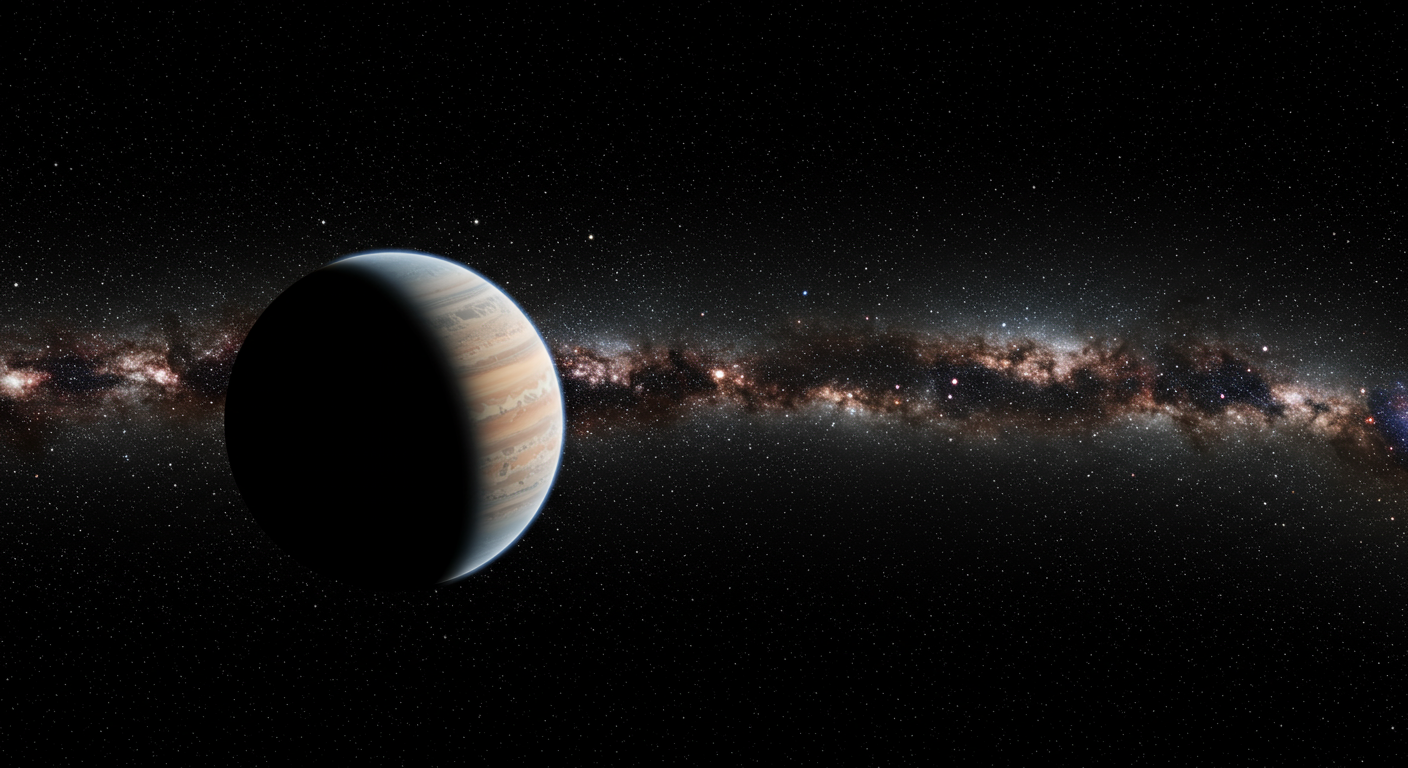
An international team of astronomers has identified a new exoplanet, a world smaller than Neptune, orbiting a star 269 light-years from Earth. The discovery, made using data from NASA’s Transiting Exoplanet Survey Satellite (TESS), provides a valuable new subject for scientists studying the formation and composition of planets that occupy a size range not represented within our own solar system. This “mini-Neptune,” designated TOI-283 b, orbits a bright orange dwarf star, making it a promising candidate for future atmospheric analysis.
The planet is an example of a common type of world in the galaxy, yet one that remains mysterious due to its absence in our immediate cosmic neighborhood. These planets, intermediate in size between rocky super-Earths and ice giants like Uranus and Neptune, challenge existing models of planetary evolution. The physical properties of TOI-283 b—larger than Earth but significantly less massive than Neptune—suggest it possesses a dense core enveloped in a thick atmosphere, and its proximity to a bright star will allow for unprecedented observational detail with next-generation telescopes.
A Transit-Based Discovery
The detection of TOI-283 b was accomplished through the transit method, a cornerstone of the TESS mission’s planet-hunting strategy. TESS continuously monitors the brightness of hundreds of thousands of the nearest and brightest stars, searching for faint, periodic dips in their light. These dips signal a potential planet passing in front of the star from our point of view. Since its launch in 2018, TESS has identified thousands of such “TESS Objects of Interest,” or TOIs, with TOI-283 b being one of the latest candidates to be officially confirmed as a planet. The satellite’s ability to scan vast swaths of the sky has revolutionized the field, building a comprehensive catalog of nearby exoplanets for further study.
Once a candidate is flagged, ground-based observatories and other instruments conduct follow-up observations to validate the discovery and measure the planet’s properties more precisely. For TOI-283 b, this process confirmed that the dimming events were indeed caused by an orbiting planet and allowed astronomers to calculate its mass and orbital characteristics. This multi-stage process of detection and confirmation is critical for distinguishing true exoplanets from other astronomical phenomena that can mimic a transit signal, such as eclipsing binary star systems or stellar activity.
Characterizing the Mini-Neptune World
Subsequent analysis revealed a detailed portrait of the newfound exoplanet, classifying it definitively as a mini-Neptune. This category of planet is thought to have a complex structure, and TOI-283 b fits the theoretical profile with its unique combination of size and mass.
Physical Properties and Composition
Astronomers calculate that TOI-283 b has a radius approximately 2.34 times that of Earth and a mass about 6.54 times greater than our home world. These figures yield an average density of 2.81 grams per cubic centimeter, which is considerably less dense than Earth but suggests a substantial composition beyond just gas. Scientists believe planets like TOI-283 b consist of a large, rocky core surrounded by thick layers of lighter materials, such as water and ammonia, all enveloped in an extended atmosphere of hydrogen and helium. This structure places it in a critical transitional zone between terrestrial planets and the gas-dominated ice giants of our outer solar system.
A Scorching Orbital Environment
The planet orbits its host star on a tight, 17.6-day trajectory. This rapid orbit places it at a distance of approximately 0.12 astronomical units (AU) from its star—roughly one-eighth of the distance between Earth and the sun. Due to this extreme proximity, the exoplanet endures intense stellar radiation, resulting in a scorching estimated equilibrium temperature of 388 degrees Celsius. This intense heat makes the planet entirely inhospitable to life as we know it and likely plays a significant role in the dynamics and potential escape of its outer atmosphere.
Profile of an Ancient Host Star
The star at the center of this system, TOI-283, is a K-type star, often referred to as an orange dwarf. It is located 269 light-years away and is notable for its brightness and its age, providing key context for the evolution of its orbiting planet. The characteristics of the host star are fundamental to understanding the planetary system as a whole, from its formation history to its potential for future observation.
TOI-283 is about 15% smaller in radius and 20% less massive than our own sun. K-type stars are of particular interest to astronomers because they have longer lifespans than larger, hotter G-type stars like our sun, potentially allowing more time for planets to form and evolve. Most significantly, the star is estimated to be 10.4 billion years old, making it more than twice the age of our solar system. This advanced age suggests the planetary system is mature and stable, offering a glimpse into the long-term evolution of mini-Neptune-type worlds.
Future Atmospheric Investigations
One of the most exciting aspects of the TOI-283 b discovery is its potential for future atmospheric characterization. The planet’s passage in front of its bright host star provides an ideal scenario for transmission spectroscopy, a technique used to analyze the chemical makeup of an exoplanet’s atmosphere.
When TOI-283 b transits its star, a small fraction of the starlight passes through its atmosphere before reaching Earth. Astronomers can analyze this light to detect the chemical fingerprints of different molecules and elements present. Researchers plan to use the James Webb Space Telescope (JWST) to perform these observations on TOI-283 b, with a particular focus on searching for the presence of water vapor and other key compounds. Such a detection would provide concrete evidence for the models of mini-Neptune composition and offer crucial insights into the atmospheric dynamics of worlds subjected to intense stellar radiation. The brightness of TOI-283 makes the system an excellent target, as it provides a strong signal that allows for more precise and detailed measurements, pushing the boundaries of exoplanetary science.
