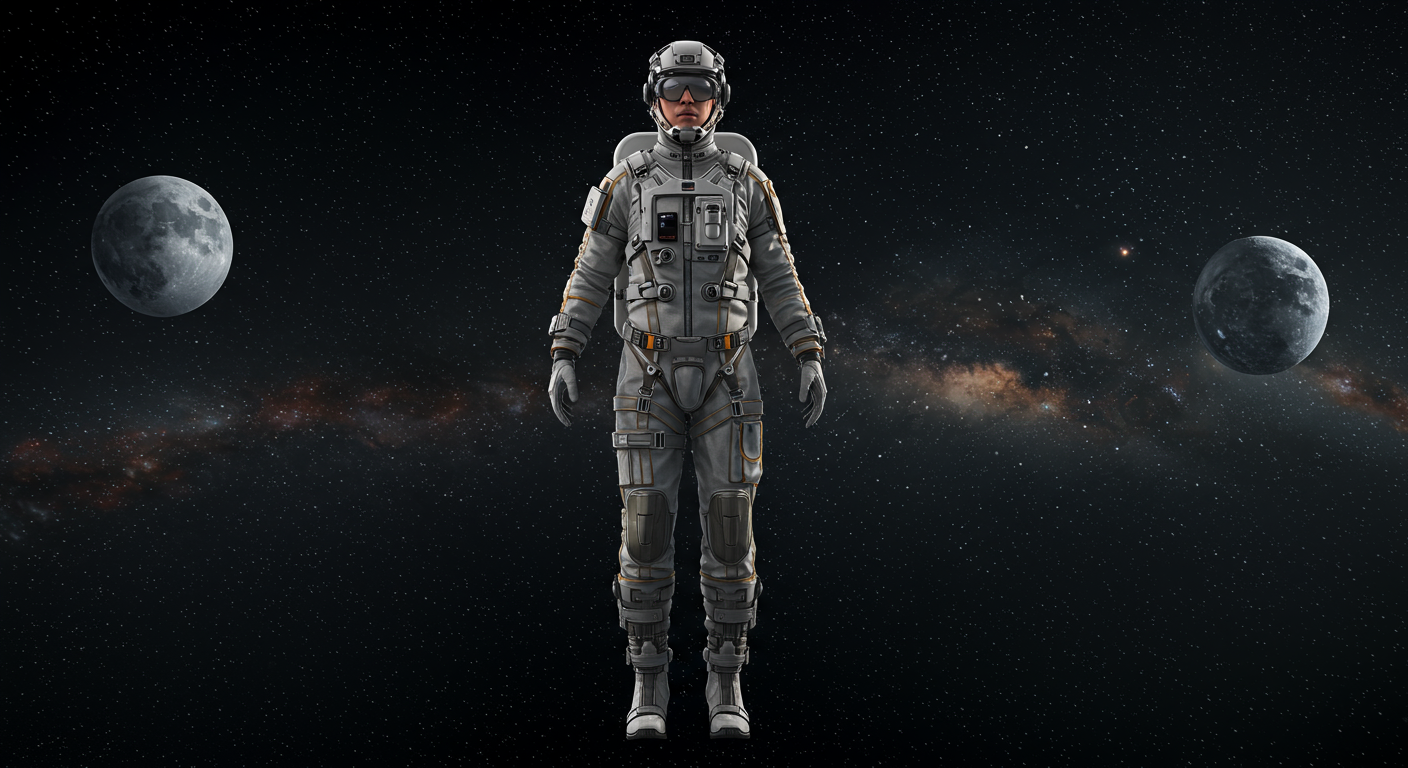
A new generation of wearable robotics, designed as a pair of soft, fabric-based trousers, is poised to enhance how astronauts work and move during missions on the Moon and Mars. Developed by researchers at the University of Bristol, this lightweight exosuit is worn underneath a conventional spacesuit and uses integrated artificial muscles to reduce physical fatigue, making strenuous extra-vehicular activities easier and more efficient. The technology promises not only to revolutionize human performance in space but also holds significant potential for assisting individuals with mobility challenges on Earth.
This innovative garment addresses the significant physical toll that performing tasks in bulky, pressurized spacesuits takes on an astronaut’s body. By providing targeted support to the lower-limb muscles, the exosuit helps maintain natural movement while simultaneously augmenting the wearer’s strength and endurance. Recent field tests in a highly realistic simulated lunar environment demonstrated the suit’s viability and comfort, marking a critical step toward its potential deployment on future space missions and in terrestrial physical rehabilitation programs. The research represents a convergence of materials science, robotics, and even traditional craftsmanship to solve a modern technological challenge.
A Novel Approach to Mobility
The device is a departure from rigid, heavy exoskeletons often depicted in science fiction. As a soft robotic exosuit, it is constructed primarily from flexible fabric materials, designed to feel like a piece of clothing rather than a machine. The core of its function lies in a network of artificial muscles that are seamlessly integrated into the trousers. These actuators work automatically to support the user’s movements, such as walking, bending, or lifting, thereby lessening the muscular strain required to perform these actions. The design prioritizes a snug fit under a multi-layer spacesuit, ensuring it does not add prohibitive bulk or hinder the astronaut’s natural biomechanics. This fabric-based approach allows for a greater range of motion and comfort over extended periods of use, which is critical for long-duration missions on planetary surfaces. The system is engineered to be assistive, meaning it augments the user’s own muscle power rather than replacing it, promoting continued muscle engagement while preventing premature exhaustion during physically demanding tasks.
Rigorous Testing in a Simulated Environment
To validate its performance, the exosuit was recently subjected to its first field test as part of a major international simulated space mission. The trials took place at the Exterres CRATER facility at the University of Adelaide in Australia, which is the largest simulated lunar environment in the Southern Hemisphere. The testing was a key component of the ADAMA mission, organized by ICEE.space, within a broader project dubbed the “World’s Biggest Analog” mission. This ambitious undertaking involved 200 scientists from 25 different countries working across four continents, with operations coordinated from a mission control center in Austria.
During the simulation, the robotic trousers were integrated into a spacesuit for the first time in a field setting. An analog astronaut wore the complete system to perform a series of tasks designed to mimic activities on a planetary surface. The experiments carefully evaluated the suit’s comfort, its effect on mobility, and its overall biomechanical impact. These activities included walking and climbing on loose, uneven terrain and carrying loads, allowing researchers to gather critical data on how the exosuit performs under realistic operational stress. The successful integration and testing marked a significant milestone, proving the concept’s feasibility in a complex, mission-oriented environment.
The Technology Behind the Trousers
Artificial Muscle Design
The “muscles” of the exosuit are sophisticated pneumatic actuators. Each artificial muscle consists of two primary layers: an inner thermoplastic layer that can be inflated with air to create a tight seal, and a durable outer nylon layer that contains the pressure and directs the force. When air is pumped into these actuators, they contract and generate assistive force, much like a biological muscle. This inflation is precisely controlled to provide support exactly when and where it is needed during a specific movement, such as pushing off from a step or lifting a heavy object. The lightweight and flexible nature of these actuators is what enables the suit’s garment-like feel, allowing them to be distributed across the legs without creating rigid points that could restrict movement or cause discomfort.
High-Strength Components
To ensure the exosuit can withstand the rigors of extra-vehicular activities, key structural components are made from advanced, high-performance materials. The waistband and knee straps, which serve as anchoring points to transfer the force from the artificial muscles to the wearer’s body, are constructed from Kevlar. This material is known for its exceptional strength-to-weight ratio and resistance to tension and tearing. Using Kevlar ensures that these critical anchoring components remain stable and reliable under significant strain, preventing slippage or failure while the astronaut is moving. This blend of soft, inflatable muscles and robust anchoring fabrics creates a durable and effective system capable of operating in extreme environments.
From Concept to Creation
The development of the exosuit was led by Dr. Emanuele Pulvirenti, a research associate in the Soft Robotics Lab at the University of Bristol. The project highlights a unique intersection of high-tech engineering and hands-on craftsmanship. Dr. Pulvirenti handmade the prototype himself, a process that required him to learn how to sew. He has noted that he received valuable advice for this work from his grandmother, who was a tailor. This personal involvement in the fabrication process underscores the project’s innovative and resourceful spirit. The development was a collaborative effort, undertaken with colleagues at the University of Bristol’s Vivo Hub. This teamwork was essential in translating the complex requirements of an assistive wearable device into a functional and test-ready prototype.
Dual Applications in Space and on Earth
Enhancing Extra-Vehicular Activities
The primary goal for the assistive exosuit is to enhance the performance and safety of astronauts during surface operations. By reducing fatigue, the technology could allow astronauts to work for longer periods, cover more ground during geological surveys, and perform physically demanding construction or maintenance tasks with greater ease. Dr. Pulvirenti has expressed his hope that the technology will one day be tested aboard the International Space Station, which would be the next logical step in its development for space applications. Ultimately, such a system could become standard equipment for missions to the Moon and Mars, where maximizing human efficiency and minimizing physical strain will be paramount to mission success.
Aiding Rehabilitation and Recovery
Beyond its applications in space, the underlying technology has profound implications for terrestrial medicine and personal mobility. The research team has also developed a resistive version of the exosuit. Instead of making movement easier, this variant applies a load to the body, which can help maintain muscle mass and bone density. This is not only useful for astronauts in zero-gravity environments but also for patients on Earth undergoing physical rehabilitation. The team’s next major goal is to create a hybrid suit that can seamlessly switch between assistive and resistive modes. Such a device could offer tailored support for individuals recovering from injuries or dealing with mobility challenges, providing assistance when needed and resistance to help rebuild strength, revolutionizing therapeutic regimens.
