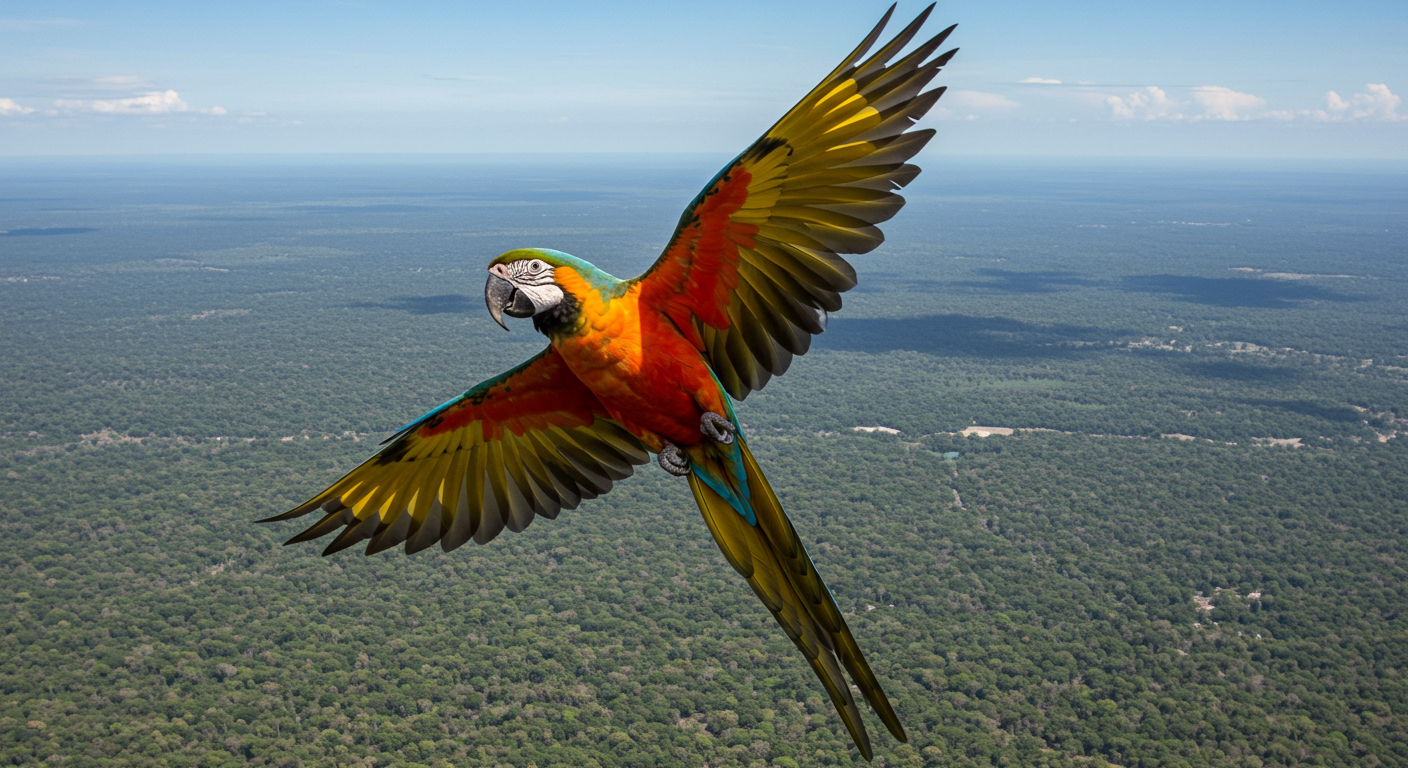
A new study has developed a high-precision risk map that identifies the most dangerous sections of power lines for Brazil’s endangered Lear’s macaw, a rare parrot species facing significant threats from electrocution. The research, published in the Journal of Applied Ecology, provides a cost-effective blueprint for conservation efforts, demonstrating that strategically modifying a small fraction of the electrical infrastructure could dramatically reduce bird fatalities. This targeted approach aims to guide energy companies and conservation planners to act before more of the threatened birds are lost, ensuring that limited financial resources are allocated for the greatest impact.
The core finding of the analysis reveals that the risk of electrocution is not evenly distributed across the landscape but is instead concentrated in specific hotspots. Researchers conducted a cost-benefit analysis showing that retrofitting just 10% of the most hazardous utility poles—approximately 37,000 structures—could prevent an estimated 80% of known macaw deaths from electric shock. This breakthrough offers a practical pathway to mitigate a major source of mortality for the species, which is found only in a small, semi-arid region of northeastern Brazil. The study’s framework integrates detailed ecological data with national energy grid maps to pinpoint where conservation interventions will be most effective.
An Endangered Species’ Deadly Obstacle
The Lear’s macaw (Anodorhynchus leari) is one of the world’s most threatened parrots, endemic to the Brazilian Caatinga, a unique semi-arid biome. The species’ survival is closely tied to its primary food source, the licuri palm (Syagrus coronata). Unfortunately, the natural landscape of the Caatinga is characterized by low vegetation, which presents a critical challenge for the birds. With a scarcity of tall, native trees for resting and socializing, the macaws have increasingly turned to artificial high points: the pylons and cables of Brazil’s expanding power grid.
This behavior brings the birds into fatal contact with medium-voltage wires, and electrocution has become a significant threat to the species’ recovery. Records show a persistent pattern of deaths, with at least 35 electrocutions of Lear’s macaws reported in 2025 alone. These incidents represent a substantial loss for a species with a very small population, concentrated almost entirely within the Raso da Catarina region of Bahia state. The power lines, which crisscross their essential feeding and roosting grounds, have inadvertently created a landscape of deadly traps that conservationists are now racing to disarm.
Pinpointing a Hidden Hazard
To identify the most dangerous parts of the electrical grid, the research team, led by Larissa Biasotto of BirdLife International, pioneered a novel analytical framework. The study moved beyond traditional methods that use a species’ entire distribution range, which can be overly broad and inefficient for guiding targeted action. Instead, the scientists focused on the macaws’ specific “area of activity,” where the birds spend most of their time feeding, perching, and interacting.
Combining Ecology and Infrastructure Data
The researchers began by obtaining a comprehensive map of Brazil’s national power grid from the National Electric Energy Agency (ANEEL). They then integrated this infrastructure data with ecological models of the macaws’ behavior, creating a composite “hazard surface.” A key innovation was concentrating on the areas where licuri palms, the macaws’ main food, grow in close proximity to power lines. These zones were correctly predicted to be the most frequented by the birds and, therefore, the most dangerous. By combining where the birds spend their time with the precise location of hazardous electrical equipment, the team produced a detailed risk map highlighting the areas in the central and southern portions of the grid that need immediate attention.
Validating the Risk Model
To ensure the accuracy of their predictive map, the scientists validated it against real-world data. They compiled a historical record of 78 known macaw electrocutions that occurred between 2005 and 2022. When they overlaid these fatality locations onto their risk map, the model proved highly accurate in predicting the danger zones. This confirmation demonstrated that the framework was not just a theoretical model but a reliable tool for identifying the pylons and cables responsible for the majority of deaths, allowing for precise and evidence-based conservation planning.
A Strategic Conservation Blueprint
The study’s ultimate goal was to create a practical, cost-effective plan to reduce macaw deaths. The research provides a clear roadmap for how to achieve maximum conservation impact with limited resources, a common challenge in environmental protection. By prioritizing interventions, the plan helps avoid the poor allocation of funds and ensures that efforts are concentrated where they will save the most lives.
The 10-Percent Solution
The cost-benefit analysis produced a powerful and clear conclusion. Retrofitting just 10% of the pylons located in the highest-risk zones—totaling around 37,000 structures—could slash macaw electrocution incidents by 80%. The analysis further showed that expanding the effort to modify 20% of the most dangerous pylons would reduce deaths by up to 90%. This principle of targeted intervention highlights how a focused strategy is far more efficient than attempting to modify an entire regional grid. As co-author Fernando Ascensão noted, prioritizing the right pylons can save both birds and money.
Beyond the Macaw
While the research centered on the Lear’s macaw, its implications extend far beyond this single species. The framework developed by the team serves as a universal model that can be adapted to mitigate human-wildlife conflicts in other regions where energy infrastructure is expanding into sensitive habitats. Power line electrocution is a major threat to bird conservation globally, affecting numerous species, especially large birds of prey and other parrots. This study provides a scientifically robust methodology for any country or utility company to identify high-risk areas and protect its vulnerable wildlife.
The expansion of electrical grids is vital for economic development but poses an increasing threat to biodiversity. This research demonstrates that development and conservation do not have to be mutually exclusive. By integrating ecological knowledge into infrastructure planning and management, it is possible to create solutions that support both human communities and the wildlife that shares their environment. The success of this targeted approach in Brazil could inspire similar efforts worldwide, fostering a more sustainable coexistence between nature and technology.