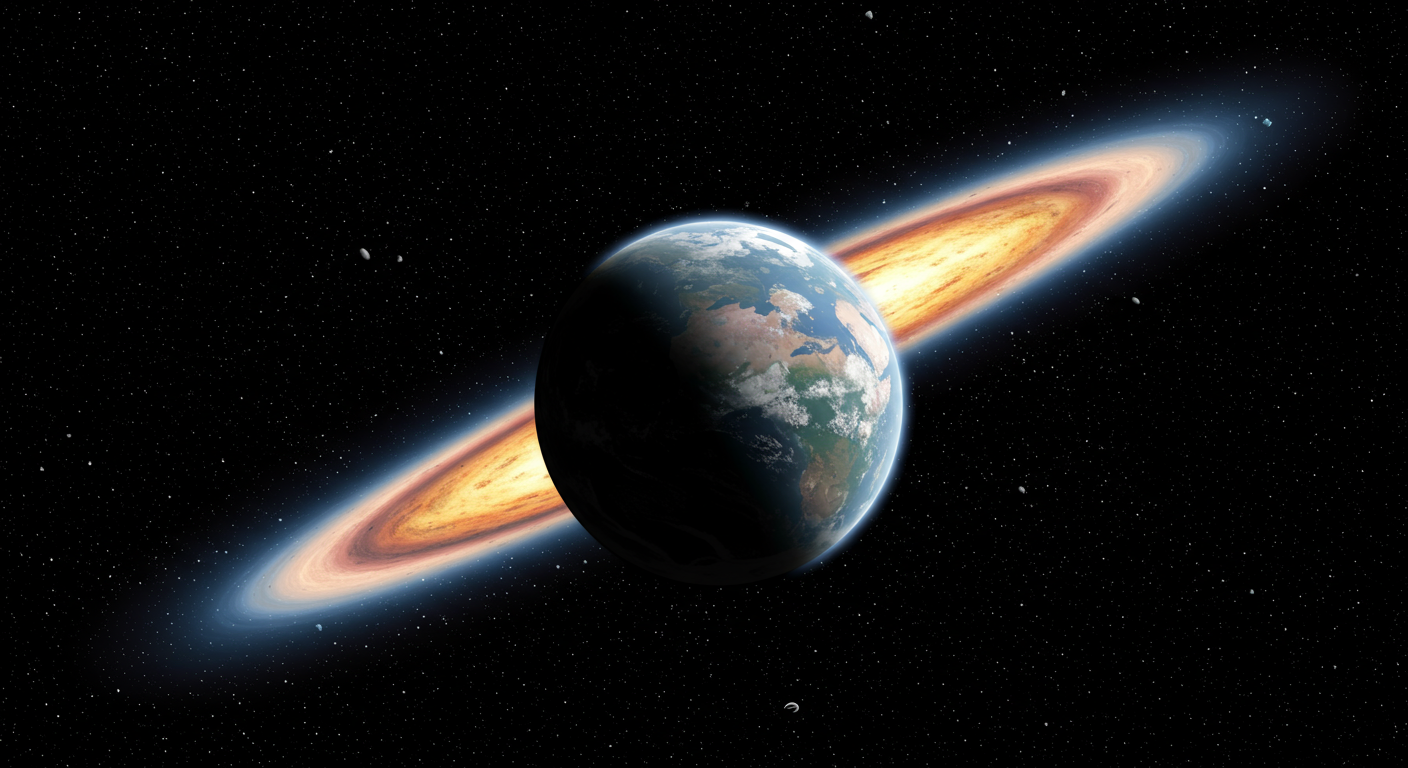
Astronomers have announced the discovery of two Earth-sized planets orbiting SDSS 1557, a compact binary star system located approximately 1,600 light-years away. The finding provides the first direct evidence that terrestrial, rocky worlds can form and persist in the complex and turbulent gravitational environment surrounding a close pair of stars, particularly one composed of stellar remnants. This landmark observation confirms a long-theorized but never-before-seen class of planetary system and fundamentally alters the understanding of where habitable-zone planets might be found.
The system consists of a white dwarf, the dense, collapsed core of a once sun-like star, and a brown dwarf, an object more massive than a gas giant but not massive enough to ignite nuclear fusion. Until now, all confirmed planets found orbiting close binary stars have been large, gaseous worlds akin to Jupiter. The detection of these two smaller, rocky bodies caps nearly a decade of research that began in 2017 when scientists first identified a vast belt of metal-rich asteroids and debris encircling the same stellar pair. That earlier discovery suggested the building blocks of terrestrial planets were present, but this new confirmation of fully-formed worlds opens a new chapter in the search for exoplanets.
A System Forged in Stellar Evolution
The central stars of SDSS 1557 paint a portrait of cosmic life and death. The primary, a white dwarf, is the Earth-sized remnant of a star that exhausted its nuclear fuel long ago. In its final phases, it would have swelled into a red giant, engulfing its inner system before collapsing into its current, intensely dense state. Its companion is a brown dwarf, often called a “failed star,” which orbits the white dwarf closely. This arrangement creates a formidable gravitational challenge for planet formation. The competing pull of two central bodies can disrupt the slow, steady process of accretion, by which dust and rock gradually clump together to form planetesimals and eventually full-sized planets.
The existence of planets in such a system demonstrates that planetesimals can indeed coalesce and remain in stable orbits despite these gravitational dynamics. Furthermore, the planets had to survive the violent expansion of the primary star during its red giant phase. This suggests they either formed much farther out and migrated inward after the star collapsed, or they are the resilient cores of larger planets that were stripped of their atmospheres during the cataclysm. Their survival offers crucial data points for models of planetary system evolution and resilience.
From Planetary Debris to Confirmation
An Atmosphere Polluted with Clues
The first hints of planets in this system emerged not from seeing them directly, but from studying the white dwarf’s atmosphere. In 2017, astronomers using the Gemini Observatory and the Very Large Telescope in Chile detected an unusually high concentration of metals—including silicon and magnesium—polluting the star’s surface layers. A white dwarf’s intense gravity should quickly pull these heavy elements down into its interior, causing them to vanish from sight within weeks. Their persistent presence meant that a steady stream of rocky material must be continuously falling onto the star. The source was determined to be a massive, circumbinary debris disk composed of shattered asteroids, estimated to contain the equivalent of a 4-kilometer-wide object. This discovery provided the first clear signature of rocky planet assembly in a close binary system.
Capturing Shadows in the Starlight
Building on the 2017 findings, research teams undertook a long-term observational campaign to search for the planets themselves. Using high-precision photometry, they monitored the faint light from the white dwarf for subtle, periodic dips in brightness. These dips, known as transits, occur when a planet passes in front of its star from the observer’s point of view. The method is challenging because Earth-sized planets block only a minuscule fraction of the star’s light, requiring incredibly sensitive instruments. After years of meticulous observation and data analysis, astronomers successfully isolated two distinct, recurring transit signals, confirming the presence of two separate planets orbiting the binary pair.
Portrait of Circumbinary Worlds
While details remain preliminary, initial analysis indicates both planets are rocky and comparable in size to Earth. Their orbits are remarkably stable, circling the shared center of mass of both the white and brown dwarfs. Due to the nature of the system, these worlds are unlikely candidates for life as we know it. The white dwarf, though cooling, still emits high-energy radiation, and the system lacks the stable, consistent energy output of a main-sequence star like our sun. The planets are likely airless, barren worlds with surfaces that have been shaped by the intense and variable radiation from their two parent stars.
The discovery is less about finding a habitable twin of Earth and more about proving that small, rocky planets can exist in a much wider variety of cosmic environments than previously thought. The gravitational dynamics of binary stars, combined with the violent history of stellar evolution, were long considered hostile to the formation and survival of such worlds. The existence of the SDSS 1557 planets challenges these assumptions and suggests the galactic census of terrestrial planets may be significantly underestimated.
Future Study of a New Planet Class
Unveiling Secrets with New Telescopes
The next step for astronomers will be to characterize these newfound planets in greater detail. The James Webb Space Telescope, with its powerful infrared capabilities, is an ideal instrument for this task. Scientists will attempt to capture the faint thermal emissions from the planets to learn more about their surface temperatures and compositions. While a substantial atmosphere is unlikely, even the detection of a tenuous envelope of gas could provide invaluable clues about the planets’ geology and history. Verifying the presence of specific elements could help determine if they are indeed the remnants of larger worlds or if they formed as they are today.
Expanding the Search
The confirmation of Earth-sized planets in the SDSS 1557 system serves as a powerful proof-of-concept for future exoplanet surveys. Astronomers now have a definitive reason to search for similar worlds around other white dwarf binaries and post-main-sequence star systems. It suggests that the “second life” of a star system, after its primary has died, may be more dynamic and fruitful than previously believed. Each new system like this one will help piece together the puzzle of planet formation, revealing it to be a more robust and adaptable process than ever imagined. The search for “Tatooines” has now expanded from sun-like stars to the remnants of suns that have long since expired.