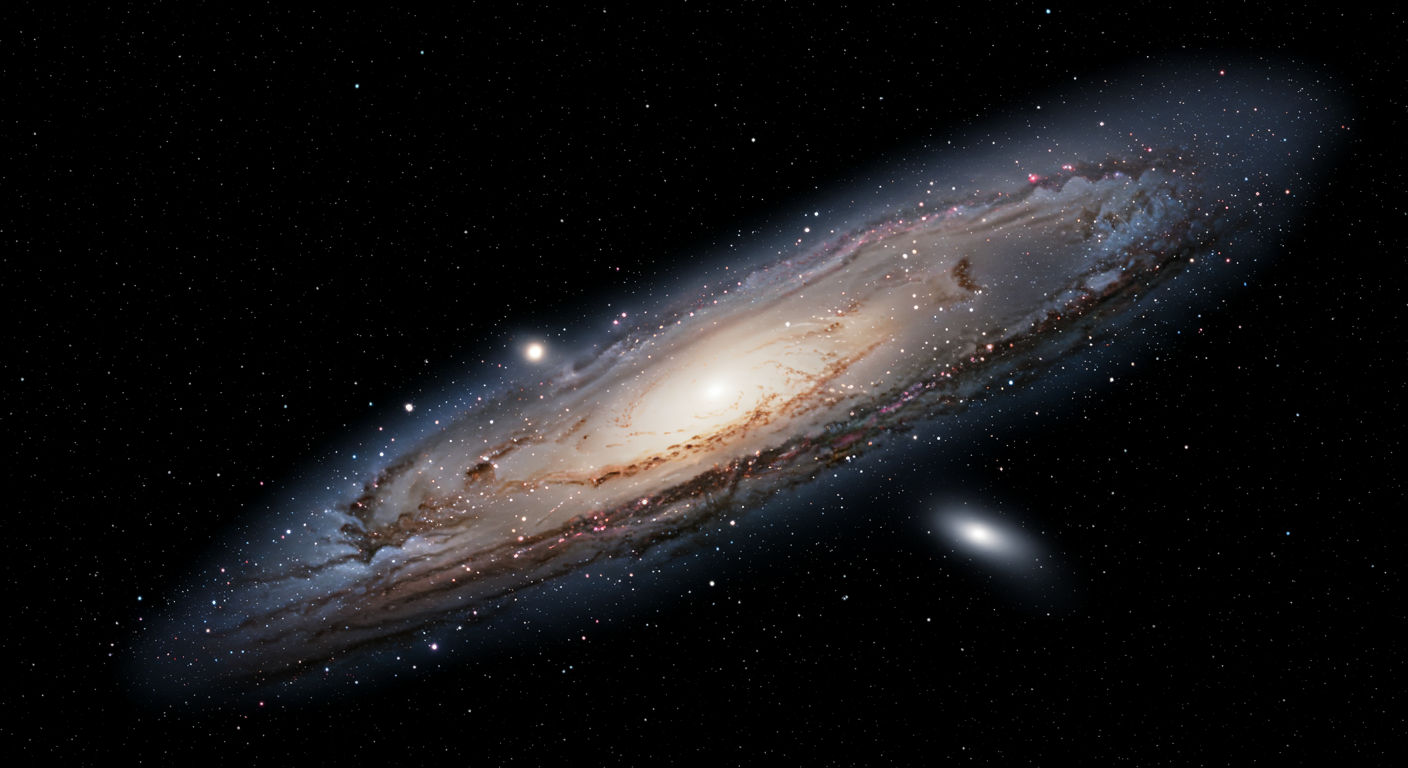
A newly released image from the Hubble Space Telescope has captured the spiral galaxy NGC 3370 with unprecedented clarity, revealing intricate structures within its swirling arms. The galaxy, located approximately 90 million light-years from Earth in the constellation Leo, has been a subject of astronomical study for decades, and this latest portrait offers a significantly more detailed view than previous observations. The image combines data from multiple wavelengths of light, providing a richly textured look at the dust lanes and star-forming regions that mark this celestial object.
This renewed focus on NGC 3370 stems from its vital role as a cosmic laboratory for measuring the expansion of the universe. The galaxy contains specific types of stars and was the site of a stellar explosion that astronomers use as “standard candles” to calculate cosmic distances with high precision. By refining our understanding of this nearby galaxy, scientists can better calibrate their measurements for objects much farther away, helping to resolve fundamental questions about the scale and growth rate of the cosmos. The observations of NGC 3370 are a critical piece of the puzzle in determining how fast the universe is expanding.
A Return to a Cosmic Neighbor
The Hubble Space Telescope has observed NGC 3370 multiple times over the past 20 years, with a notable image released in 2003. The new image surpasses that earlier effort by incorporating data from both the Advanced Camera for Surveys and the Wide Field Camera 3, capturing wavelengths of light that were previously not included. This enhancement results in a sharper, more vibrant picture that distinguishes between different stellar populations, from the yellowish glow of older stars in the galactic center to the brilliant blue-white clusters of young, hot stars scattered throughout the spiral arms.
These detailed observations allow astronomers to better map the galaxy’s complex anatomy. The intricate network of dust, which obscures light from stars behind it, is rendered with striking clarity. Also visible are numerous bright knots of glowing gas, indicating active regions of star formation. Amid the galaxy’s stars, a backdrop of much more distant galaxies can be seen, appearing as faint, reddish smudges in the vastness of space. NGC 3370 is part of a small galactic cluster known as the NGC 3370 group, which also includes the galaxies NGC 3447 and NGC 3455.
Profile of a Critical Galaxy
NGC 3370, sometimes referred to as the Silverado Galaxy, is a spiral galaxy similar in size and mass to our own Milky Way. It was first identified by the German-British astronomer William Herschel on March 21, 1784. For modern astronomers, however, its true importance lies not in its appearance but in its contents. The galaxy is a crucial rung on the cosmic distance ladder, a succession of methods used by scientists to determine distances to celestial objects.
Measuring distances across the universe is a formidable challenge. Since astronomers cannot simply extend a tape measure to a distant star, they rely on objects with a known intrinsic brightness. By comparing how bright an object truly is to how dim it appears from Earth, its distance can be calculated. NGC 3370 is exceptionally valuable because it hosts two of the most reliable types of these cosmic yardsticks, allowing for cross-calibration that strengthens the foundation of the entire distance ladder.
The Universe’s Standard Candles
The two key objects that make NGC 3370 a prime target for research are Cepheid variable stars and Type Ia supernovae. Both provide a way to confidently measure distances, but they operate on different scales and offer complementary information.
Pulsating Cepheid Stars
Cepheid variable stars are a special class of star that pulsates, causing it to brighten and dim on a regular, predictable cycle. A fundamental discovery in the early 20th century revealed a direct relationship between the period of this pulsation and the star’s true luminosity. The brighter the Cepheid, the longer its pulsation period. By observing a Cepheid’s cycle, which can last from days to months, astronomers can determine its intrinsic brightness. This value is then compared to its apparent brightness as seen from Earth to calculate its distance, and by extension, the distance to its host galaxy. Hubble’s sharp vision is essential for identifying and measuring these individual stars in galaxies as far away as NGC 3370.
The Echo of a Supernova
In November 1994, astronomers witnessed a massive stellar explosion in NGC 3370. This event, designated SN 1994ae, was a Type Ia supernova, which occurs when a white dwarf star in a binary system accumulates too much mass and triggers a runaway thermonuclear explosion. These explosions are prized by cosmologists because they consistently reach the same peak luminosity, making them excellent standard candles for measuring distances to the far corners of the universe. SN 1994ae was one of the nearest and most closely studied Type Ia supernovae of the modern era, providing a benchmark for the field. The supernova has long since faded, but its legacy makes NGC 3370 a critical site for calibrating this measurement tool.
Calibrating the Expansion Rate
The true power of NGC 3370 comes from the fact that it contains both Cepheid variables and was the host of a well-observed Type Ia supernova. This allows for a direct and powerful calibration. Astronomers can use the Cepheids to determine a precise distance to NGC 3370. With that distance known, they can then calculate the true intrinsic brightness of the supernova SN 1994ae that exploded there.
This calibration is vital because Type Ia supernovae are bright enough to be seen in galaxies billions of light-years away, far beyond the range where individual Cepheids can be resolved. By anchoring the brightness of nearby supernovae like SN 1994ae to the reliable distance measurements from Cepheids, astronomers can confidently use these explosions to map the vast expanse of the universe. This process is fundamental to pinning down the Hubble constant, the value that describes the universe’s current rate of expansion. Ultimately, the detailed new portrait of NGC 3370 is more than just a beautiful image; it is a key piece of evidence in the ongoing effort to understand the origin, evolution, and ultimate fate of the cosmos.