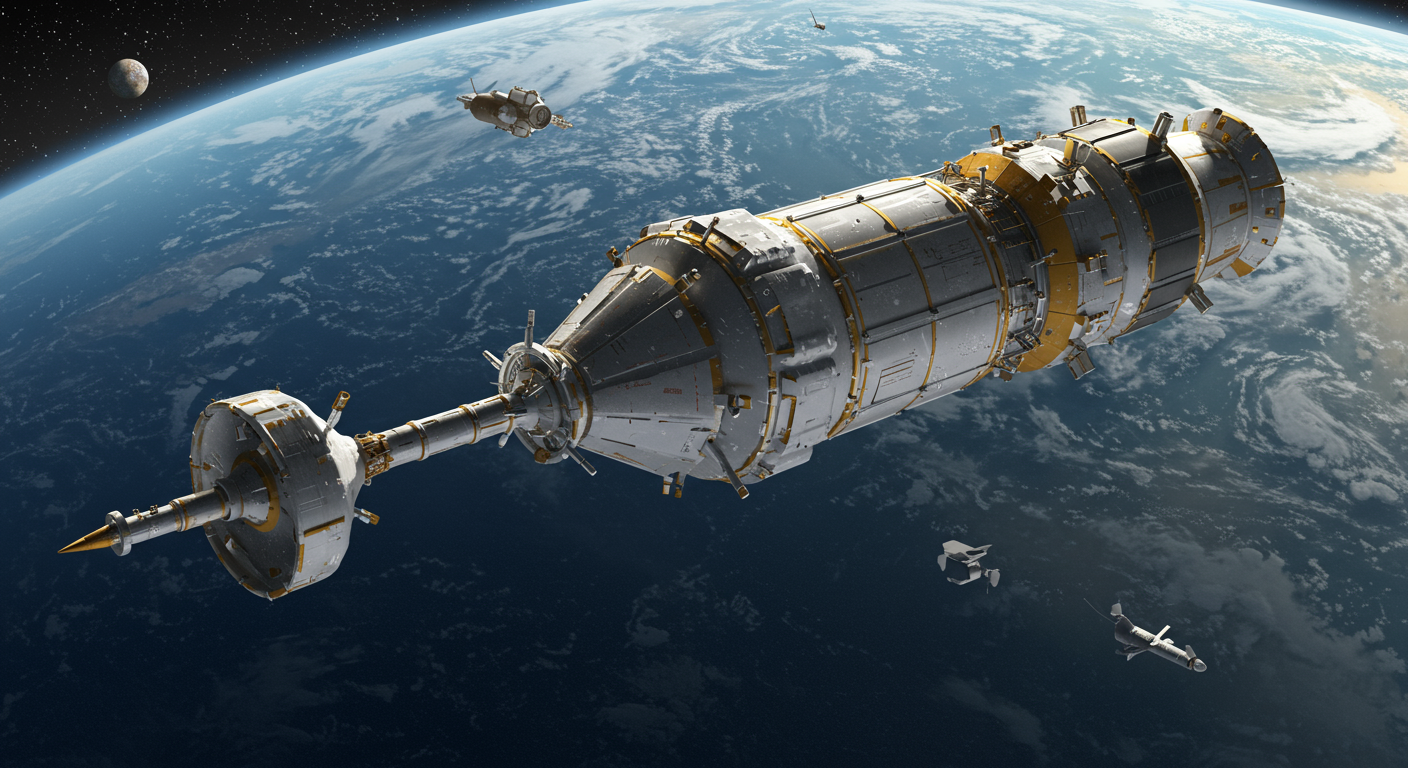
Researchers are making significant strides in developing technologies that could one day enable spacecraft to travel vast distances without the need for traditional fuel. A recent review highlights several concepts for propellantless propulsion, which harness natural forces to generate thrust. These methods, if perfected, could fundamentally alter the economics and capabilities of space exploration, opening up new possibilities for long-duration missions and interstellar travel.
The core challenge of deep space exploration has always been the immense amount of fuel required for conventional rockets. This limitation restricts the range and scope of missions. Propellantless systems sidestep this issue by using external energy sources, such as solar radiation or planetary gravity. While some of these ideas have been utilized in a limited capacity for decades, recent advancements are bringing more exotic concepts closer to reality, sparking renewed interest in a future of space travel untethered from the need to carry heavy propellants.
Harnessing Natural Forces for Propulsion
Several propellantless methods leverage the natural environment of space. Solar sails, for instance, use the pressure from sunlight to move. Made of large, lightweight reflective materials, these sails capture the momentum of photons emitted from the Sun. This provides a continuous, albeit gentle, acceleration that can build up to significant speeds over time, making them a promising option for missions beyond what current propulsion systems can achieve. Another established technique is the gravity assist, or “slingshot,” maneuver. Missions like the Voyager probes have successfully used the gravitational pull of planets to gain speed and alter their trajectories without burning fuel. This method requires precise timing and alignment with planetary bodies but has been instrumental in exploring the outer solar system.
Breakthroughs in Electrostatic Propulsion
A New Force in Propulsion Physics
Dr. Charles Buhler, a former NASA engineer and co-founder of Exodus Propulsion Technologies, has announced a significant breakthrough in propellantless propulsion. His team has developed a drive that appears to generate thrust by creating asymmetry in electrostatic pressure, a method that does not expel mass. This work challenges conventional physics, particularly the law of conservation of momentum, which has been a major hurdle for similar concepts in the past. Buhler, a specialist in electrostatics who established the Electrostatics and Surface Physics Laboratory at Kennedy Space Center, believes his team has discovered a new fundamental force. This force, he claims, allows for the generation of a sustainable thrust using only electric fields.
From Milligravity to Unity
The journey to this discovery involved decades of research and experimentation. Between 2016 and 2020, the devices created by Buhler’s team were producing only minuscule amounts of thrust. However, starting in 2022, they observed dramatic increases in performance. The team’s latest device has achieved a significant milestone: generating enough thrust to counteract the force of Earth’s gravity, a state they refer to as “unity.” This means the drive can lift its own weight. The tests were conducted in a custom-built vacuum chamber to simulate the conditions of deep space, lending credibility to the results.
Implications for Future Space Missions
If this technology can be scaled up and proven in space, it could revolutionize space exploration. A propellantless drive would eliminate the need for massive fuel tanks, allowing for spacecraft that are lighter, cheaper, and capable of traveling for much longer durations. Dr. Buhler envisions a future where his propulsion system could power spacecraft for millennia, making interstellar voyages a realistic possibility. The team has secured a patent for their technology and is now seeking funding for space-based demonstrations to further validate their findings.
Historical Context and Scientific Scrutiny
The Shadow of Past Attempts
The concept of a propellantless drive is not new and has been met with skepticism in the scientific community. The most well-known example is the EmDrive, first proposed in 2001 by British engineer Roger Shawyer. The EmDrive, which used microwaves in a conical cavity, also claimed to produce thrust without propellant, in defiance of known physics. After years of testing and debate, the scientific consensus in 2021 was that the EmDrive’s observed thrust was likely due to experimental error. This history creates a high bar for any new claims in the field of propellantless propulsion.
Awaiting Independent Verification
While Buhler’s credentials and the detailed progress reports presented at the Alternative Propulsion Energy Conference (APEC) have generated interest, the scientific community will require independent verification of these results. The claims made by Exodus Propulsion Technologies are extraordinary and, if proven true, would represent a paradigm shift in our understanding of physics. The next crucial step will be to test the drive in the vacuum of space to eliminate any possibility of atmospheric or other environmental interference. Until then, the scientific world will be watching closely as this potentially transformative technology moves from the lab toward real-world application.
The Path Forward for Propellantless Drives
The work of Dr. Buhler and his team, along with ongoing research into concepts like solar sails, signifies a renewed push to overcome the fundamental limitations of space travel. While some of these technologies are more theoretical than others, they all point toward a future where humanity’s reach into the cosmos is not constrained by the amount of fuel we can carry. The development of a viable propellantless propulsion system would not only open up new frontiers for exploration but could also have profound implications for other areas of science and technology. As research continues and new breakthroughs emerge, the dream of interstellar travel may be moving one step closer to reality.