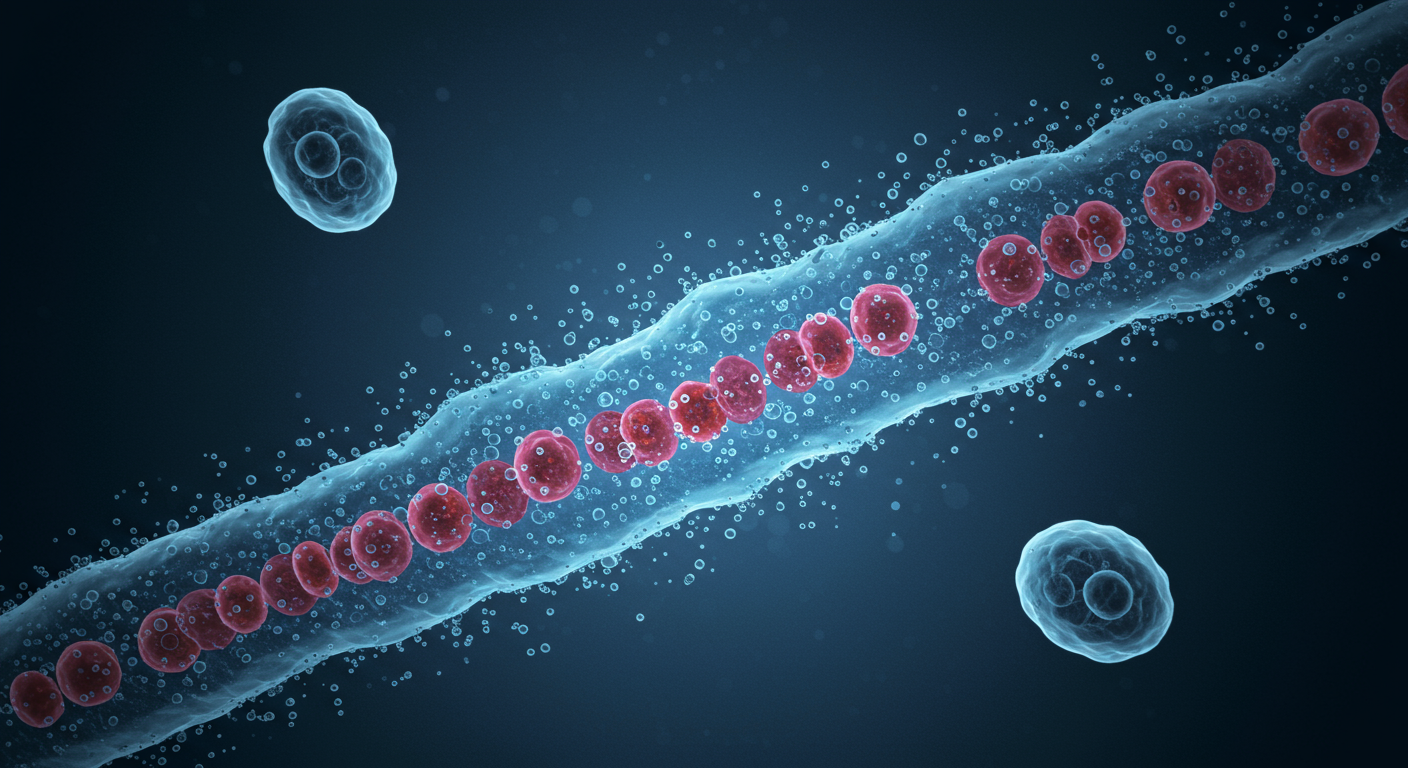
Researchers have developed and released a new computational tool that provides a uniquely detailed view of how critical RNA molecules behave inside the complex and crowded environment of living cells. The model offers scientists an powerful way to investigate the molecular missteps that can lead to a range of devastating neurodegenerative diseases and cancers.
Created by chemists at the University of Massachusetts Amherst, the publicly available tool, called iConRNA, simulates a fundamental biological process known as phase separation. This process allows portions of the cell to self-organize without membranes, and disruptions in this delicate dance are increasingly linked to diseases like ALS and Huntington’s. The new model is the first to efficiently simulate this RNA activity in high resolution, giving researchers a virtual window into the origins of cellular dysfunction.
A Crowded Cellular Metropolis
The interior of a human cell is a bustling and densely packed environment. It contains numerous distinct structures, or organelles, such as the nucleus and mitochondria, which are enclosed by protective membranes. These can be thought of as the cars in a busy traffic intersection, keeping their contents separate from the surrounding chaos. However, the cell is also teeming with unenclosed materials, primarily long, flexible strands of RNA and proteins that move more like pedestrians and cyclists through the crowded environment.
For many years, scientists have worked to understand how these unprotected molecules manage to find each other, organize into functional units, and perform specific tasks at precisely the right moments without getting lost in the cellular traffic. The ability of these molecules to self-organize into stable, membrane-less organelles is crucial for many life-sustaining processes, and understanding this mechanism has been a significant challenge in molecular biology.
The Phenomenon of Phase Separation
A major breakthrough in understanding this organization came in 2009, when researchers first identified phase separation as the physical process responsible. This phenomenon is similar to how a mixture of oil and water, when shaken, will naturally separate into distinct droplets. Inside the cell, certain RNA and protein molecules can condense into self-enclosed, liquid-like droplets called biomolecular condensates.
These condensates create micro-environments that concentrate the necessary components for specific biochemical reactions, effectively creating temporary, specialized factories within the cell without the need for a physical wall. This process is essential for a vast array of cellular functions, from gene regulation to stress responses. When the formation, properties, or dissolution of these condensates goes awry, it can lead to the formation of harmful molecular aggregates, a hallmark of numerous diseases.
Introducing the iConRNA Model
While the concept of phase separation has become central to cell biology, studying the process at a molecular level has been extremely difficult. Previous computational models were often “coarse-grained,” providing only a low-resolution view that omitted critical details. The new iConRNA tool, described in the Proceedings of the National Academy of Sciences, overcomes this limitation.
The model was developed by a UMass Amherst team led by senior author Jianhan Chen, a professor of chemistry. Professor Chen credits the success of the project to the meticulous work and physics intuition of Shaolong Li, a post-doctoral researcher on his team. Chen noted that the immense difficulty of the challenge is why a tool like iConRNA had not existed before, despite intense interest and effort from the scientific community.
A Virtual Laboratory
The iConRNA model is powerful because it accurately resolves the distinct physical forces that drive RNA phase separation. More importantly, it allows scientists to conduct virtual experiments by changing conditions within the simulation to see how the RNA molecules respond. Researchers can “turn the knob” on variables such as temperature and salt concentration to predict how these environmental shifts affect the balance of forces and the behavior of the condensates.
Crucially, the performance of the iConRNA model aligns closely with observations from physical experiments conducted in laboratories. This alignment validates its accuracy and means that, for the first time, scientists have a reliable and detailed tool for exploring one of the most fundamental organizational principles inside the human cell.
Unlocking the Roots of Disease
The most significant application of iConRNA is in the study of human disease. The malfunction of phase separation and the subsequent formation of solid, unhealthy aggregates are directly implicated in neurodegenerative conditions like ALS and Huntington’s disease, as well as in the development of many types of cancer. By providing a clear view of how these processes work when healthy, the tool also allows scientists to investigate what happens when they fail.
Researchers can use iConRNA to simulate the conditions that lead to abnormal condensate behavior, offering insights into the precise molecular triggers of disease. This could help identify new targets for therapeutic intervention, potentially leading to novel strategies for preventing or treating these conditions before they cause irreversible damage. The model provides a foundational tool for digging into the molecular details that were previously inaccessible.
A Public Resource for Global Science
A key aspect of the iConRNA project is that the tool has been made publicly available to the scientific community. This decision democratizes access to this advanced modeling capability, allowing researchers from institutions worldwide to apply it to their specific areas of interest in RNA biology and disease. By providing the resource openly, the UMass Amherst team aims to accelerate the pace of discovery across the field.
This widespread access can foster collaboration and innovation, enabling scientists to ask new questions and test hypotheses about the role of RNA condensates in both health and sickness. The research and development of the tool were supported by funding from the U.S. National Science Foundation, reflecting its importance as a fundamental scientific advancement.