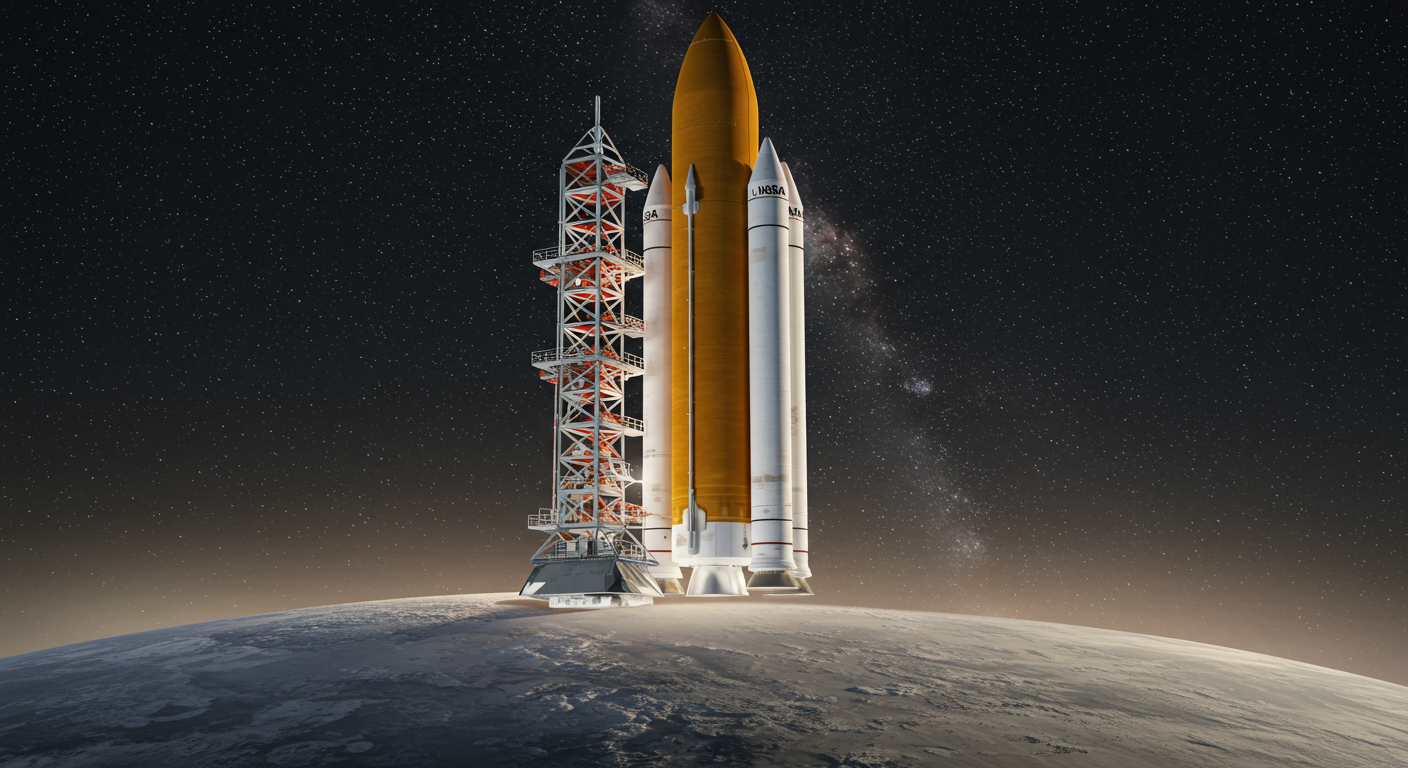
In a crucial step toward returning humans to the Moon, NASA has fully assembled the powerful Space Launch System (SLS) rocket and Orion spacecraft for the Artemis II mission. The final component, the Orion crew capsule, was carefully lifted and secured atop the 322-foot-tall rocket stack on October 19 inside the Vehicle Assembly Building at Kennedy Space Center in Florida. This milestone completes the physical construction of the vehicle that will carry four astronauts on a flight around the Moon, marking the end of a multi-year assembly process and the beginning of comprehensive integrated testing.
The Artemis II mission is the first crewed flight in NASA’s program to establish a long-term presence on the lunar surface and prepare for future human missions to Mars. This roughly 10-day flight will send a crew farther into space than any human has gone before, looping around the far side of the Moon to validate the Orion spacecraft’s life-support systems, navigation, and communication capabilities. The successful stacking of the complete launch vehicle moves the mission out of the hardware assembly phase and into a rigorous series of electrical and systems checks, paving the way for a launch window currently scheduled to open in early 2026.
A Monumental Assembly Process
The final stacking operation on October 19, 2025, was the culmination of a meticulous, large-scale construction effort within the iconic Vehicle Assembly Building (VAB). The process began much earlier, with the stacking of the twin solid rocket boosters. Each of the ten booster segments was transported from a nearby processing facility and precisely lifted by an overhead crane onto the mobile launcher, a 380-foot-tall structure that serves as the assembly and launch platform. This phase of the assembly started in November 2024 and concluded in February 2025 with the placement of the forward nose cone assemblies.
Following the booster construction, teams integrated the massive SLS core stage between the two boosters. After the core stage was secure, the Interim Cryogenic Propulsion Stage (ICPS) was placed on top, followed by the Orion stage adapter. The final piece was the fully integrated Orion spacecraft, which includes the crew module, the European-built service module, and the launch abort system. With the spacecraft, named “Integrity” by its crew, now physically mated to the rocket, engineers will proceed with connecting extensive electrical and data umbilicals and begin a series of joint integrated tests to ensure all components function together as a single, cohesive launch vehicle.
The Powerhouse Behind the Mission
The Space Launch System is the most powerful rocket NASA has ever built, designed specifically for deep-space missions. The initial “Block 1” configuration being used for Artemis II stands taller than the Statue of Liberty and weighs 5.75 million pounds when fully fueled. Its immense power is necessary to propel the 27-metric-ton Orion spacecraft to a speed of 24,500 mph, fast enough to break free from Earth’s gravity and set a course for the Moon.
Core Stage and Boosters
The rocket’s primary structure is its 212-foot-tall core stage, which holds 733,000 gallons of super-cooled liquid hydrogen and liquid oxygen. This propellant feeds four RS-25 engines, the same model of highly efficient engines that powered the Space Shuttle fleet. Flanking the core stage are two five-segment solid rocket boosters, each standing 177 feet tall. These boosters provide the majority of the rocket’s power during the first two minutes of flight.
Propulsion and Thrust
At liftoff, the four RS-25 engines and the twin solid rocket boosters will ignite simultaneously, generating a combined 8.8 million pounds of thrust. This is approximately 15% more thrust than the Saturn V rockets of the Apollo era. The boosters will burn through six tons of propellant per second before separating from the core stage, which will continue to power the ascent. After the core stage depletes its fuel and separates, the Interim Cryogenic Propulsion Stage will fire to perform the final burn that sends Orion on its path to the Moon.
Orion: The Crew’s Lunar Vessel
The Orion spacecraft is a state-of-the-art exploration vehicle designed to carry astronauts on long-duration missions far beyond low-Earth orbit. It consists of the crew module, which can support four astronauts for up to 21 days, and the European Service Module (ESM), which provides the spacecraft’s primary power and propulsion. The crew module is equipped with advanced life support, navigation, and communication systems, all protected by a robust heat shield designed to withstand reentry temperatures of nearly 5,000°F.
The ESM, a contribution from the European Space Agency, is a critical component that makes deep-space missions possible. It houses the main engine for major in-space maneuvers, 32 smaller thrusters for attitude control, and 8.6 metric tons of propellant. Its four solar array wings, spanning 19 meters when deployed, generate enough electricity to power two households. The ESM also carries the crew’s water, oxygen, and nitrogen, making it the powerhouse and life-support hub of the spacecraft.
The Four Astronauts on Board
Artemis II will be crewed by a diverse and experienced team of four astronauts, including the first woman, the first person of color, and the first non-American to fly on a lunar mission.
- Reid Wiseman (NASA), Commander: A veteran naval aviator and former chief of the Astronaut Office, Wiseman previously served as a flight engineer on the International Space Station.
- Victor Glover (NASA), Pilot: An accomplished F/A-18 test pilot, Glover piloted the first post-certification mission of the SpaceX Crew Dragon spacecraft to the International Space Station.
- Christina Koch (NASA), Mission Specialist: An electrical engineer who holds the record for the longest single spaceflight by a woman, Koch also participated in the first all-female spacewalk.
- Jeremy Hansen (Canadian Space Agency), Mission Specialist: A former CF-18 fighter pilot, Hansen will be the first Canadian to travel to deep space, representing a significant international partnership.
Mission Profile and Objectives
The primary goal of the Artemis II mission is to test and verify the spacecraft’s systems with a human crew in the deep-space environment. The roughly 10-day flight will follow a unique “hybrid free return” trajectory.
Lunar Flyby Trajectory
After launching from Kennedy Space Center, the Orion and its attached upper stage will first enter a low Earth orbit. From there, the upper stage will fire to raise the spacecraft into a highly elliptical high-Earth orbit that will last approximately 42 hours. This phase allows the crew to test Orion’s systems while remaining relatively close to home. Following these checkouts, Orion will separate from the upper stage and fire its own engines for the trans-lunar injection burn. This will send the crew on a four-day journey to the Moon, where they will fly over 6,400 miles beyond the lunar far side before Earth’s gravity naturally pulls them back home.
Testing Critical Systems
During the flight, the crew will conduct a series of tests that cannot be fully replicated on the ground. A key demonstration will involve proximity operations, where the astronauts will manually pilot the Orion spacecraft, using the discarded upper stage as a target to test handling and maneuverability. They will thoroughly evaluate the life-support, communication, and navigation systems to provide critical data for ensuring the safety and readiness of the vehicle for future, more complex missions.
Paving the Way for Future Landings
Artemis II is a foundational mission that directly enables the next major step in lunar exploration: Artemis III. That mission, planned for later in the decade, will use the same SLS rocket and Orion spacecraft to land the first woman and first person of color on the lunar surface, specifically near the Moon’s South Pole. The data gathered during Artemis II on vehicle performance and crew operations is essential for certifying the hardware for a lunar landing.
Beyond the immediate goal of landing, the Artemis program aims to establish a sustainable human presence on and around the Moon. This includes the construction of the Gateway, a small space station in lunar orbit that will serve as a staging point for surface missions, and the development of an Artemis Base Camp. The lessons learned and technologies tested on these lunar missions are intended to serve as the blueprint for the next giant leap in human exploration: sending astronauts to Mars.