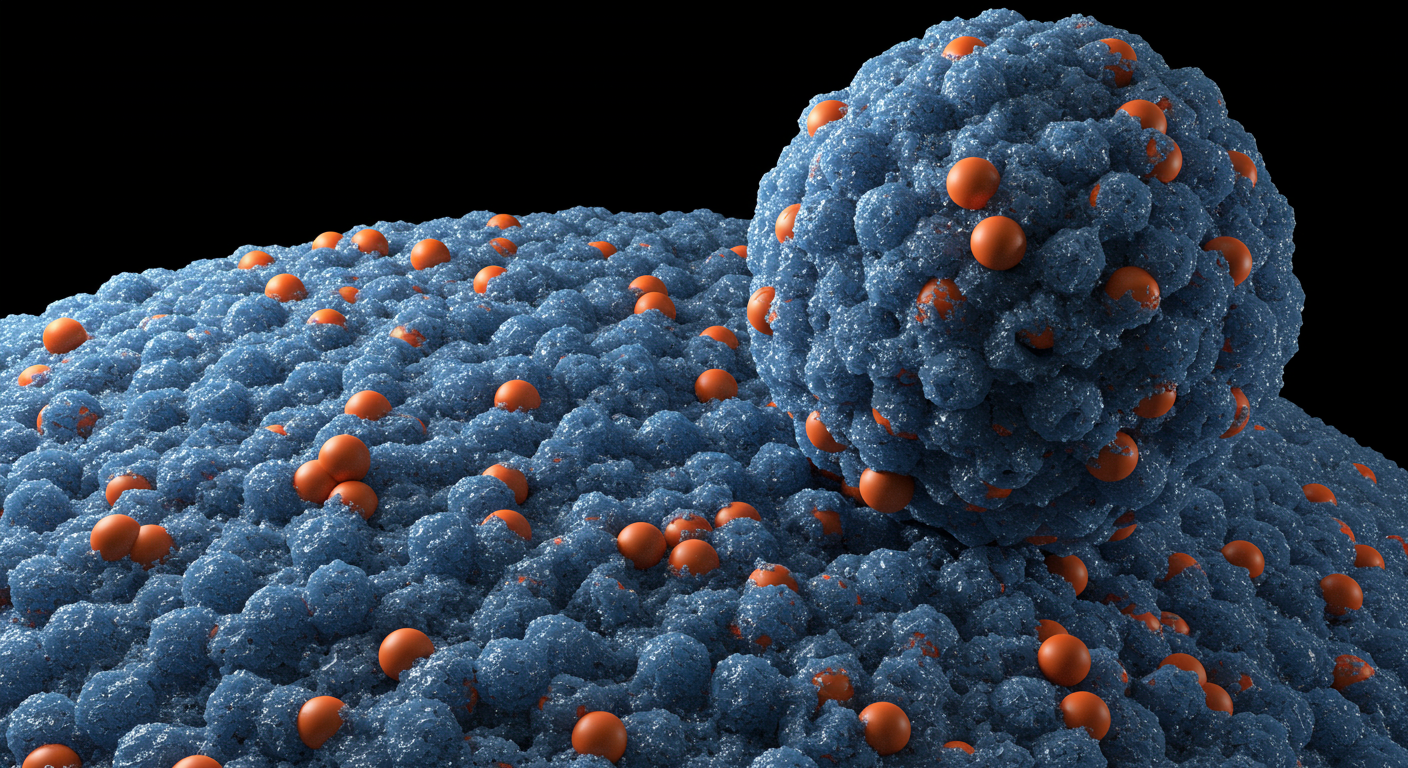
Researchers are developing a novel approach to cancer treatment that utilizes molecules-sized machines to destroy cancer cells mechanically. These “molecular motors” are activated by light and can be designed to target and kill cancer cells with high precision, offering a promising alternative to traditional therapies like chemotherapy and radiation. This method, which has shown a high success rate in laboratory studies, could lead to less invasive and more effective cancer treatments with fewer side effects.
The core of this technology lies in the use of photosensitive molecules that, when exposed to a specific wavelength of light, undergo rapid conformational changes, essentially transforming them into microscopic drills or hammers. This mechanical action is powerful enough to rupture the cell membrane of cancer cells, leading to their swift destruction. Because the activation is triggered by light, researchers can control the location and timing of the treatment with great accuracy, minimizing damage to healthy surrounding tissues. This emerging field of mechanical therapy represents a significant shift in the paradigm of cancer treatment, moving from chemical and radiological approaches to a physical assault on cancer cells at the nanoscale.
Mechanism of Action
Light-Activated Nanomachines
The molecular motors at the heart of this new therapy are sophisticated compounds designed to respond to external stimuli. One prominent type, known as Feringa-type motors, can be prompted by ultraviolet or visible light to spin at incredibly high speeds, reaching up to 3 million rotations per second. This rotational motion allows them to drill through the protective membranes of cancer cells, leading to cell death through necrosis. The ability to use visible light is a significant advancement, as it offers deeper tissue penetration and is less harmful than UV light.
Molecular Jackhammers
A more recent and even more powerful development in this field is the creation of “molecular jackhammers.” These are aminocyanine molecules that, when stimulated with near-infrared (NIR) light, vibrate at a staggering 40 trillion times per second. This vibration creates a powerful mechanical force that tears apart the cancer cell’s membrane. This process, termed vibronic-driven action (VDA), is a novel mechanical effect distinct from photodynamic and photothermal therapies. Unlike those methods, VDA is not dependent on the presence of oxygen and does not generate significant heat, reducing the risk of collateral damage.
Advantages Over Conventional Therapies
Precision and Selectivity
A key advantage of molecular motor-based therapies is their high degree of precision. The activating light can be focused on the tumor, ensuring that only the cancer cells are targeted. Furthermore, the molecular machines themselves can be designed to bind specifically to cancer cells, enhancing their targeting capabilities. Some aminocyanine molecules, for example, naturally accumulate in cancer cells, making them ideal candidates for this type of therapy. This selectivity is a significant improvement over chemotherapy, which often affects healthy cells throughout the body, leading to a wide range of side effects.
Overcoming Treatment Resistance
Cancer cells are known to develop resistance to chemotherapy drugs over time, rendering them ineffective. However, it is highly unlikely that cancer cells could develop resistance to the physical forces exerted by molecular motors. The mechanical disruption of the cell membrane is a direct and overwhelming assault that is difficult for a cell to counteract through biological adaptations. This makes molecular motor therapy a promising strategy for treating cancers that have become resistant to other forms of treatment.
Preclinical Research and Results
In Vitro and In Vivo Studies
Laboratory studies have demonstrated the remarkable efficacy of molecular motors in killing cancer cells. In cultured cells, the application of light-activated molecular jackhammers resulted in the destruction of 99% of cancer cells. The cell death is rapid, occurring within minutes of activation.
The therapy has also shown success in animal models. In studies involving mice with melanoma tumors, treatment with molecular jackhammers led to a significant reduction in tumor size. Remarkably, about 50% of the mice in these studies were completely cured of their tumors. These results provide strong evidence for the potential of this therapy in a clinical setting.
Applications and Future Directions
Targeting a Range of Cancers
The versatility of molecular motors allows them to be adapted for various types of cancer. The use of near-infrared light is particularly advantageous for treating tumors deep within the body, as NIR light can penetrate up to four inches into human tissue. This could open up new treatment possibilities for cancers that are difficult to reach with conventional methods, such as pancreatic cancer. The technology is also being explored for its potential to treat breast cancer and melanomas, particularly those that are resistant to chemotherapy.
Drug Delivery Systems
Beyond directly destroying cancer cells, molecular motors are also being developed as advanced drug delivery systems. Rotaxane- and pseudorotaxane-based motors can be engineered to carry anticancer drugs and release them specifically within tumor cells. These nanomachines can be designed to be sensitive to the unique environment of a tumor, such as the presence of certain enzymes, ensuring that the therapeutic payload is delivered precisely where it is needed. This targeted approach can increase the effectiveness of the drugs while minimizing their exposure to healthy tissues.
Challenges and Outlook
Biocompatibility and Clinical Translation
While the results from preclinical studies are promising, there are still challenges to overcome before molecular motor therapy can be used in humans. A primary concern is ensuring the biocompatibility of the nanomachines. Researchers are actively working on designing motors from non-toxic materials and developing propulsion systems that are safe for the human body, such as those powered by light, ultrasound, or magnetic fields. The development of dual-propulsion systems, combining different energy sources, is another area of active research.
The journey from the laboratory to the clinic is a long one, but the progress in this field is rapid. Scientists have already developed 75 different types of molecular jackhammers and are continuously working to optimize their design and effectiveness. If the current trajectory of success continues, clinical trials for these innovative therapies could begin within the next seven years, heralding a new era in the fight against cancer.