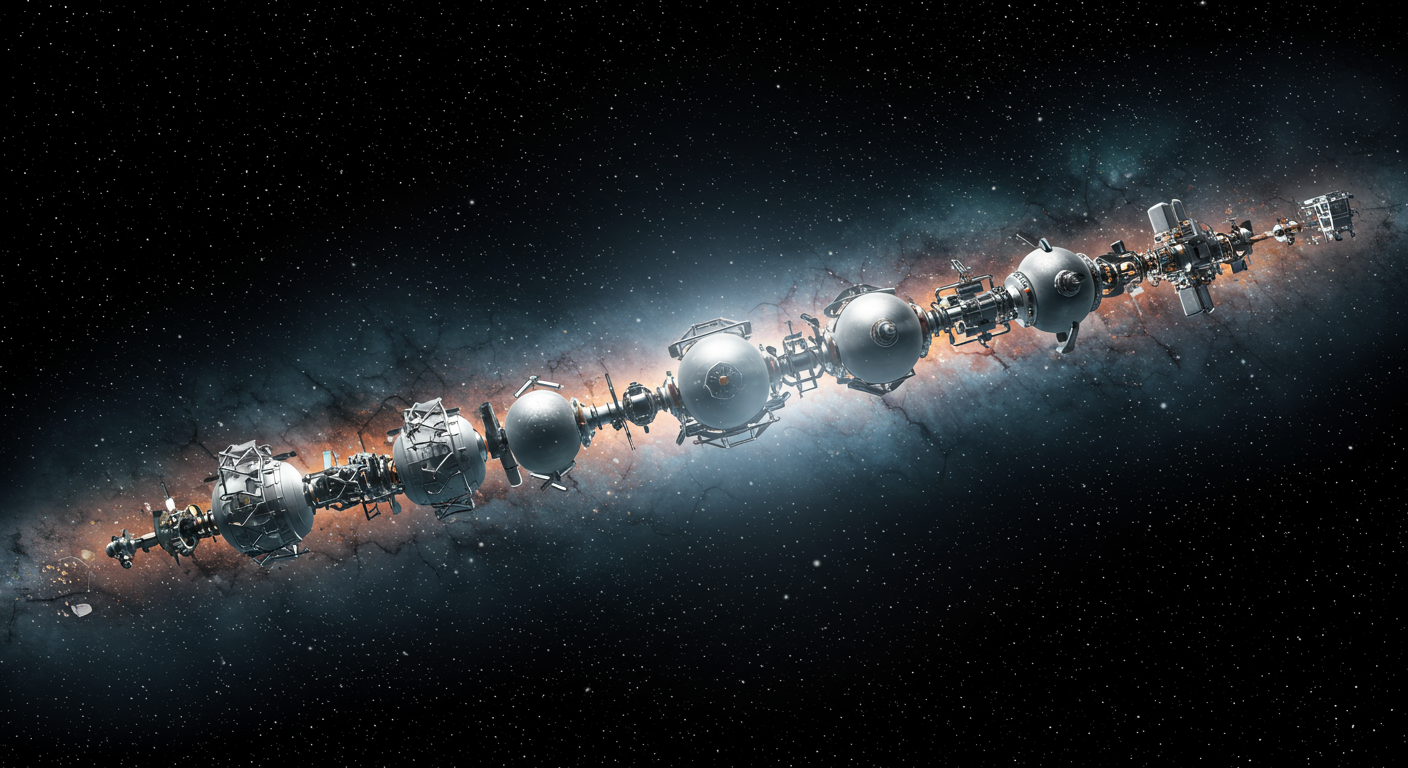
The International Space Station has now housed human beings continuously for a quarter of a century, a milestone marking an unparalleled era of scientific research and international partnership in low Earth orbit. Since the first crew floated aboard on November 2, 2000, the orbiting laboratory has been a constant hub of activity, evolving from a nascent outpost into a sprawling complex that has hosted astronauts and researchers from around the globe, fundamentally shaping humanity’s understanding of living and working in space.
This enduring presence represents more than just a record for the longest continuous human habitation in space; it is a testament to a collaborative spirit that has persevered through shifting geopolitical landscapes. The station has served as a critical platform for thousands of experiments, driven advancements in technology, and fostered a burgeoning commercial space economy. Now, as the iconic structure enters its final decade of operation, it continues to pave the way for future deep-space missions to the Moon and Mars while a new generation of commercial space stations prepares to take its place.
An Unprecedented Global Partnership
The International Space Station is the product of a collaboration between five major space agencies: NASA from the United States, Russia’s Roscosmos, the European Space Agency (ESA), the Japan Aerospace Exploration Agency (JAXA), and the Canadian Space Agency (CSA). This consortium of 15 countries came together to design, build, and operate the largest and most complex spacecraft ever constructed. Its assembly in orbit was a monumental undertaking that began with the launch of the first module in 1998. Major components were delivered over years by Russian Proton and Soyuz rockets as well as the American Space Shuttle fleet.
A pivotal moment came in July 2000 with the addition of the Russian-built Zvezda service module. Equipped with the essential living quarters and life-support systems, Zvezda transformed the station from a temporary worksite into a habitable environment, making long-duration missions possible. This set the stage for the arrival of Expedition 1 on November 2, 2000. NASA astronaut Bill Shepherd and Russian cosmonauts Yuri Gidzenko and Sergei Krikalev blasted off from Kazakhstan aboard a Soyuz rocket and, two days later, entered the station, beginning the unbroken chain of human presence that continues to this day. Despite political tensions on Earth, former Navy SEAL Shepherd has noted that the person-to-person and agency-level cooperation has remained remarkably strong.
A Prolific Laboratory in Microgravity
At its core, the ISS is a world-class scientific laboratory operating in the unique environment of microgravity. For 25 years, it has provided a platform for groundbreaking research that is impossible to conduct on Earth. The station has hosted more than 4,000 experiments conceived by over 5,000 researchers from more than 110 countries and territories. This research has yielded critical insights into human health, materials science, Earth observation, and fundamental physics.
Advancing Human Health and Exploration
Much of the research focuses on understanding the effects of long-duration spaceflight on the human body. Studies on bone density loss, muscle atrophy, and cardiovascular changes have led to the development of countermeasures that are not only crucial for future missions to Mars but also have applications for treating diseases on Earth, such as osteoporosis. One of the most famous human experiments was the twin study involving NASA astronauts Scott and Mark Kelly, which provided unprecedented data on how space affects human genetics and physiology. In another instance, an astronaut’s blood clot was discovered and treated remotely by doctors on the ground, highlighting both the risks and the growing capabilities of space medicine.
Benefits for Life on Earth
Beyond human biology, the ISS has been a testbed for new technologies and materials. Experiments have led to innovations in water purification, advanced robotics, and the development of new metal alloys. The station’s vantage point, circling the planet every 90 minutes, also makes it an invaluable tool for Earth and climate science, providing data on natural disasters, deforestation, and atmospheric changes. The research performed aboard the station is explicitly for the benefit of all humanity, a goal symbolized in the official 25th-anniversary logo created by NASA.
Life and Resilience Above the World
Since Expedition 1 first turned the lights on, the ISS has been visited by more than 290 people from 26 different countries. These residents have included astronauts, scientists, and, more recently, private citizens. The station has evolved into an orbital village, where crew members celebrate birthdays and holidays while managing the complex operations of their home in space. Peggy Whitson, the station’s first female commander, once remarked that “space brings people together,” a sentiment echoed by many who have lived there.
Life aboard the ISS has not been without its dangers. The station has navigated numerous challenges that underscore the hostile nature of space. Astronauts have contended with critical situations, including a spacewalker’s helmet filling with water in a near-drowning incident, persistent air leaks, and the constant threat of orbital debris, which requires the station to perform avoidance maneuvers. The fact that many of its systems have operated for more than double their designed lifespan is a testament to the robust engineering and the diligent work of both the crews in orbit and the mission controllers on the ground.
Fostering a New Commercial Frontier
The International Space Station has been instrumental in cultivating a commercial market in low Earth orbit. It has served as a reliable destination for private cargo and crew transportation services, most notably from companies like SpaceX and Northrop Grumman. This has allowed NASA to shift its focus toward deep-space exploration while fostering a new space economy.
The era of private spaceflight aboard the station began in 2001 when American businessman Dennis Tito funded his own trip aboard a Russian Soyuz, becoming the first space tourist despite initial objections from NASA. Russia continued to offer flights to private citizens, including a film crew in 2021. NASA has since embraced this model and now facilitates privately funded missions, hosting crews for short-duration stays. These commercial missions are bringing a more diverse group of people to space, including astronauts from nations that have not had space travelers in decades.
Charting the Course for a Successor
The operational life of the International Space Station is scheduled to conclude at the end of 2030. Following its final mission, NASA will execute a controlled deorbit procedure to ensure the massive structure comes down safely. The agency has awarded a contract to SpaceX to develop a specialized vehicle that will guide the station into Earth’s atmosphere, targeting a remote area of the Pacific Ocean for its final descent in early 2031.
The Next Generation of Orbiting Platforms
The retirement of the ISS will not mark the end of human presence in low Earth orbit. Instead, it will usher in a new era dominated by commercial space stations. NASA’s strategy is to become a customer, purchasing services from private companies to conduct research and maintain an American foothold in orbit. Companies like Axiom Space are already developing their own orbital outposts. Axiom plans to first attach its modules to the ISS before detaching to become a free-flying commercial station. This seamless transition is intended to ensure that, even after the ISS is gone, there is never a day without humans living and working in space, continuing the legacy that began 25 years ago.