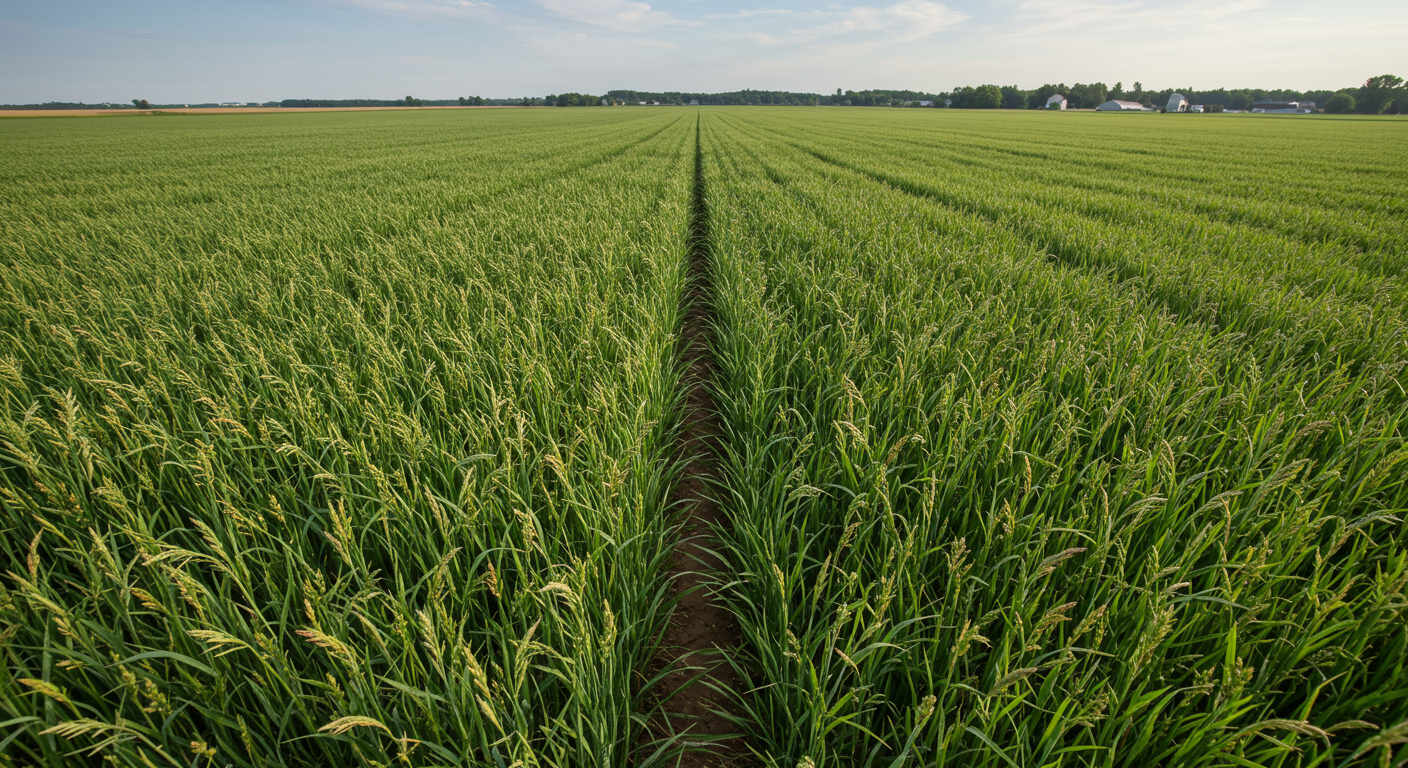
Farmers battling the spread of herbicide-resistant Italian ryegrass have a powerful tool in their arsenal, according to recent research. Studies confirm that applying residual herbicides in the fall, before the troublesome weed emerges, is a highly effective strategy for managing infestations that have developed resistance to glyphosate and other common chemistries. This proactive approach prevents the weed from establishing a foothold, protecting crop yields the following spring.
The problem is particularly acute in the southern United States, where Italian ryegrass has become one of the most challenging weeds for producers of rice, corn, cotton, and soybeans. Over-reliance on single-mode-of-action herbicides has led to widespread resistance, rendering many traditional spring burndown applications ineffective. Research from Mississippi State University and other institutions demonstrates that shifting to a fall-applied residual herbicide program can provide clean fields into the next growing season, offering a sustainable and economical path forward for growers.
The Growing Challenge of Resistance
Italian ryegrass is a formidable adversary for crop producers due to its rapid growth and genetic adaptability. The weed has confirmed resistance to multiple herbicide classes, including ALS inhibitors, clethodim, glyphosate, and paraquat. This multi-class resistance means that waiting until spring to manage the weed often results in control failures, as few effective postemergence options remain. The consequences of inaction are severe; uncontrolled Italian ryegrass has been shown to reduce yields by as much as 85% in cotton, 65% in corn, and 37% in soybeans.
The weed is especially problematic in winter wheat because its germination and growth cycle are very similar to the crop’s. Furthermore, its prevalence as a cover crop has contributed to its spread, as some seed stocks have been found to contain glyphosate-resistant ryegrass. This underscores the need for a management strategy that begins long before the primary crop is planted.
Proactive Control Before Emergence
The consensus among weed scientists is that the best time to control herbicide-resistant Italian ryegrass is before it germinates. Fall applications of soil-residual herbicides offer the most effective and consistent results. This strategy targets the weed at its most vulnerable stage, preventing it from ever competing with the future crop for light, water, and nutrients. Applying these products after the fall harvest and before ryegrass emergence is the ideal window.
This preemptive strike is far superior to reactive spring applications. By spring, the ryegrass is often well-established and more tolerant to herbicides, necessitating complex tank mixes and sequential applications that still may not provide complete control. Researchers have found that waiting until February or March often proves too late for reliable management.
Key Herbicides and Proven Efficacy
Field-Tested Residual Herbicides
Multiple studies have identified a core group of residual herbicides that are highly effective when applied in the fall. Research conducted at Mississippi State University’s Delta Research and Extension Center from 2021 to 2023 evaluated several leading options. In these field trials, herbicides containing the active ingredients dimethenamid-P (found in Outlook), pyroxasulfone (Zidua), and S-metolachlor (Dual Magnum) each provided greater than 94% control of glyphosate-resistant Italian ryegrass when assessed 21 days after treatment. Long-term studies dating back to 2005 have validated the efficacy of these and other products, including Treflan and Command, which can provide control for 120 to 150 days with adequate rainfall for incorporation.
Combining for a Knockdown Punch
For situations where some ryegrass has already emerged at the time of fall application, experts recommend including an effective burndown herbicide. Products like paraquat (Gramoxone) are often tank-mixed with the residual herbicide to control existing weeds. This ensures that the residual product starts with a clean field, allowing it to focus on preventing new flushes of germination. However, it is the residual activity that provides the lasting control necessary to protect the subsequent crop.
Building an Integrated Program
Lessons from University Research
The Mississippi State University studies highlight the importance of a programmed approach. Researchers conducted both a “Herbicide Mixture Study” and a “Sequential Herbicide Application Study” to determine the most robust strategies. According to Jason A. Bond, a professor at Mississippi State University, “The most effective and economical management strategy to control GR Italian ryegrass is with preemergence (PRE) followed by postemergence (POST) herbicide programs.” The research confirms that fall-applied residual herbicides should be the foundational first step in these sequential programs.
Avoiding Negative Interactions
An integrated program also considers potential herbicide antagonisms. For instance, Bond notes that applying S-metolachlor without a fall residual herbicide can reduce the efficacy of a subsequent clethodim application aimed at controlling the ryegrass. This demonstrates how a proactive fall application not only controls the weed directly but also preserves the effectiveness of other chemical tools that may be needed later.
Crop Rotation and Labeling Considerations
The choice of a fall residual herbicide must align with the intended crop for the following spring. Different products have specific plant-back restrictions. For example, Command is a primary option for fields that will be planted in rice, while Dual Magnum or Treflan are suitable for land rotating to cotton or soybeans. Dual Magnum is noted as the only fall residual option safe for fields intended for corn.
Growers must also pay close attention to herbicide labels. Some products, like Dual Magnum and Parallel PCS, have special local needs labels that permit their application during a specific fall window, typically from September through November. Proper application is also critical for success. Most soil-applied herbicides require rainfall for incorporation and activation, so timing applications ahead of expected rain events is key to maximizing their performance.