## Elusive WIMPs remain the toughest particles for physicists to find
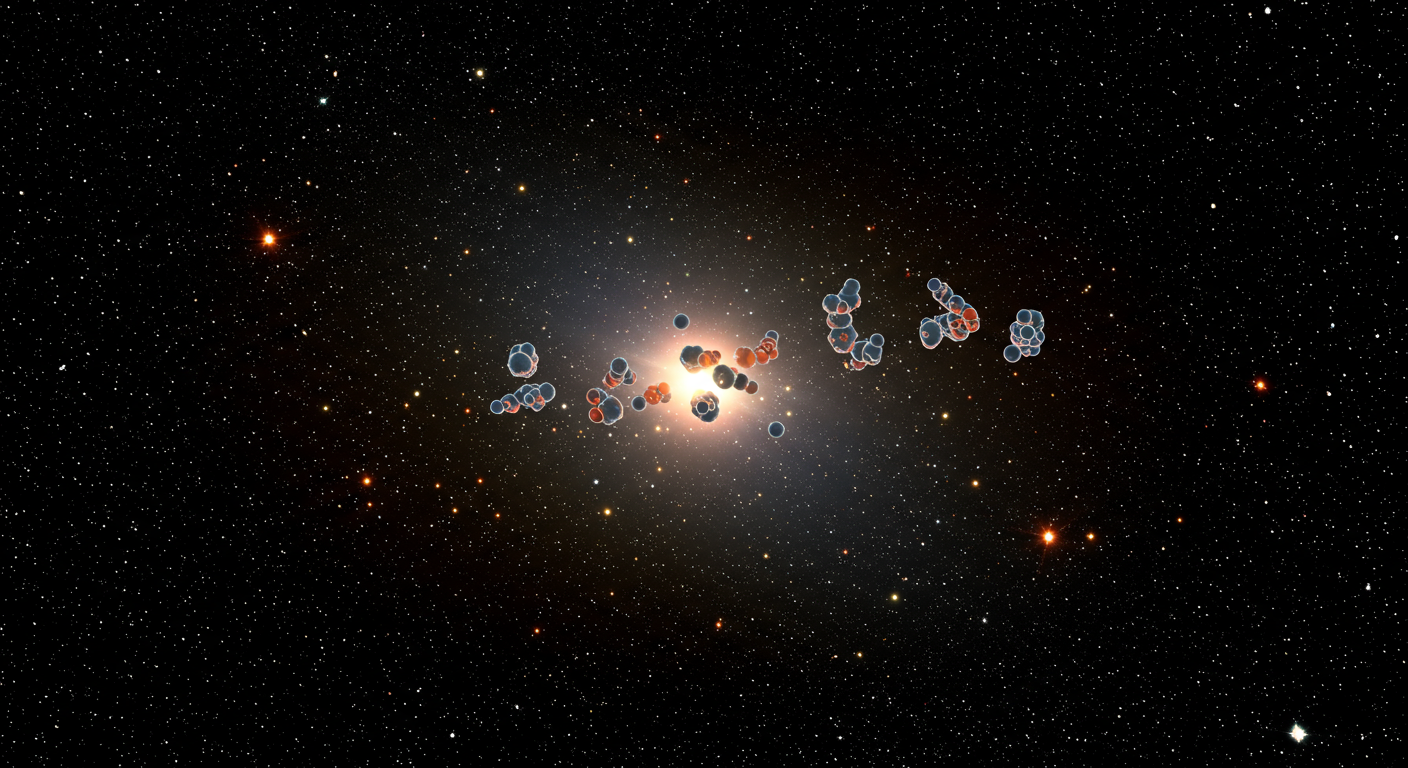
Scientists are searching for weakly interacting massive particles, or WIMPs, which are hypothetical particles that are thought to be the main component of dark matter. Dark matter is a mysterious substance that makes up about 27% of the universe, but it does not emit or reflect any light, making it impossible to see directly. The existence of dark matter is inferred from its gravitational effects on visible matter, such as stars and galaxies. Physicists believe that WIMPs are the key to understanding the nature of dark matter and the evolution of the universe.
The search for WIMPs is one of the most challenging and exciting frontiers in physics. These particles are thought to be massive, which is why their gravity would be strong enough to hold galaxies together. However, they are also thought to be weakly interacting, which means they rarely interact with ordinary matter. This makes them extremely difficult to detect. Scientists are using a variety of methods to search for WIMPs, including direct detection experiments, indirect detection experiments, and particle colliders. Despite decades of searching, there has been no conclusive evidence of WIMPs, but the search continues with increasingly sensitive experiments.
The Nature of WIMPs
WIMPs are a leading candidate for dark matter because they would have been produced in the right abundance in the early universe to account for the amount of dark matter we observe today. According to the Big Bang theory, the early universe was a hot, dense soup of particles. As the universe expanded and cooled, the particles that make up ordinary matter, such as protons and neutrons, were formed. If WIMPs exist, they would have been created in the same way, and then they would have annihilated with each other until the universe expanded and cooled enough that they could no longer find each other to annihilate. The remaining WIMPs would then have “frozen out” and become the dark matter we see today.
Properties of WIMPs
WIMPs are thought to have a number of specific properties. They are expected to be massive, with a mass between 10 and 1,000 times that of a proton. They are also expected to be electrically neutral, which is why they do not interact with light. Finally, they are expected to be stable, which means they do not decay into other particles. These properties are all consistent with what we know about dark matter.
Direct Detection Experiments
Direct detection experiments are designed to detect WIMPs as they pass through the Earth. These experiments are typically located deep underground to shield them from cosmic rays and other sources of background radiation. The detectors are made of materials such as liquid xenon, germanium crystals, or sodium iodide. When a WIMP collides with an atomic nucleus in the detector, it can create a tiny flash of light or a small amount of heat, which can then be detected by sensitive sensors.
Challenges of Direct Detection
The main challenge of direct detection experiments is the extremely low rate of WIMP interactions. A WIMP is expected to interact with a nucleus in a detector only about once per year. This means that the detectors must be very large and very sensitive to have a chance of detecting a WIMP. Another challenge is to distinguish a WIMP signal from background noise. There are many other particles that can create similar signals in a detector, so scientists must be very careful to rule out all possible sources of background noise.
Indirect Detection Experiments
Indirect detection experiments are designed to detect the products of WIMP annihilation. When two WIMPs collide, they can annihilate each other and produce a shower of other particles, such as gamma rays, neutrinos, and antimatter particles. These particles can then be detected by telescopes on the ground or in space. The advantage of indirect detection is that it can be used to search for WIMPs in regions where they are expected to be most abundant, such as the center of our galaxy.
Particle Colliders
Particle colliders, such as the Large Hadron Collider (LHC) at CERN, can also be used to search for WIMPs. The LHC collides protons at very high energies, which can create new particles that are not found in ordinary matter. If WIMPs exist, they could be produced in these collisions. The WIMPs themselves would not be detected, but they would carry away energy and momentum, which could be detected as “missing energy” in the detector. The search for WIMPs at the LHC is a very active area of research, and it has the potential to either discover WIMPs or to rule out some of the most popular theories about them.
The Future of WIMP Searches
The search for WIMPs is a global effort, with many different experiments being conducted around the world. These experiments are constantly being upgraded to become more sensitive, and new experiments are being proposed. The next generation of direct detection experiments will be much larger and more sensitive than the current generation, and they will have the potential to either discover WIMPs or to rule out a large part of the parameter space where they are expected to exist. The future of WIMP searches is very bright, and it is possible that we will finally discover the nature of dark matter in the coming years.

