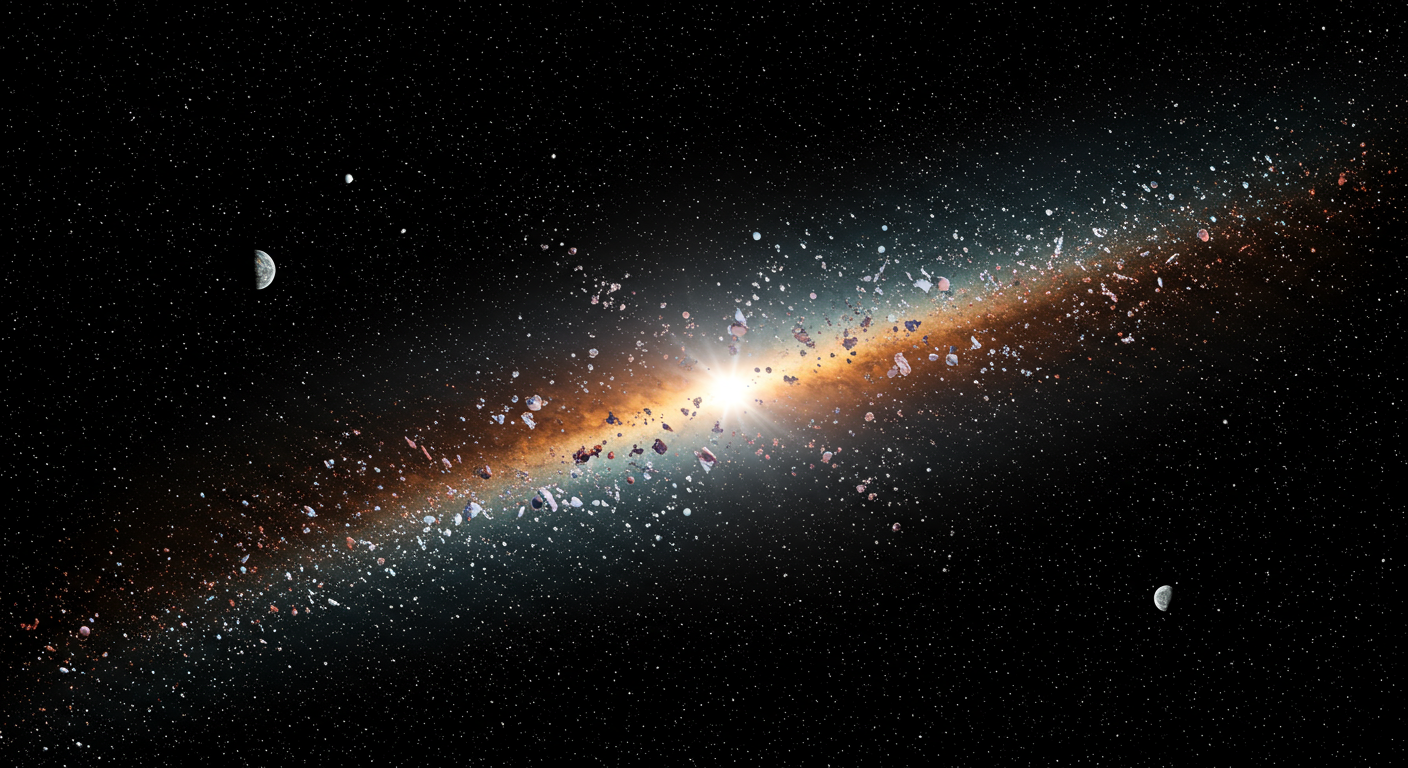
New research is upending the long-held image of our solar system’s formation as a serene and orderly process. Instead of planets gradually accumulating material from a pristine cloud of gas and dust, a recent study suggests a far more violent and chaotic beginning. The findings paint a picture of the early solar system as a cosmic demolition derby, where infant planetary bodies were repeatedly smashed to pieces and reassembled from the wreckage, leading to the diverse worlds we see today.
This revised origin story comes from a team of researchers who argue that planets, including Earth, are not built from untouched, original materials, but from a hodgepodge of recycled fragments. This “patchwork” assembly process, driven by high-energy collisions, fundamentally shaped the chemical makeup of the planets. By analyzing ancient meteorites and running sophisticated simulations, scientists are piecing together a new timeline of events that portrays the solar system’s first few million years as a dynamic environment of constant destruction and rebirth, profoundly influencing the composition of rocky worlds and their metallic cores.
A New Model of Planetary Genesis
For decades, the prevailing theory of planet formation, known as the nebular hypothesis, described a relatively gentle process. It posited that after the sun’s formation, the remaining dust and gas in a surrounding protoplanetary disk began to clump together. Through accretion, tiny dust grains became pebbles, pebbles formed rocks, and these rocks eventually amassed into the planetesimals—the building blocks of planets. While this model accounts for the basic architecture of the solar system, it has struggled to explain certain chemical anomalies and the sheer diversity among planetary bodies. The new research reframes this narrative, suggesting the early solar system was less like a construction site and more like a recycling plant.
The study, published in the journal Science Advances, proposes that rather than forming in isolation from a unique local supply of materials, the planets share a common history of violent impacts. The lead author, Damanveer Singh Grewal, an assistant professor at Yale University, likens the process to building with a bin of well-used LEGO blocks. This analogy captures the essence of the findings: planetary bodies were not built from a fresh set of pieces but from a jumbled collection of pre-owned, shattered, and reconfigured parts. This chaotic mixing and matching of materials from different parent bodies is key to understanding the final composition of Earth and its neighbors.
Clues from Iron Meteorites
To reconstruct this turbulent history, the research team turned to some of the oldest objects available for study: iron meteorites. These meteorites are not just space rocks; they are the remnants of the metallic cores of the very first planetesimals that formed in our solar system. By studying their chemical composition, scientists can effectively peer back in time to the conditions present during the solar system’s infancy. The researchers reinterpreted existing data from these ancient artifacts, using them as a foundation for a new series of simulations modeling how planetary cores developed.
Previous analyses of these meteorites had presented a puzzle. Some contained unusual chemical signatures that could not be easily explained by the gradual process of core formation. For instance, the presence of certain metals seemed to require highly unlikely starting conditions. The new study resolves this discrepancy by introducing widespread, high-energy collisions into the model. These impacts were not minor bumps but cataclysmic events capable of shattering a planetesimal, stripping away its outer layers, and exposing its developing core. This process of destruction and subsequent re-accretion provides a compelling explanation for the previously mysterious chemical compositions observed in the meteorite record.
The Cycle of Shattering and Reassembly
The simulations conducted by the researchers pinpoint the start of this violent era to approximately 1 to 2 million years after the formation of the solar system. In cosmological terms, this is remarkably early. During this period, many planetesimals had already begun the process of differentiation, forming iron-rich metallic cores. However, their growth was far from complete. As these bodies collided at high speeds, their newly formed cores were shattered into countless fragments. These metal-rich shards were then scattered throughout the protoplanetary disk.
Crucially, this debris did not remain scattered. Over time, gravity pulled these fragments back together, where they reassembled into new, second-generation planetary bodies. This cycle of destruction and reconstruction happened repeatedly, effectively mixing materials from numerous parent bodies. A planet like Earth, therefore, would not have formed from a single, continuous stream of local material. Instead, it would be a composite, incorporating core fragments and mantle pieces from a multitude of shattered planetesimals. This patchwork assembly process ensured that the building blocks of planets were far more diverse and chemically varied than previously assumed.
Implications for Core Formation
This new understanding has profound implications for the process of core formation. The traditional view held that a planet’s core formed in a single, continuous stage as heavier elements like iron and nickel sank to the center of a molten planetary body. The latest research suggests this was a much more convoluted and interrupted process. Core development could be initiated in one planetesimal, halted abruptly by a catastrophic impact, and then restarted after its fragments were incorporated into a new, growing body. This stop-and-start mechanism helps explain the complex and varied compositions of planetary cores across the solar system.
The model of recycled planetary fragments elegantly accounts for the observed diversity. The intense energy from the collisions would have triggered significant chemical changes in the core material, and the subsequent mixing of these varied fragments would create unique planetary compositions. This dynamic, multi-stage process of core development, driven by violent impacts, marks a significant departure from the more linear and peaceful models of the past. It suggests that the formation of a stable planetary core was not a guaranteed outcome but the result of a tumultuous and unpredictable journey through a cosmic crucible.
A Refined View of Our Solar Origins
The findings do not entirely discard the foundational principles of the nebular hypothesis but add a crucial layer of complexity and violence to the story of accretion. The idea that planets grew from smaller bodies remains central, but the nature of those building blocks has been radically redefined. They were not pristine spheres of original elements but a motley collection of recycled planetary parts. This chaotic process of shattering and rebuilding appears to be a fundamental, rather than incidental, feature of planet formation.
This revised narrative helps scientists better understand the unique characteristics of each planet in our solar system. The specific sequence of collisions and the particular mix of fragments that a planet incorporated would have set it on a distinct evolutionary path, influencing everything from its size and density to its geological activity and potential to host life. By recognizing the violent and patchwork nature of their origins, we gain a clearer and more accurate picture of how our solar system, and Earth itself, came to be.