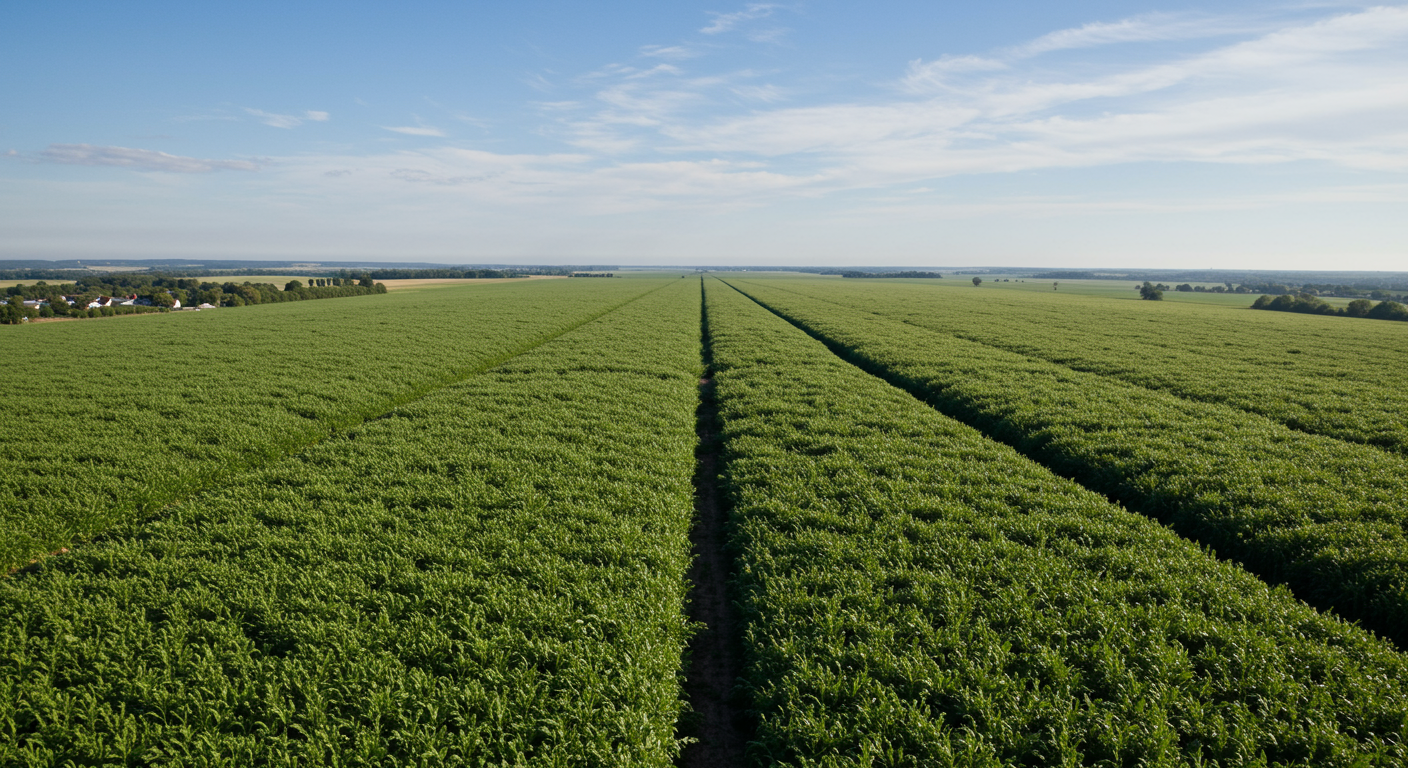
A proposed method for combating climate change could unintentionally reduce the protein content of essential global food crops, according to a new modeling study from Rutgers University. The research suggests that deliberately cooling the planet by injecting aerosols into the stratosphere would create a novel climate with unforeseen consequences for agriculture and human nutrition, particularly in regions already struggling with food security. This technique, known as stratospheric aerosol injection (SAI), would not simply reverse the effects of global warming but would instead alter the fundamental relationship between carbon dioxide, temperature, and plant growth in ways that could diminish the nutritional value of maize, rice, wheat, and soybeans.
The study, published in *Environmental Research Letters*, reveals a critical trade-off hidden within this form of geoengineering. While rising atmospheric carbon dioxide is known to decrease the protein content in many crops, the simultaneous rise in global temperatures has a smaller, opposing effect that tends to increase it. By implementing SAI to cool the planet, scientists found this warming-related protein boost is eliminated, allowing the negative impact of CO2 to dominate. This “decoupling” of temperature and CO2 concentrations would lead to a net loss of protein in staple foods that form the bedrock of diets worldwide, raising new questions about the unintended side effects of climate intervention technologies.
A Novel Climate Scenario
The research explores a specific type of solar radiation management designed to mimic the cooling effects of large volcanic eruptions. This method involves the continuous injection of sulfur dioxide gas into the stratosphere, the atmospheric layer roughly 6 to 30 miles above the Earth’s surface. Once there, the gas converts into sulfuric acid aerosols—a fine mist of particles that reflects a portion of incoming solar radiation back into space, thereby lowering global temperatures. This proposed intervention is one of the most widely discussed forms of geoengineering because of its potential to rapidly offset rising temperatures.
To investigate its agricultural impact, the scientists utilized a sophisticated computer modeling framework. They simulated a future scenario under a geoengineering project named ARISE-SAI-1.5, which is designed to maintain the global temperature at 1.5°C above pre-industrial levels. This simulation allowed researchers to project how crop growth and nutritional content would respond in a world that is both high in atmospheric CO2 and artificially cooled. The work focused on four of the world’s most important crops: maize, wheat, rice, and soybeans, which together provide a massive share of the calories and protein consumed by the global population.
The Decoupling Effect on Crop Nutrition
The core of the study’s findings lies in how SAI alters the environmental signals that plants use for growth. In a typical global warming scenario, rising CO2 and rising temperatures occur together. While elevated CO2 can act as a fertilizer, boosting the growth of carbohydrates and leading to a dilution of protein and other nutrients, the heat stress from higher temperatures often has a counteracting effect that slightly increases protein concentration. The researchers found that SAI breaks this link. The models showed that by keeping temperatures down while CO2 levels continue to climb, the natural offset provided by warming disappears.
An Unintended Nutritional Deficit
Without the counterbalancing effect of heat, the negative influence of CO2 on crop protein becomes more pronounced. The study projects that, under an SAI scenario, the protein content of all four major crops would decline compared to a future world with the same amount of warming but without geoengineering. The models demonstrated that this effect is not uniform across the globe but varies based on regional climate, soil conditions, and the specific crop being grown. According to lead author Brendan Clark, a former doctoral student at Rutgers, SAI does not perfectly counteract climate change but instead creates a new and unfamiliar climate, with complex impacts on ecology that are not yet fully understood.
Global Hotspots and Food Security
The potential decline in protein content carries significant implications for global food security, with the burden likely falling hardest on those who are already vulnerable. The model simulations revealed that the nutritional losses would be distributed unevenly across the planet. Some of the largest projected declines in crop protein were seen in nations that currently face high rates of malnutrition and protein deficiency. These regions often rely heavily on staple crops like rice and wheat for daily protein intake, making their populations especially sensitive to reductions in nutritional quality.
This geographic disparity highlights critical equity and justice concerns surrounding the deployment of geoengineering. While the technology might be implemented with the global goal of reducing climate risk, its side effects could exacerbate existing inequalities. The authors of the study stress that these regional differences in crop impacts—driven by complex changes in temperature, sunlight, and precipitation patterns—must be a central part of any policy conversation about SAI. They call for further research, including localized field experiments and more detailed models, to better predict the outcomes for the world’s diverse agricultural systems before any such large-scale interventions are considered.
Broader Implications for Ecosystems
Beyond the direct impact on crop nutrition, the study raises broader questions about how artificially managing the climate could affect terrestrial ecosystems. Plants are finely tuned to their environments, and the relationship between sunlight, temperature, and atmospheric gas concentrations governs their physiology. Changing one of these fundamental variables while holding another steady creates an environmental condition that has not existed in the planet’s recent history. The study’s authors warn that the consequences of such a novel climate are difficult to predict and could extend far beyond agriculture.
The research underscores a growing consensus among scientists that climate intervention technologies are not a simple “cure-all” for global warming. Instead, they represent complex interventions with their own sets of risks and potential harms. While reflecting sunlight could cool the planet, it would not address other consequences of rising CO2 emissions, such as ocean acidification. This study adds another major concern to the list: the potential degradation of the nutritional quality of the global food supply. It suggests that a full accounting of the costs and benefits of geoengineering must include these intricate and potentially severe impacts on the world’s ecosystems and the people who depend on them.