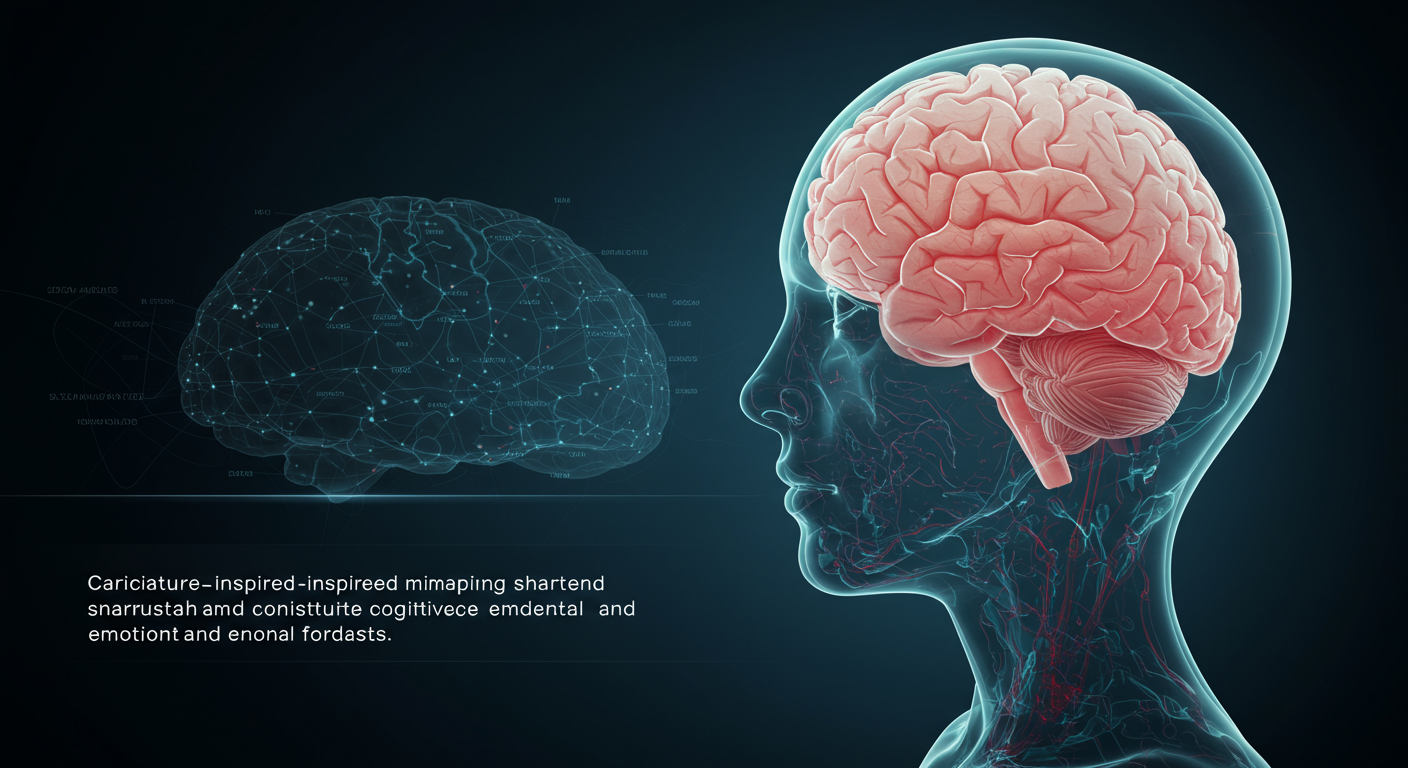
Researchers at Yale have developed a novel method for analyzing brain activity that borrows its core principle from the art of caricature, leading to more accurate predictions of a person’s cognitive and emotional characteristics. By creating “caricatures” of brain maps that exaggerate the unique features of an individual’s neural connections, the scientific team found they could forecast traits like age and IQ with significantly improved precision. This innovative approach challenges conventional brain-mapping techniques that have historically prioritized the similarities between individuals over their differences.
The new technique, detailed in the November 3 issue of Nature Neuroscience, reframes how scientists interpret the vast datasets generated by brain scans. Traditionally, researchers have focused on identifying patterns of neural activity that are common across large groups, often treating the distinct variations in any single person’s brain as statistical noise to be minimized or discarded. The Yale study demonstrates that these individual differences, far from being irrelevant, contain a wealth of valuable information. By algorithmically amplifying these unique neural signatures—much like an artist exaggerates a prominent nose or wide-set eyes—the researchers have unlocked a new layer of predictive insight, suggesting that the most personal aspects of our brain activity may be key to understanding our behavior and mental health.
Re-evaluating Discarded Brain Data
For years, the field of neuroscience has leaned heavily on creating generalized maps of the brain, known as connectomes, to understand its functions. These maps chart the intricate web of neural connections. The prevailing method involved averaging data across many individuals to find the most consistent and reproducible patterns. Researchers successfully used these shared patterns to predict certain behaviors and conditions. This success, however, led to a scientific blind spot: the vast amount of data that did not fit the average was largely ignored.
Lead author Raimundo Rodriguez, a Ph.D. student at the Yale School of Medicine, highlighted this gap in knowledge as the primary motivation for the study. “What’s going on in that activity? It has been left behind, so we really don’t know whether there’s value in it,” he noted, referring to the individualized patterns that deviate from the norm. The research team questioned whether this residual activity was truly noise or if it held important, untapped information about what makes a person unique. This line of inquiry set the stage for a paradigm shift, moving the focus from the universal to the deeply personal aspects of brain function.
The Caricature-Inspired Method
The team’s innovative solution was to apply the logic of caricature to the connectome data. Just as a caricature artist identifies and exaggerates the most distinctive features of a face to create a recognizable and insightful portrait, the researchers designed an algorithm to identify and amplify the most unique aspects of an individual’s brain connectivity map. This process effectively minimizes the shared, common patterns of brain activity, thereby throwing the person’s most idiosyncratic neural features into high relief. The goal was to test whether these emphasized differences could provide a clearer and more informative neurological profile.
By transforming the raw data in this way, each brain map became a “caricatured connectome.” This technique represents a direct departure from methods that smooth out individual distinctions to fit a generalized model. Instead of asking what is common among all brains, the Yale researchers asked what is most different about a single brain. The resulting maps provided a new lens through which to examine the link between brain structure and individual human traits, testing the hypothesis that this amplified individuality would translate into more powerful predictive models.
A Leap in Predictive Accuracy
The application of the caricature method yielded immediate and striking results. When the researchers used the caricatured connectomes to forecast a range of personal attributes and cognitive measures, they found a marked improvement in accuracy over models that used non-caricatured, or conventional, data. The new technique proved to be a better predictor for several fundamental characteristics.
Notable Successes
The method demonstrated superior predictive power for a person’s age, sex, and Body Mass Index (BMI). It also more accurately forecasted performance on specific cognitive tasks, including fluid intelligence (IQ) and assessments that measure the ability to identify similarities across different objects. Furthermore, the caricatured maps were better at predicting how individuals performed on tasks related to emotional processing, a key component of social cognition. These successes span a wide array of domains, from basic demographics to complex cognitive functions, highlighting the broad utility of focusing on neural individuality.
An Important Exception
Interestingly, the caricature technique did not improve predictions for every trait. The team found it was less predictive when it came to identifying individuals with borderline personality disorder. According to senior author Dustin Scheinost, an associate professor at Yale, this specific limitation is highly informative. It suggests the method is not simply a universal “cleaning” tool that removes noise to make the data better in all situations. “That there’s this nuance in where prediction improves and where it doesn’t tells us that this method isn’t simply ‘cleaning’ the data,” Scheinost stated. This finding implies that some conditions or traits may be better understood through the common, shared patterns of brain activity that the caricature method intentionally minimizes.
Distinct Information in Different Patterns
The study’s most profound implication is that shared and individual patterns in brain activity carry different types of information, both of which are crucial for a complete understanding of human behavior. The results indicate that the data once dismissed as noise is, in fact, a distinct signal containing rich, person-specific information. As Rodriguez explained, “What we’re finding is that information carried in caricatured data is distinct from non-caricatured data.” This reframes the long-standing debate over signal versus noise in brain imaging.
This dual-stream information model suggests that a comprehensive approach to connectomics should account for both types of patterns. Some neurological or psychological phenomena may be rooted in our shared human biology, making them more visible when looking at averaged brain data. Others, however, may be products of our unique genetic makeup and life experiences, which are best revealed by exaggerating our neural individuality. Future diagnostic and predictive models may need to flexibly switch between these two perspectives depending on the question being asked.
Future Clinical and Research Horizons
The development of the caricature method opens up promising new avenues for both basic research and clinical application. By providing a more precise way to create individual neurological profiles, this technique could significantly sharpen forecasts related to mental health and behavior. It has the potential to refine our understanding of psychiatric conditions and cognitive differences, possibly leading to more personalized diagnostics and treatment strategies. The ability to identify which traits are linked to unique brain patterns versus shared ones could help tailor therapies to an individual’s specific neural makeup.
Looking forward, the research team aims to further explore why some traits are better predicted by caricatured data while others are not. This work could help create a more detailed map of which aspects of human cognition and emotion are driven by individual variation and which arise from more universal brain organization. Ultimately, this approach moves neuroscience away from a one-size-fits-all model of the brain and toward a more nuanced appreciation for the beautiful and informative complexity of each person’s inner world.