“`html
Amazon is testing a new generation of artificial intelligence-powered smart glasses for its delivery drivers, a move designed to streamline the final, complex stage of a package’s journey. The prototype, known internally as “Amelia,” integrates a heads-up display, computer vision, and a wearable control unit to give delivery associates hands-free access to critical information, aiming to reduce their reliance on handheld devices.
The core objective of the initiative is to enhance both the safety and efficiency of the company’s vast last-mile logistics network. By projecting navigation, package details, and hazard warnings directly into a driver’s field of view, the system is intended to keep their attention focused on their surroundings rather than a phone screen. Amazon estimates the technology could save drivers approximately 30 minutes during a typical 8- to 10-hour shift, an efficiency gain that could scale significantly across millions of daily deliveries. The company is currently testing the system with hundreds of drivers across several delivery service partners in North America.
A New Generation of Delivery Technology
The Amelia system represents a significant evolution from the handheld scanners that have long been standard for delivery workers. It was engineered as an enterprise tool specifically for the logistics environment, with feedback from hundreds of delivery associates shaping its design for comfort and usability. The technology is focused on creating a seamless, hands-free workflow from the moment a driver parks their vehicle.
How the System Works
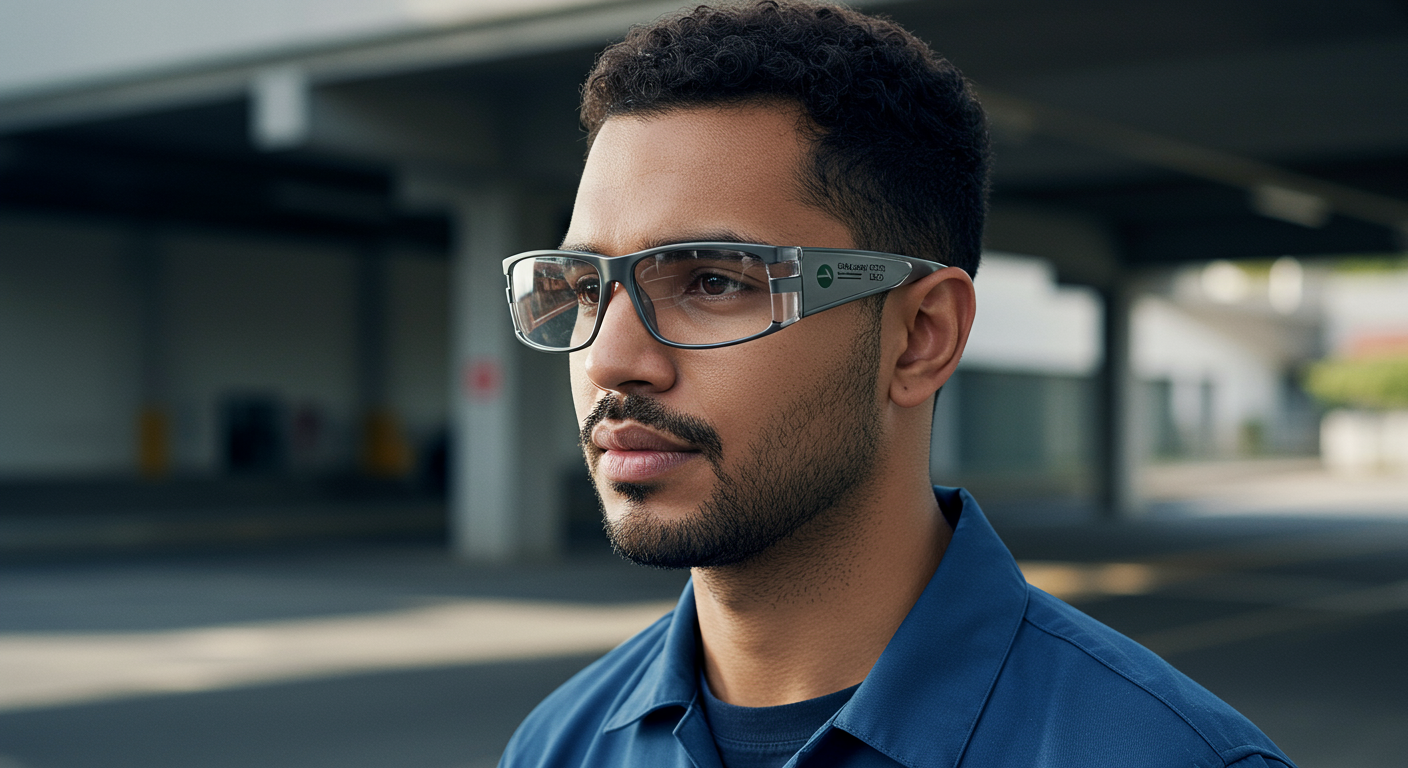
The glasses themselves are designed to be lightweight, with much of the processing hardware and power source offloaded to a separate unit. This controller, which is integrated into the driver’s vest, houses a swappable battery, operational controls, and a dedicated emergency button for immediate access to emergency services. When a driver stops at a delivery location, the glasses automatically activate, presenting information on a monochrome green display that appears in the corner of their vision. This display is powered by a high-brightness MicroLED projector combined with waveguide optics, a common configuration for enterprise smart glasses. To ensure driver safety, the display automatically deactivates when the vehicle is in motion to prevent distraction. The design also accommodates drivers who wear glasses by supporting prescription and transitional lenses that adapt to changing light conditions.
The Driver’s Field of View
Once active, the heads-up display provides a suite of information tailored to the delivery process. It can show turn-by-turn walking directions to a customer’s doorstep, which is especially useful for navigating large or confusing apartment and business complexes. The system also helps the driver locate the correct package within their vehicle and allows them to perform tasks like scanning barcodes and capturing proof-of-delivery photos without reaching for another device. Kaleb M., a delivery associate who tested the technology in Omaha, Nebraska, reported feeling safer because the information was constantly in his line of sight. “Instead of having to look down at a phone, you can keep your eyes forward and look past the display – you’re always focused on what’s ahead,” he explained.
The AI Powering the Glasses
The Amelia prototype is more than just a wearable display; its core functionality is driven by artificial intelligence and computer vision. These technologies analyze data from the glasses’ built-in camera and other sensors to provide real-time assistance and alerts that go beyond simple navigation.
Real-Time Hazard Detection
A primary safety feature is the system’s ability to identify and flag potential hazards in the driver’s path. The AI is trained to recognize environmental risks such as uneven walkways, poor lighting conditions, or the presence of a pet in the yard. This information is then relayed to the driver via the display, allowing them to proceed with greater caution. The data gathered can also be used to inform future deliveries to that location, creating a continuously updated repository of site-specific safety information.
Streamlining the ‘Last Hundred Yards’
Much of the efficiency gains promised by the technology are focused on the “last hundred yards” of delivery—the final steps from the parked van to the customer’s door. The AI assists in quickly locating specific packages inside a loaded vehicle, reducing search time. By providing precise, augmented-reality-style walking directions, the system helps drivers navigate complex environments with more confidence and speed. It is this combination of small time-saving actions, repeated across hundreds of stops, that Amazon projects will add up to a 30-minute reduction in shift time.
Future Capabilities and System Integration
Amazon views the current prototype as a foundational platform and has a roadmap for more advanced AI-driven features. The company anticipates that future versions of the glasses will be able to perform real-time defect detection, such as notifying a driver if they are about to leave a package at an address that does not match the label. Other planned upgrades include automatically adjusting the lens tint in response to low light and providing more sophisticated hazard alerts.
The Amelia project is part of a broader company strategy to infuse AI and automation throughout its logistics chain. The glasses are designed to integrate with a network of other advanced systems. For example, Amazon has also recently introduced “Blue Jay,” a robotic arm for sorting items in warehouses, and “Eluna,” an AI system that analyzes warehouse data to predict bottlenecks and improve operational flow. Together, these innovations point toward a future where human workers and intelligent machines collaborate closely at every stage of the fulfillment and delivery process.
Industry Context and Competition
While Amazon’s application of AI glasses to last-mile delivery is novel, the use of wearable technology in logistics is an established trend. For years, major logistics companies have explored smart glasses for warehouse operations. DHL, for instance, successfully piloted “vision picking” in the Netherlands, equipping warehouse workers with smart glasses to provide hands-free order picking instructions. The pilot demonstrated significant increases in performance and accuracy while receiving positive feedback from employees.
The broader enterprise market for augmented reality hardware includes established players like Vuzix, which provides similar devices for various industrial applications. Furthermore, other e-commerce giants are entering the space; China’s Alibaba is also reportedly preparing to ship its own AI and AR glasses. This industry-wide movement suggests a growing consensus that wearable, AI-powered devices can offer substantial benefits for productivity and accuracy in supply chain and logistics work.
Ergonomics and Worker Adoption
For any wearable technology to succeed in the workplace, it must be comfortable and intuitive enough for all-day use. Broader research into workplace augmented reality has highlighted potential ergonomic challenges, including physical fatigue from the weight of devices worn for extended periods and “cybersickness” caused by a mismatch between visual and physical motion. Ensuring that smart glasses can be worn easily over existing prescription eyewear is another critical design hurdle.
Amazon appears to have considered these factors by prioritizing a lightweight design and offloading components to the vest. The company has emphasized its collaborative design process, which involved gathering extensive feedback from hundreds of drivers to refine display brightness, comfort, and overall usability. This approach of co-development with end-users is crucial for overcoming the reluctance that can sometimes meet the introduction of new workplace technologies and for ensuring the final product is a help rather than a hindrance.
Privacy and Data Implications
The deployment of smart glasses in any work environment inevitably raises important questions about privacy and data. Devices equipped with cameras and microphones that are active during a work shift can capture sensitive information, leading to potential concerns for both employees and the public. The technology’s ability to constantly monitor a worker and their surroundings creates a new stream of data that employers must manage responsibly.
Legal and ethical frameworks are still evolving to address the nuances of workplace augmented reality. Issues such as data transparency, worker consent, and the security of collected information are paramount. As with any enterprise technology that monitors activity, establishing clear policies that balance operational benefits with the right to privacy will be a critical step. While Amazon’s current trial is focused on operational gains, the broader implementation of such technology will require navigating these complex human and legal realities to ensure worker trust and fair use.
“`
