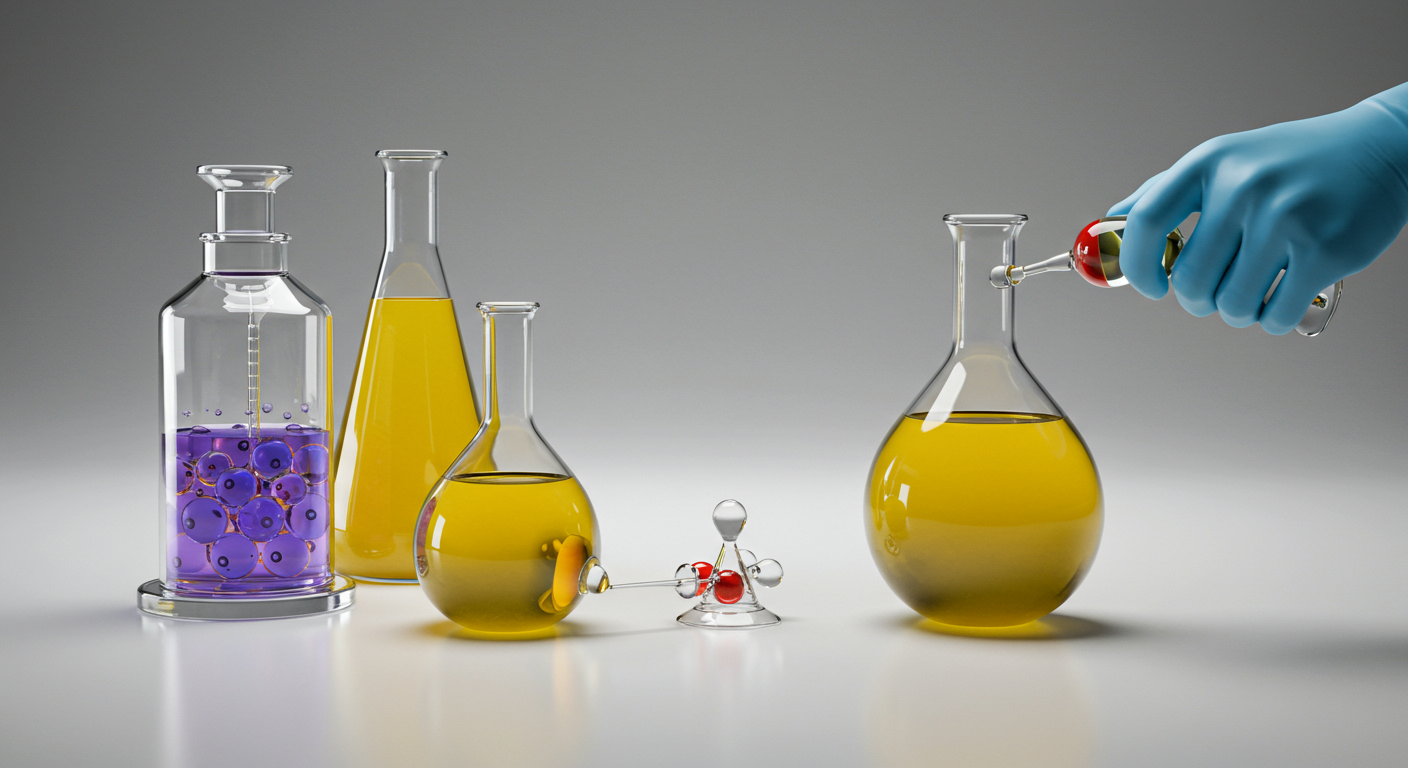
Scientists have developed a new approach that integrates artificial intelligence with automated chemistry to dramatically accelerate the discovery of novel polymers, a breakthrough that promises to slash the development time for new rubber-like materials from years to mere days. This method addresses a fundamental challenge in materials science: finding substances that combine traditionally contradictory properties, such as high strength and high flexibility, by efficiently navigating a nearly infinite landscape of chemical combinations.
The innovation lies in creating a closed-loop system where a machine learning model predicts promising chemical recipes, and a robotic platform synthesizes and tests them. The results are then fed back to the AI, which learns from the outcome and suggests the next, more refined experiment. This iterative process allows researchers to intelligently search for materials with a specific suite of desired characteristics, replacing slow, manual trial-and-error with a highly targeted and rapid optimization cycle. The technology could revolutionize industries reliant on advanced polymers, including soft robotics, sustainable packaging, and biomedical devices.
A New Model for Material Discovery
The traditional process for creating new polymers is notoriously slow and laborious. Scientists often tweak existing materials, but discovering fundamentally new compositions with superior properties can take years of painstaking lab work. Researchers at Carnegie Mellon University and the University of North Carolina at Chapel Hill have pioneered a human-augmented AI model to overcome this bottleneck. Their system specifically targets property trade-offs that have long constrained material design, such as the inverse relationship between a material’s toughness and its elasticity.
This collaborative approach pairs a sophisticated machine learning algorithm with the intuition and expertise of human chemists. The AI handles the complex task of predicting how different chemical ingredients will behave when mixed, while the chemists guide the process and validate the results. This synergy allows the team to explore chemical possibilities far more broadly and deeply than a human-led team could alone. The goal is to move beyond incremental improvements and unlock entirely new classes of materials engineered for specific, high-performance applications.
The AI-Powered Optimization Loop
The core of the new discovery engine is a rapid, iterative cycle of prediction and verification. The system is designed to learn on the fly, continuously refining its understanding of chemical cause and effect to zero in on an optimal solution with maximum efficiency.
AI-Guided Experimentation
The process begins when researchers input a set of target properties into the machine learning model. For instance, they might ask for a polymer with the strength of industrial plastic but the flexibility of natural rubber. The AI, which has been trained on existing materials data, analyzes the request and computationally models thousands of potential chemical formulations. Instead of randomly testing options, it identifies a small number of novel experiments that are most likely to yield the desired outcome. This predictive power allows the system to sidestep chemical dead-ends, saving immense amounts of time and resources that would otherwise be spent on unproductive experiments.
Automated Synthesis and Feedback
Once the AI proposes a set of candidate materials, the information is sent to an automated synthesis platform. Here, robotic liquid handlers meticulously mix the specified monomers, catalysts, and other chemical precursors in precise ratios. The resulting polymer samples are then automatically cured and subjected to a battery of physical tests to measure their actual properties. These empirical results—the material’s true strength, flexibility, and other characteristics—are digitized and fed directly back to the machine learning model. This crucial feedback loop allows the AI to compare its predictions to real-world outcomes, learn from any discrepancies, and generate an even more intelligent set of proposals for the next round of discovery.
Achieving Contradictory Properties
One of the most compelling demonstrations of this AI-driven method was the creation of a new rubber-like material that successfully reconciled conflicting physical properties. For decades, chemists have understood that making a polymer stronger typically makes it more brittle, while making it more flexible tends to make it weaker. The research team tasked the AI with finding a chemical formulation that could deliver both high strength and high elasticity simultaneously.
Through its iterative process, the system rapidly identified a unique combination of ingredients that produced a material with an exceptional balance of these two traits. This achievement serves as a powerful proof of concept, showing that AI-guided discovery can solve complex materials challenges that have long stymied traditional research methods. The ability to define a desired function and have the system “invent” the corresponding material represents a paradigm shift from conventional, forward-looking experimentation to a more powerful model of “inverse design.”
The Rise of Autonomous Chemical Platforms
The work at Carnegie Mellon and UNC is part of a broader trend toward automating scientific discovery. In a parallel effort, researchers at the Massachusetts Institute of Technology have developed a fully autonomous experimental platform that further accelerates the process. The MIT system requires even less human intervention and is capable of identifying, mixing, and testing up to 700 unique polymer blends in a single day.
This high-throughput capability opens the door to tackling even larger and more complex materials science problems. While the initial focus of the MIT platform was on polymers for stabilizing proteins and developing new battery electrolytes, its underlying technology is highly adaptable. These autonomous platforms represent the next frontier in materials research, where intelligent algorithms and robotics work around the clock to uncover next-generation materials for a host of applications.
Transforming Materials Science for the Future
The fusion of AI and automation is poised to reshape the entire landscape of materials science, pushing beyond rubber-like polymers to transform nearly every sector of the economy.
Future Applications
The potential applications for custom-designed polymers are vast. In medicine, these methods could be used to create better materials for drug delivery systems, flexible implants, and scaffolds for tissue engineering. In the electronics industry, they could lead to more efficient battery electrolytes or novel polymers for flexible screens. Furthermore, the technology is being aimed at one of society’s most pressing challenges: sustainability. Researchers are using AI to design high-performance plastics that are inherently recyclable or biodegradable, as well as to find better ways to optimize formulations that incorporate higher percentages of recycled content without sacrificing quality.
A New Era of Efficient Discovery
Beyond creating new products, this technology fundamentally changes the economics of research and development. By compressing discovery timelines and increasing the success rate of experiments, it dramatically lowers the cost of innovation. Several research groups have committed to making their AI models open source, which would allow labs around the world to adopt these powerful tools. This democratization of AI-driven discovery could unleash a global wave of innovation, enabling scientists everywhere to design and create the advanced materials needed to solve the complex challenges of the 21st century.