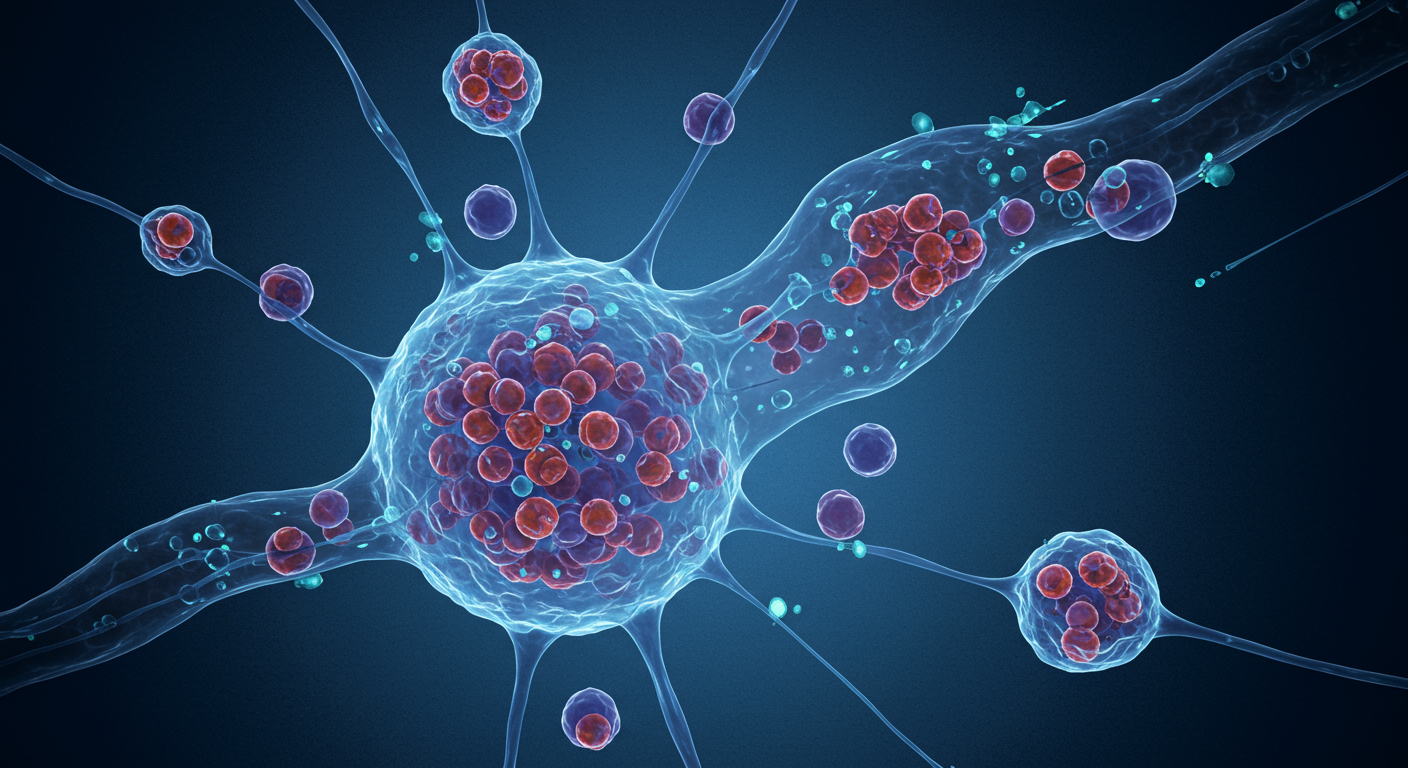
Scientists have uncovered a sophisticated system of molecular signals and genetic switches that dictates one of the most fundamental decisions in biology: how a single progenitor cell chooses to become either a muscle fiber or a neuron. By investigating the proteins that turn genes on and off, researchers have deciphered a complex “language” written not just in the DNA sequence, but in its accessibility, its structure, and the conversations between neighboring cells. This work illuminates how the astounding diversity of cell types in the body arises from an identical set of genetic instructions.
The findings carry significant weight for the future of regenerative medicine and our understanding of developmental diseases. The master-switch proteins and signaling pathways identified by researchers are the very mechanisms that guide tissue formation and repair. By learning to speak this cellular language, scientists hope to one day direct stem cells to rebuild damaged tissues, correct developmental errors, or even halt the uncontrolled growth seen in some cancers, which often co-opt these basic cellular programs. The research transforms a long-standing biological mystery into a set of precise rules that could eventually be engineered for therapeutic benefit.
The Transcriptional Rulebook
At the heart of a cell’s fate lies a class of proteins known as transcription factors, which bind to DNA to activate or silence specific genes. Research from the Friedrich Miescher Institute focused on two such factors: NGN2, which powerfully pushes a stem cell to become a neuron, and MyoD1, which directs it down the muscle pathway. By turning on each factor individually in stem cells, the team tracked precisely where they attached to the genome and what genes were subsequently activated, providing a direct view of the decision-making process at the molecular level.
However, the investigation revealed that the simple presence of a DNA sequence is not enough to guarantee a transcription factor will bind to it. The team discovered a more complex set of rules, a kind of genomic syntax. A key element is the physical state of the DNA; some transcription factors act as “pioneers,” capable of prying open tightly coiled, inaccessible DNA to activate previously silent genes. Furthermore, the presence of other “partner” proteins can influence where a factor binds, and even a single-letter change in the genetic code can alter the outcome. To make sense of this complexity, the researchers employed machine learning algorithms. These models learned to recognize the subtle patterns governing transcription factor binding, successfully predicting where the molecular switches would act to determine a cell’s ultimate identity across various cell types.
A Crucial Cellular Conversation
Beyond the internal machinery of a single cell, fate decisions are profoundly influenced by communication between cells. This dialogue is primarily managed by the Notch signaling pathway, a fundamental mechanism that links the choices of one cell to those of its neighbors. The system works through transmembrane proteins, with a cell expressing a ligand protein like Delta or Jagged, which then activates a Notch receptor on an adjacent cell. This process is essential for creating organized, complex tissues, preventing, for example, an entire sheet of cells from all becoming neurons at once.
Lateral Inhibition
A primary function of Notch signaling is a process called lateral inhibition, which helps generate cellular diversity. When one cell begins to differentiate into a specific type, such as a neuron, it presents the Delta ligand on its surface. This signal activates Notch receptors on its immediate neighbors, triggering an internal cascade that inhibits them from following the same neuronal path. This ensures a balanced distribution of cell types, creating a mosaic of neurons interspersed with other cells, rather than a uniform cluster. This mechanism operates across the animal kingdom, from insects to humans, and is a foundational principle of developmental biology.
The Hes1 Repressor
When the Notch pathway is activated in a receiving cell, it triggers the expression of other genes, most notably members of the Hes family. The protein Hes1 is a powerful transcriptional repressor, meaning it functions by shutting other genes off. In the context of neural development, Hes1 acts as a brake, suppressing the very proneural genes that NGN2 and its relatives activate. Therefore, the Notch-Hes1 axis serves to maintain cells in an undifferentiated, proliferative state. For a progenitor cell to finally commit to becoming a neuron, Notch signaling must be attenuated, or weakened, allowing the proneural factors to take over and execute the final steps of differentiation.
An Oscillating State of Readiness
The interplay between these factors can be remarkably dynamic. In muscle stem cells, researchers discovered that both Hes1 and the master muscle regulator MyoD are not expressed at steady levels. Instead, their protein levels oscillate, rising and falling over a period of hours. This rhythmic fluctuation is crucial for maintaining the stem cells in a state of readiness, allowing them to proliferate and build up their numbers without differentiating prematurely. The oscillatory expression of MyoD, driven by Hes1, essentially keeps the muscle-building program in a holding pattern.
The decision to differentiate is triggered when this oscillation is broken. Scientists found that if they ablated the `Hes1` gene, the levels of MyoD protein stopped fluctuating and became sustained at a high level. This stable expression of MyoD acts as an irreversible switch, pushing the cell to exit the proliferative cycle and commit fully to becoming a mature muscle fiber. This mechanism ensures that muscle repair and growth are tightly controlled, preserving a pool of stem cells for future needs while deploying them only when necessary.
A Journey of Sequential Choices
The commitment to a single fate is rarely a one-step process. Research from Karolinska Institutet and Harvard Medical School used single-cell sequencing to trace the developmental paths of individual cells, revealing that differentiation is a journey marked by a series of binary decisions. At each juncture, or “fork in the road,” a cell must choose between two possible paths. For example, an early neural crest cell must first decide whether to become a sensory neuron or another cell type. If it continues down the neural path, it faces subsequent choices, such as becoming a neuron versus a glial support cell.
This analysis showed that at these decision points, competing sets of genes are simultaneously active, gently nudging the cell in different directions. The ultimate choice is often guided by external signals from the cell’s surrounding environment. As one genetic program becomes stronger, the competing one fades, locking the cell into its chosen trajectory. This model portrays cellular development not as a single dramatic decision, but as a cascade of smaller, incremental choices that progressively refine a cell’s identity.
