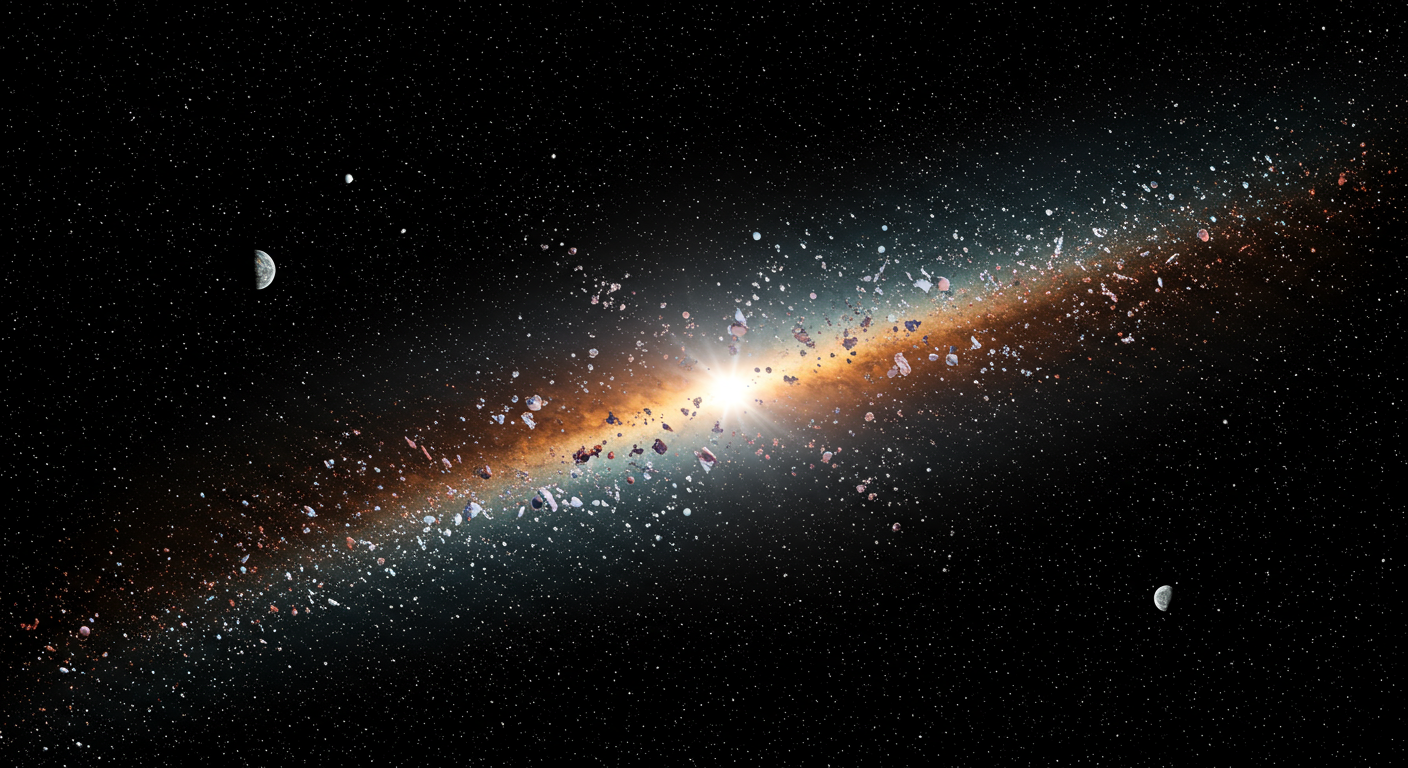
A new international study has concluded that dark matter, the unseen substance that dominates the universe, adheres to the known laws of gravity on cosmic scales. The research provides the most precise constraints to date on the behavior of this mysterious matter, suggesting it is not influenced by an unknown fifth fundamental force of nature, or that any such force must be exceptionally weak.
For decades, a central question in cosmology has been whether dark matter, which is about five times more prevalent than ordinary matter, follows the same physical rules. This study offers compelling evidence that it does, behaving just as stars, planets, and galaxies do when subjected to gravity. By analyzing the movement of galaxies within the vast structures of the universe, researchers have shed new light on the fundamental properties of dark matter, even as its true identity remains one of science’s most profound puzzles.
Mapping the Invisible Universe
To test the behavior of dark matter, an international team of researchers, led by scientists at the University of Geneva, devised a novel method to observe its response to gravity over immense distances. The universe’s structure is defined by massive celestial bodies that warp spacetime, creating “gravitational wells” into which matter is drawn. The team’s central question was whether dark matter falls into these wells in the same manner as the ordinary matter we can see.
The study, published in the journal Nature Communications, utilized current cosmological data to compare the velocities of galaxies with the depths of the gravitational wells they inhabit. Because galaxies are composed mostly of dark matter, their motion provides a powerful tracer for how dark matter itself is behaving. The analysis allowed scientists to determine if dark matter’s motion was governed solely by gravity or if an additional, undiscovered force was at play.
The Search for a Fifth Force
The known universe operates under four fundamental forces: gravity, electromagnetism, and the strong and weak nuclear forces that govern atoms. Some theories have proposed the existence of a fifth force that would act exclusively on dark matter, causing it to behave differently from ordinary matter. Such a force could help explain some of the lingering mysteries about the cosmos, but its existence has never been proven.
Camille Bonvin, an associate professor at the University of Geneva and a co-author of the study, explained the logic behind their test. If dark matter is only subject to gravity, galaxies will fall into gravitational wells in a predictable way, described by established principles like Einstein’s theory of general relativity and Euler’s equations, which detail the motion of fluids and particles under force. However, if a fifth force were influencing dark matter, it would alter the motion of galaxies, causing them to fall into these wells differently. By precisely measuring galaxy velocities against the well depths, the team could effectively search for deviations that would signal a new force.
Consistency with Standard Physics
Ruling Out Strong Deviations
After applying their approach to the latest cosmological data, the research team found that dark matter’s behavior was consistent with the laws of gravity as they are currently understood. The galaxies moved as predicted by models that include only gravity, with no evidence of an additional force influencing their paths. The study concluded that dark matter falls into gravitational wells in the same way as ordinary matter, thus obeying Euler’s equations.
Placing Limits on New Forces
While the results represent a significant step in characterizing dark matter, they do not entirely eliminate the possibility of a fifth force. However, they place the strongest constraints on its potential strength yet. According to Natassia Grimm, the study’s first author from the University of Portsmouth’s Institute of Cosmology and Gravitation, any hypothetical fifth force cannot be more than 7% of the strength of gravity. If it were stronger, its effects would have been detectable in the team’s analysis. This finding significantly narrows the possibilities for theories that propose modified laws of physics for the dark sector of the universe.
Future Probes and Deeper Questions
This study marks a pivotal moment in the ongoing effort to understand dark matter, but the work is far from over. The next generation of astronomical instruments is poised to provide even more sensitive tests. Future experiments, such as the Legacy Survey of Space and Time (LSST) and the Dark Energy Spectroscopic Instrument (DESI), will gather unprecedented amounts of data on the positions and velocities of billions of galaxies.
These powerful new tools will allow cosmologists to probe for forces that are far weaker than current technology can detect. Scientists anticipate that these upcoming surveys will be sensitive enough to identify a fifth force if its strength is as little as 2% of gravity’s pull. Such a discovery would revolutionize our understanding of physics and the cosmos. For now, however, the evidence suggests that dark matter, despite its elusive nature, plays by the same gravitational rules as everything else in the universe.