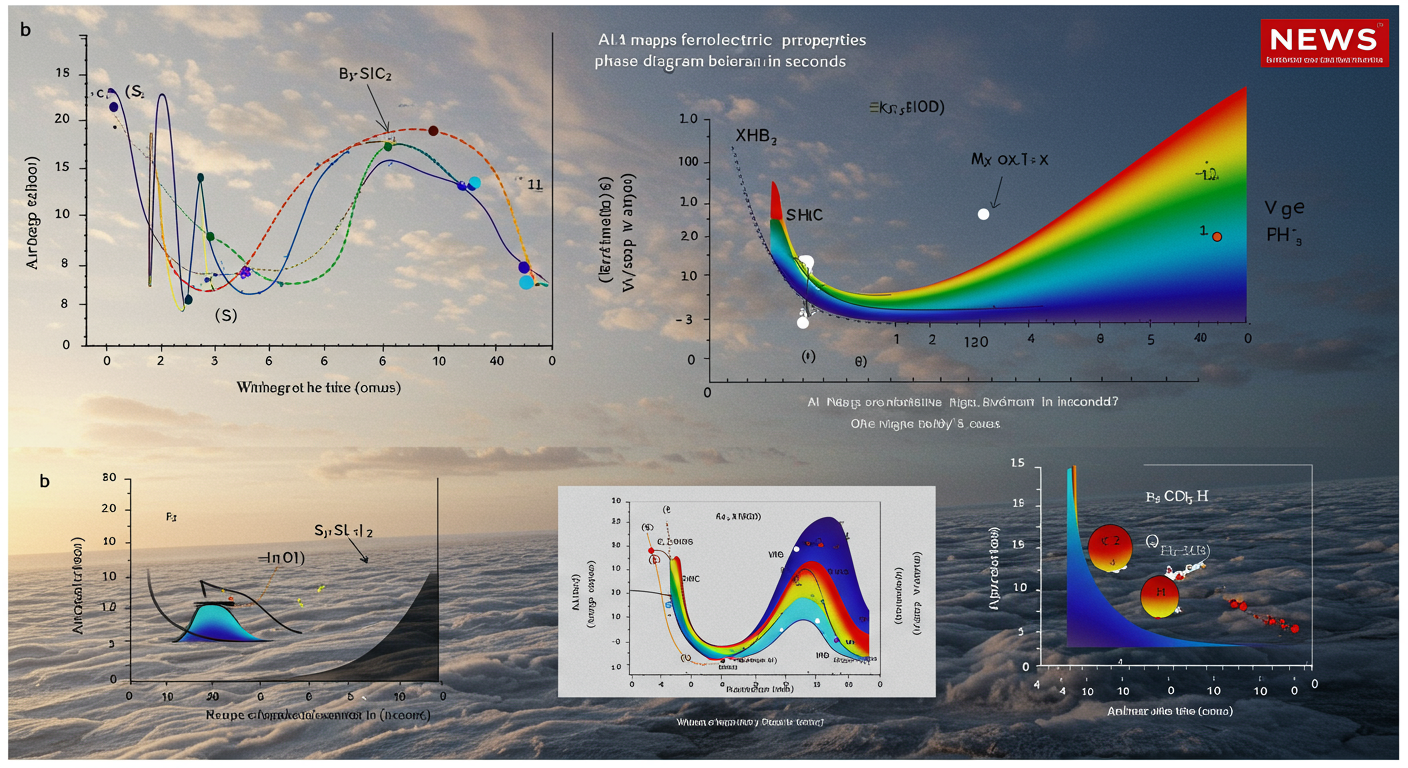
An artificial intelligence model can generate phase diagrams for ferroelectric materials in seconds, a task that has traditionally taken months or even years. This new deep learning model, called FerroAI, is poised to accelerate the discovery and design of new functional materials, which are crucial components in a wide range of electronic devices.
The rapid creation of these phase diagrams, which map the properties of materials under different compositions and temperatures, represents a significant leap forward in materials science. Researchers from the Hong Kong University of Science and Technology and Tongji University developed FerroAI by training it on a massive dataset extracted from over 40,000 published research papers. This innovative approach has already led to the discovery of a novel ferroelectric material with an exceptionally high dielectric constant, a key measure of its electrical performance.
Accelerating Materials Discovery
The traditional method for developing new ferroelectric materials is a laborious and time-consuming process. It involves the synthesis of numerous samples, followed by extensive experimental testing and computational analysis to determine their properties and construct a phase diagram. This entire workflow can stretch over months or even years for a single material system. FerroAI dramatically shortens this timeline, generating a phase diagram in just 20 seconds. This speed allows scientists to quickly identify promising new materials and focus their experimental efforts on the most viable candidates.
The Power of a Massive Dataset
The success of FerroAI is built on a comprehensive database of phase transformations, encompassing thousands of ferroelectric systems. The research team used natural language processing to text-mine over 40,000 scientific articles, compiling a dataset of 2,838 phase transformations across 846 different ferroelectric materials. This large and diverse dataset was crucial for training the deep learning model, allowing it to learn the complex relationships between a material’s composition, temperature, and crystal structure.
Overcoming Previous Limitations
Prior machine learning models in materials science have been limited in their ability to generalize across different families of materials. They could often predict phase transitions for a specific material system but struggled to apply that knowledge to new and different materials. FerroAI overcomes this challenge by leveraging its vast training data and advanced data augmentation techniques, enabling it to accurately predict the properties of novel material compositions.
A Breakthrough Discovery and Validation
To validate their AI model, the researchers used it to predict the properties of new ferroelectric materials. One of the most significant outcomes of this research was the discovery of a new material with an exceptionally high dielectric constant of 11,051. Another validation involved the prediction of a morphotropic phase boundary in a novel material system, which was then experimentally confirmed to have a dielectric constant of 9,535. These discoveries not only demonstrate the power of FerroAI but also represent a major advancement in the development of high-performance ferroelectric materials.
Impressive Accuracy
Experimental validation of FerroAI’s predictions has shown an accuracy rate of over 80% across multiple crystal structures. The model can accurately predict phase boundaries and transformations, including the critical morphotropic phase boundaries where the functional properties of these materials are often optimized. This high level of accuracy gives researchers confidence in the model’s ability to guide their experimental work and accelerate the discovery of new materials with desired properties.
The Future of Materials Science
The development of FerroAI is a clear indication of the transformative potential of artificial intelligence in materials science. By automating and accelerating the process of phase diagram construction, AI is reshaping the research paradigm for functional materials. This approach allows for the rapid exploration of a vast landscape of potential materials, opening up new possibilities for the design of next-generation sensors, memory devices, and energy-harvesting technologies.
A New Research Paradigm
The researchers believe that their work provides a template for developing similar AI tools for other classes of functional materials. The success of this data-driven approach highlights the critical importance of high-quality datasets in training effective AI models for scientific discovery. As AI becomes more integrated into the research process, it promises to accelerate the pace of innovation in both basic and applied science, leading to the faster development of new materials with tailored properties for a wide range of applications.
