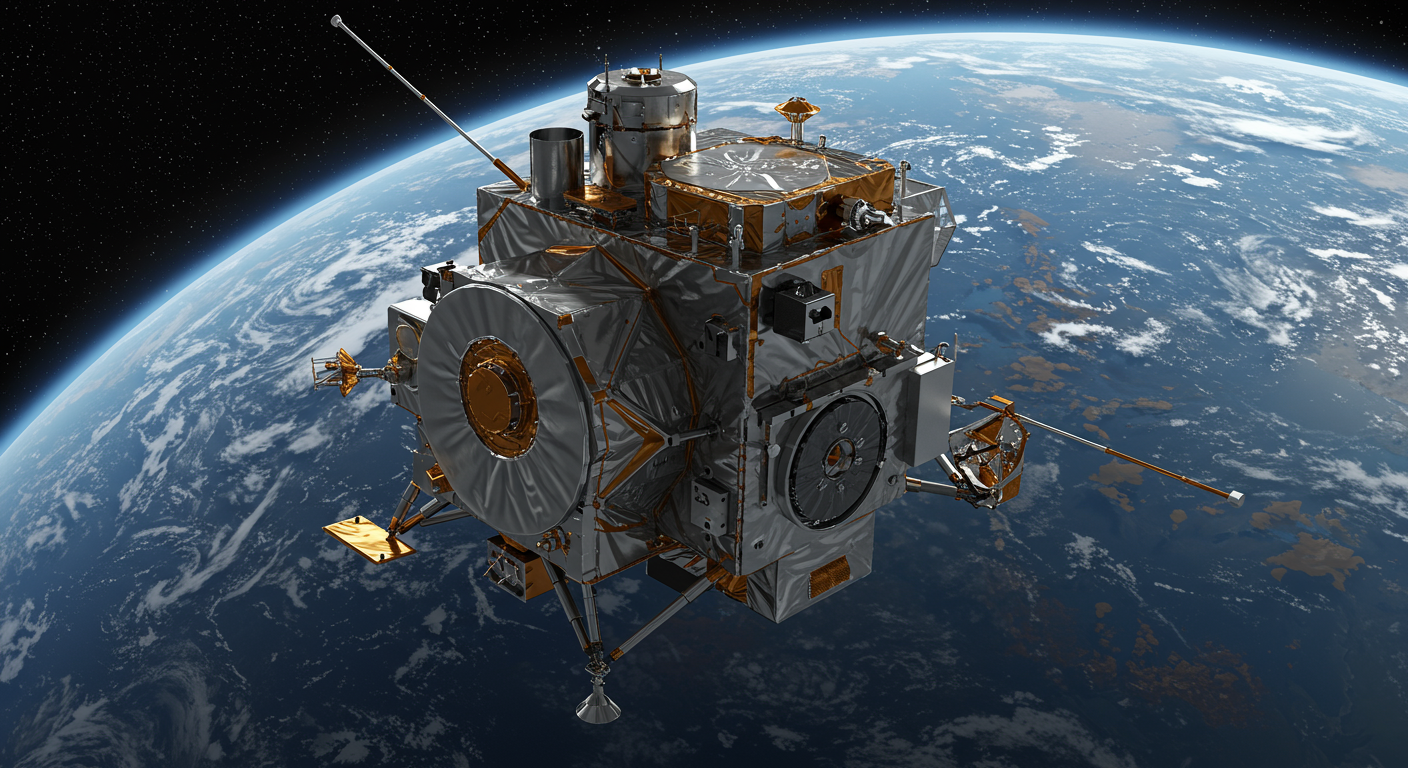
The European Space Agency is advancing a new era of interplanetary exploration with its first fully autonomous deep-space CubeSat, a mission set to demonstrate that small, cost-effective satellites can perform complex tasks far from Earth. The spacecraft, named Henon, will be the first of its kind to navigate to and operate in a distant orbit around the sun without the support of a larger mothership, representing a significant leap in miniaturized space technology and mission architecture.
Henon’s primary objective is to test a new model for space weather forecasting, providing warnings of potentially hazardous solar storms 3–6 hours earlier than current systems allow. To achieve this, the carry-on luggage-sized satellite will be positioned in a unique orbit upstream of the Earth, using a suite of miniaturized instruments to monitor the solar wind and detect coronal mass ejections. The success of this technology demonstration could pave the way for a future fleet of small satellites providing continuous, real-time monitoring of solar activity, fundamentally enhancing the protection of vital space-based and terrestrial infrastructure.
A New Class of Autonomous Explorer
Historically, CubeSats venturing into deep space have operated as secondary payloads, relying on a larger parent spacecraft for communication, navigation, and propulsion. The Henon mission, short for Heliospheric Pioneer for Solar and Interplanetary Threats Defence, shatters this paradigm. It is designed for complete independence, a crucial step toward realizing the potential of low-cost, multi-point scientific observations in the solar system. Once deployed, Henon will establish a direct communications link with Earth using its own miniaturized deep-space transponder, interfacing with the European Space Agency’s Estrack network of ground stations. This capability is unprecedented for a spacecraft of its size and is a cornerstone of the mission’s design.
The mission is funded through ESA’s General Support Technology Programme (GSTP), which focuses on demonstrating and validating new technologies in orbit. The prime contractor for the spacecraft is Argotec, an Italian aerospace company, which recently completed the satellite’s Critical Design Review, a major engineering milestone confirming the maturity and feasibility of the design. This review validated a highly innovative and compact configuration that accommodates three scientific payloads and multiple advanced subsystems within the standardized 12U CubeSat frame, which is roughly the size of a briefcase.
Miniaturized Propulsion and Advanced Systems
Enabling Henon’s journey into deep space is a suite of groundbreaking miniaturized technologies, chief among them a highly efficient electric propulsion system. This compact ion engine, developed by a UK consortium led by Mars Space, uses electricity from Henon’s solar panels to accelerate charged xenon gas atoms, generating gentle but persistent thrust. This system, similar in principle to the one used on the much larger BepiColombo mission to Mercury, has been scaled down for CubeSat applications and will allow Henon to perform the significant maneuvers required to travel from its initial drop-off point to its final operational orbit millions of kilometers away.
Onboard Instrumentation
Beyond its propulsion system, Henon integrates several other advanced subsystems developed across Europe. A miniature X-band transponder for deep-space communication and a specialized solar array drive assembly are being provided by IMT in Italy. Argotec is developing the craft’s sophisticated power conditioning and distribution unit. For its scientific objectives, Henon carries a payload of miniaturized instruments designed for space weather observation. These include an energetic particle flux telescope to measure protons, electrons, and heavy ions; a magnetometer mounted on a deployable boom to measure magnetic fields; and a Faraday Cup Analyzer to measure the properties of the solar wind. Together, these instruments will provide a comprehensive, in-situ picture of interplanetary conditions.
Journey to a Unique Solar Orbit
Henon’s mission profile is as innovative as its technology. The CubeSat is scheduled to be launched as a rideshare payload with a larger mission, initially traveling to the Sun-Earth Lagrange point 2 (L2), located approximately 1.5 million kilometers from Earth in the direction away from the Sun. From this staging point, Henon will deploy and begin its solo journey. Over several months, it will use its electric propulsion system to navigate to a Distant Retrograde Orbit (DRO), a highly stable and elliptical path around the Sun. This will be the first time any spacecraft has entered this type of orbit, which was first theorized by French astronomer Michel Hénon in 1969 and gives the mission its name.
The chosen orbit is ideal for space weather forecasting. At its closest point, the orbit will bring Henon about 12 million kilometers from Earth, and at its farthest, it will be 24 million kilometers away. Crucially, this trajectory will place the spacecraft “upstream” of Earth, passing up to 10 times nearer to the Sun than spacecraft positioned at the traditional L1 Lagrange point. This vantage point allows it to detect solar storms, such as Coronal Mass Ejections (CMEs), hours before they arrive at Earth, providing significantly more lead time for authorities to take protective measures for satellites, power grids, and aviation.
Future of Interplanetary Monitoring
The Henon mission serves as a critical pathfinder for a new approach to planetary science and space weather monitoring. By demonstrating the reliable use of CubeSat technologies in the harsh environment of deep space, it will open the door for more ambitious and cost-effective missions. ESA envisions a future where entire fleets of small, autonomous satellites could be deployed to various locations in the solar system, from the Moon and asteroids to orbits around Mars. This distributed approach would enable simultaneous, multi-point measurements of phenomena that are impossible to capture with single, monolithic spacecraft.
Specifically for space weather, a successful Henon demonstration could lead to a constellation of four or five similarly equipped CubeSats spaced equally in the Distant Retrograde Orbit. Such a network would provide continuous, uninterrupted monitoring of solar emissions from the sunward side of Earth, offering a robust and resilient early warning system. This would complement observations from other key ESA missions, like the Vigil spacecraft planned for the L5 Lagrange point, to create the most comprehensive space weather monitoring system ever deployed. The launch of Henon, currently planned for the end of 2026, is therefore not just a single mission but the first step toward a more proactive and networked defense against the threats posed by our Sun.