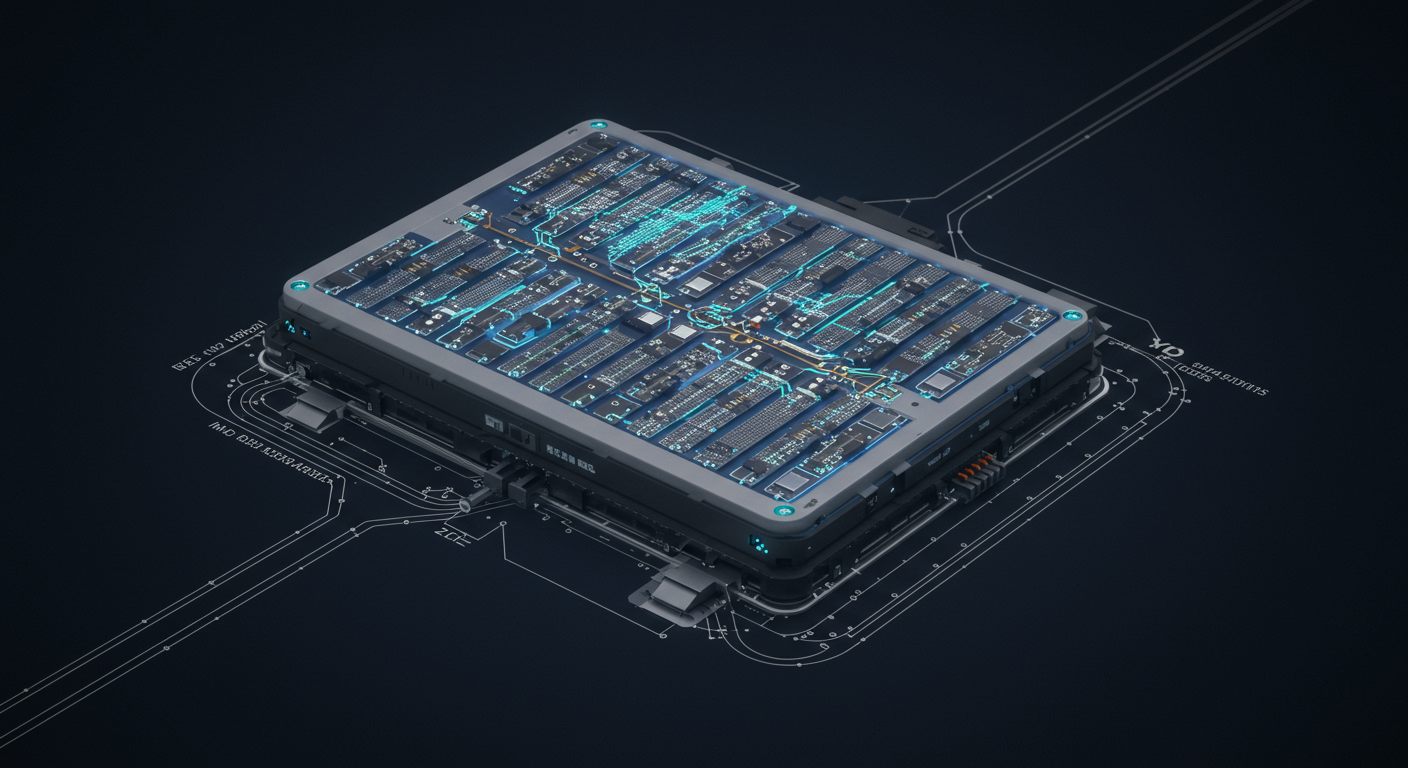
AI research firm Anthropic is dramatically scaling its computational power through an expanded partnership with Google Cloud, securing access to a massive fleet of specialized processors to train and deploy its future AI systems. The collaboration, announced on October 23, 2025, will provide Anthropic with up to one million of Google’s Tensor Processing Units (TPUs) by 2026, representing one of the largest publicly disclosed AI infrastructure agreements to date.
This multi-year commitment builds upon an existing relationship established in 2023 and is designed to meet the surging enterprise demand for Anthropic’s Claude family of AI models. The deal provides Anthropic with well over a gigawatt of computing capacity, an amount valued in the tens of billions of dollars, to accelerate the development of more advanced and capable AI while supporting a growing roster of corporate clients. The move signals Anthropic’s strategic decision to rely heavily on Google’s custom-built AI accelerators for its next wave of innovation.
A Strategic Deepening of a Foundational Partnership
The collaboration between Anthropic and Google Cloud first began in 2023, when Anthropic started using Google’s AI infrastructure to train its foundational models. That initial partnership also made the Claude models available to businesses through the Google Cloud Vertex AI platform and its marketplace, allowing companies to integrate the technology into their own operations. Thousands of businesses, including prominent technology firms like Figma, Palo Alto Networks, and Cursor, have since adopted Claude through Google Cloud.
The latest expansion marks a significant escalation of this alliance. According to Anthropic’s Chief Financial Officer, Krishna Rao, the expanded capacity is essential to meet exponentially growing demand and keep the company’s models at the cutting edge of the industry. The decision to deepen the reliance on Google’s infrastructure reflects Anthropic’s positive experience with the platform’s performance and efficiency over the past several years.
The Technical Backbone: Next-Generation TPUs
At the core of the agreement is access to Google’s Tensor Processing Units, which are highly specialized chips designed specifically for large-scale machine learning and AI workloads. Unlike general-purpose processors, TPUs are engineered to handle the complex mathematical operations inherent in training and running large language models with greater speed and energy efficiency. Anthropic cited the strong price-performance and efficiency of TPUs as key factors in its decision.
The deployment will include Google’s seventh-generation TPU, codenamed “Ironwood,” which is part of its mature AI accelerator portfolio. By 2026, Anthropic will have access to a total capacity exceeding one gigawatt, delivered through a network of up to one million individual TPU chips. This massive scale provides the raw computational power necessary for the intensive and time-consuming process of training frontier AI models, which involves processing vast datasets and adjusting billions of parameters.
Powering the Future of Claude AI
The primary purpose of this immense computational resource is to fuel the research, development, and deployment of future generations of Anthropic’s Claude models. The additional power will allow Anthropic’s research teams to experiment with more complex architectures and larger datasets, pushing the boundaries of what the models can achieve in areas like reasoning, comprehension, and task automation. Faster training cycles enable quicker iteration and refinement of the AI’s capabilities.
Beyond training, the TPU infrastructure will also be critical for serving the models to customers. As more businesses integrate Claude into their workflows, the demand for fast and reliable inference—the process of generating responses—grows. This expanded capacity ensures that Anthropic can provide consistent, low-latency performance even as its user base scales. The company has also recently introduced new features like memory for its Claude Pro and Max users, which allows the AI to retain context across conversations to support more sophisticated problem-solving.
Meeting Surging Enterprise Demand
The expansion is a direct response to the rapid adoption of Claude in the corporate sector. Anthropic currently serves over 300,000 business customers, a number that has grown significantly since the initial Google Cloud partnership. The company reported that its number of large accounts, defined as those generating over $100,000 in annualized revenue, has increased nearly sevenfold in the past year alone. This growth underscores the increasing reliance of Fortune 500 companies and AI-native startups on Claude for critical business functions.
These enterprise clients utilize Claude for a wide range of applications, from productivity and automation to complex data analysis. The robust and scalable infrastructure provided by the Google TPU fleet is essential for supporting these mission-critical deployments and ensuring that performance does not degrade as demand continues to climb. The partnership solidifies Anthropic’s position as a key provider of enterprise-grade AI solutions.
A Commitment to Responsible AI Development
Central to Anthropic’s mission is the development of AI that is safe, transparent, and aligned with human values. The company has stated that the massive increase in computational resources will also support its safety research. With more capacity, Anthropic can conduct more thorough testing, safety evaluations, and alignment research in parallel with the development of more powerful models.
This strategic approach helps the company address evolving AI challenges while maintaining a focus on integrity and accountability. The partnership with Google Cloud provides the stable, high-performance foundation necessary to build and refine these complex systems responsibly. By investing heavily in the infrastructure for both innovation and safety, Anthropic aims to set a benchmark for sustainable and ethical practices within the AI industry.
