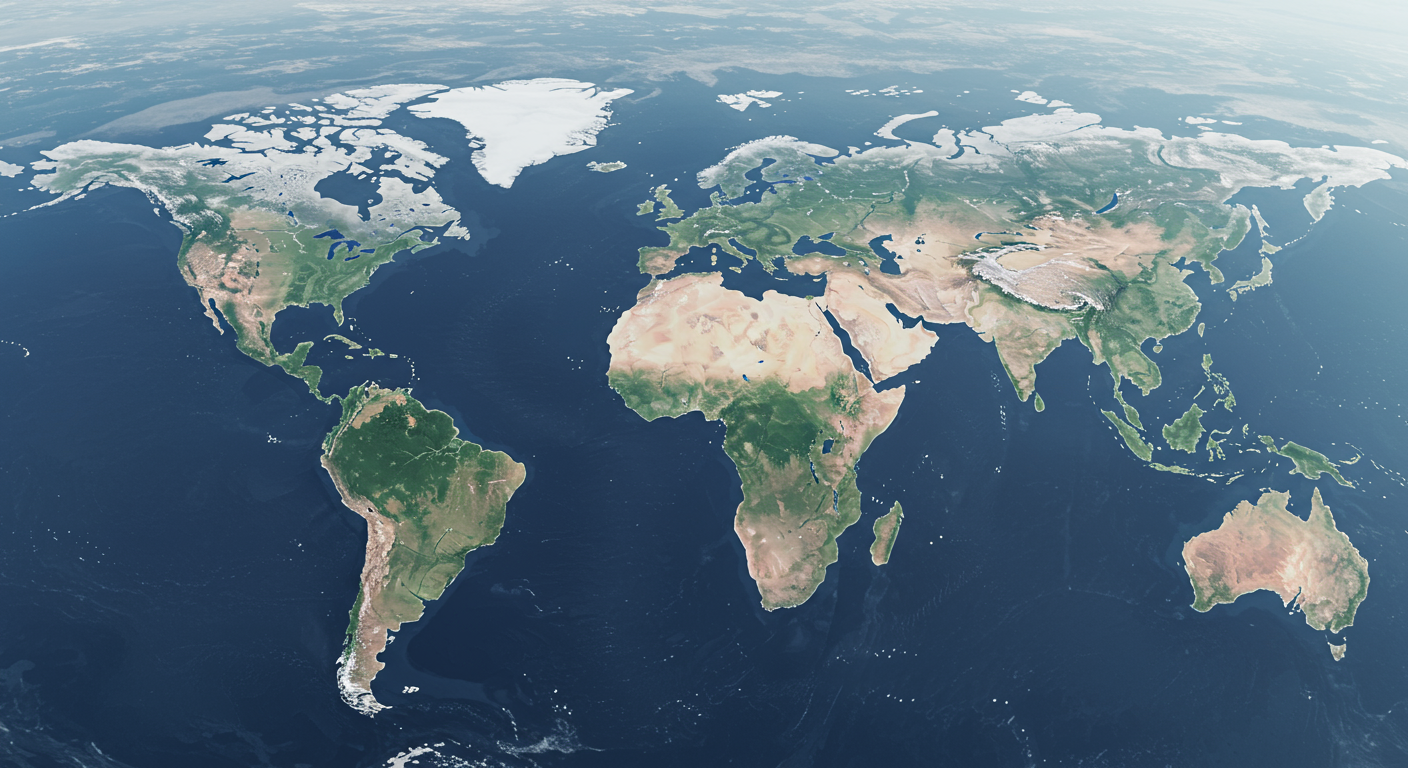
A new generation of artificial intelligence models is revolutionizing weather forecasting, promising faster and more accurate predictions that could reshape how industries from energy to retail manage climate-related risks. As climate change intensifies and extreme weather events become more frequent, technology giants are leveraging AI to deliver forecasts with unprecedented speed and detail, potentially saving economies billions of dollars and protecting lives. The World Meteorological Organization (WMO) reported nearly 12,000 extreme weather, climate, and water-related disasters between 1970 and 2021, causing US$4.3 trillion in economic losses. While early warning systems have reduced human casualties, the rising economic toll underscores the urgent need for improved forecasting.
This technological shift moves beyond traditional numerical weather prediction (NWP), which relies on massive supercomputers to solve complex physics-based equations. Instead, AI-driven models learn directly from vast amounts of historical weather data, recognizing patterns to predict future atmospheric conditions. This data-driven approach is not only faster—generating forecasts in minutes instead of hours—but also significantly more energy-efficient, capable of running on a single computer instead of a supercomputer. Companies like Google, Microsoft, and Nvidia are at the forefront, developing proprietary AI platforms that promise to enhance disaster preparedness and transform critical business operations affected by weather.
Corporate Giants Enter the Atmosphere
Leading the charge are some of the biggest names in technology, each developing sophisticated AI-driven platforms to tackle the complexities of weather prediction. These companies are investing heavily in creating models that can outperform traditional systems in speed, accuracy, and cost-efficiency. Their entry into the meteorological space signals a significant shift, as weather forecasting has historically been the domain of government agencies and public institutions. By leveraging their immense computational resources and AI expertise, these tech giants are not just complementing existing methods but are poised to fundamentally change how weather forecasts are made and used across various sectors.
Google’s WeatherNext Initiative
Google, through its DeepMind and Research divisions, has developed WeatherNext, a family of AI models designed to be faster and more reliable than conventional physics-based methods. Google claims these models offer superior forecast reliability and are already being used to improve disaster response and global food security. WeatherNext is available to Google Cloud customers, enabling businesses in sectors like retail and logistics to better prepare for weather-related disruptions. The platform also includes specialized models for predicting specific phenomena, such as a tropical cyclone model that can generate 50 possible scenarios up to 15 days in advance.
Microsoft’s Aurora Foundation Model
Microsoft’s contribution is Aurora, a versatile foundation model developed by Microsoft Research. With over a billion parameters, Aurora is not limited to weather; it can be fine-tuned to predict a wide range of environmental events, including air pollution and tropical cyclones, often with greater precision and at a lower cost than specialized systems. Aurora was trained on over a million hours of diverse atmospheric data and can generate forecasts up to 5,000 times faster than traditional supercomputer-based systems. Microsoft has made Aurora’s code open-source, allowing researchers and developers worldwide to build upon the technology.
Nvidia’s Earth-2 Platform
Nvidia has developed Earth-2, a cloud platform designed to build and run AI-accelerated digital twins of Earth’s weather and climate. A key component is CorrDiff, a generative AI model that refines coarse global data into high-resolution, kilometer-scale forecasts. Nvidia states that CorrDiff is up to 1,000 times faster and 3,000 times more energy-efficient than traditional simulation methods. The platform also includes FourCastNet, an AI model that emulates atmospheric dynamics at a low cost. Earth-2 aims to provide hyper-local forecasting down to tens of meters, which can model airflow around buildings and predict phenomena like damaging downwash winds at street level.
A New Paradigm in Prediction
The transition to AI-based weather forecasting marks a fundamental shift from physics-based simulations to data-driven methodologies. Traditional NWP models divide the atmosphere into a grid and use complex equations to simulate the physical processes of fluid dynamics and thermodynamics. While these models have become increasingly accurate over decades of refinement, they require immense computational power and time to run. AI models, in contrast, learn patterns from historical data, allowing them to make predictions based on recognizing similar past weather setups. This approach is orders of magnitude faster and can be run on less powerful hardware, making advanced forecasting more accessible.
Speed and Efficiency Gains
One of the most significant advantages of AI models is their dramatic reduction in computational cost and time. Making a 10-day forecast with AI can take less than a minute, whereas traditional models require hours on a supercomputer with hundreds of processors. This efficiency allows for the generation of large ensembles of forecasts, providing a better understanding of the range of possible outcomes and improving risk assessment for extreme events. Nvidia’s CorrDiff model, for example, is reported to be 3,000 times more energy-efficient than traditional methods.
Accuracy and Emerging Capabilities
While still a relatively new technology, AI models have already demonstrated impressive accuracy, in some cases matching or even outperforming leading physics-based systems for certain predictions, such as temperature and tropical cyclone tracks. Microsoft’s Aurora model correctly forecasted all hurricanes in 2023 more accurately than operational forecasting centers. AI also excels at “nowcasting,” which focuses on short-term predictions of high-impact events like thunderstorms. Furthermore, AI can improve predictions in areas with limited historical data by using physics-based models to generate synthetic data for training.
Challenges and the Road Ahead
Despite the immense promise of AI in weather forecasting, experts caution that the technology is not a silver bullet and will likely complement, rather than completely replace, traditional methods for the foreseeable future. Integrating these new tools into operational workflows presents several challenges, including the need for expert oversight to validate forecasts and address potential errors. There is also concern about the potential for misinformation and the “black box” nature of some AI models, which can make it difficult to understand the reasoning behind a particular forecast.
Data Dependency and Model Limitations
A significant limitation of current AI models is their reliance on historical data for training. Since the past is not always a perfect predictor of the future, especially in a rapidly changing climate, AI models may underestimate the intensity of unprecedented extreme weather events. If historical datasets do not reflect the new realities of a warming planet, the models may fail to accurately predict the severity of future storms or heatwaves. Therefore, ongoing research is focused on integrating physical principles into AI models to improve their robustness and reliability in unfamiliar conditions.
The Future of Forecasting
The collaboration between tech companies, national meteorological services, and academic researchers is crucial for advancing the field. Projects like the WMO’s AI for Nowcasting Pilot Project bring together experts from public and private sectors to advance the technology. As AI models become more sophisticated, they are expected to be integrated into a hybrid forecasting approach that combines the strengths of both data-driven and physics-based methods. This synergy will likely lead to more accurate, reliable, and accessible weather forecasts, helping societies better prepare for and mitigate the impacts of an increasingly volatile climate.