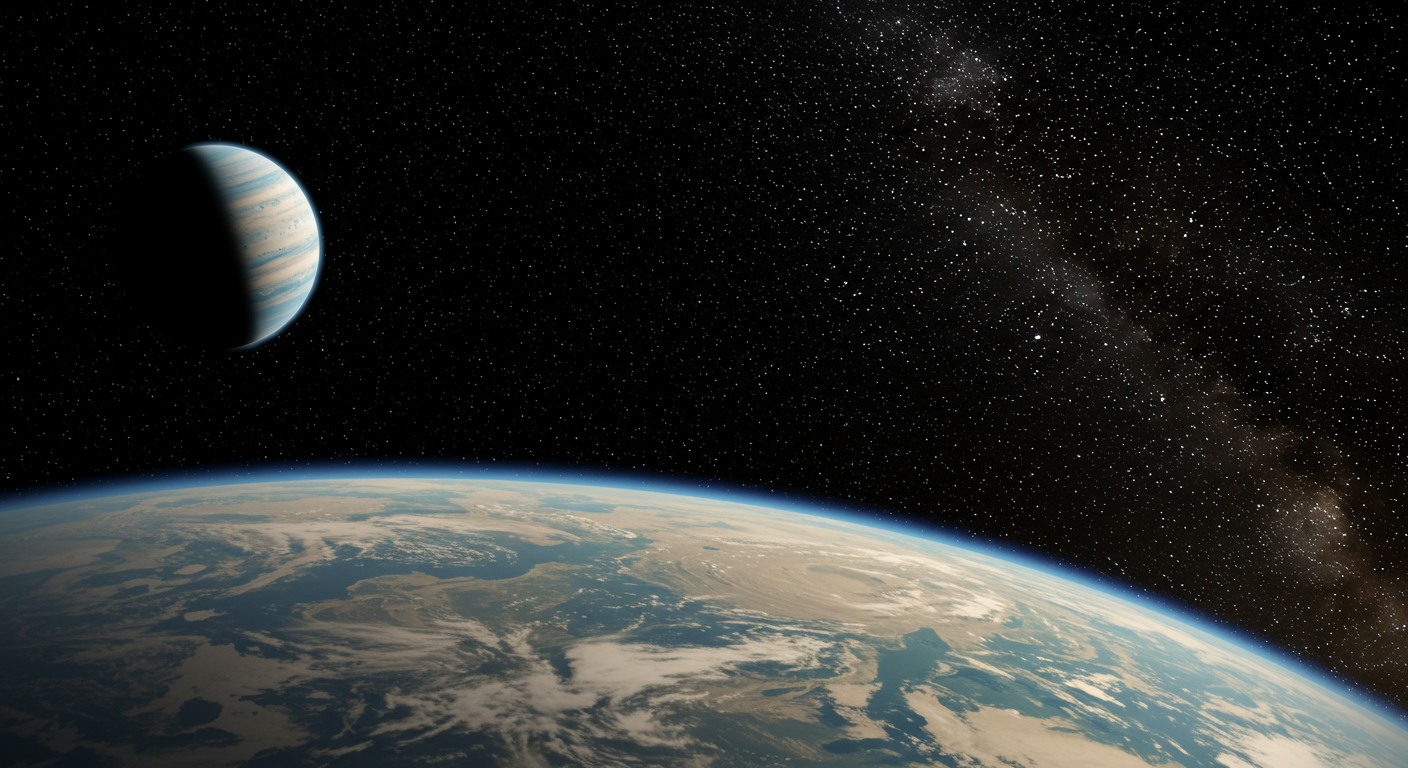
New research reveals the immense influence of Jupiter’s birth on the architecture of our solar system, suggesting the gas giant’s rapid early growth was directly responsible for creating the conditions that allowed for Earth’s formation. Using advanced computer simulations, planetary scientists have demonstrated that Jupiter’s gravitational pull carved a great divide in the primordial disk of gas and dust around the young sun, a process that not only protected the inner solar system but also solved a long-standing mystery about the origin of certain meteorites.
The study, published in Science Advances by researchers from Rice University, provides a comprehensive model that links Jupiter’s formation to the creation of distinct planetary nurseries. As Jupiter grew to a critical mass, it opened a gap in the protoplanetary disk, effectively creating a barrier that prevented the building blocks of the outer solar system from mixing with those of the inner solar system. This separation preserved a chemical distinction still seen in meteorites today and, crucially, halted a process of inward migration that would have likely prevented Earth from ever forming. The findings paint a picture of Jupiter as the solar system’s primary architect, a celestial Guardian that shaped the stable environment in which the terrestrial planets could assemble and thrive.
A Destabilizing Growth Spurt
In the first few million years of the solar system’s history, the sun was surrounded by a rotating disk of gas and dust. According to state-of-the-art hydrodynamic models developed by planetary scientists André Izidoro and Baibhav Srivastava, the rapid formation of Jupiter profoundly disturbed this environment. As the nascent planet underwent runaway gas accretion, its gravitational influence sent powerful ripples through the disk, creating a series of rings and gaps akin to those now observed by astronomers in distant, young star systems.
The most significant of these features was a large, stable gap that Jupiter carved in the disk. This gap was not merely an empty space but a region where the gravitational push from the giant planet counteracted the inward pull of gas, creating what the researchers describe as “cosmic traffic jams.” These pressure bumps at the edges of the gap disrupted the flow of material toward the sun, trapping dust and pebble-sized particles that would have otherwise been lost. This process fundamentally restructured the disk and set the stage for a new wave of planet formation.
Forging a Second Generation of Worlds
The pressure bumps created by Jupiter’s gap became highly concentrated regions of solid material. Here, particles that drifted inward from the outer solar system piled up, increasing the local dust-to-gas ratio dramatically. This pile-up triggered instabilities that led to the gravitational collapse of the collected material, forming a new generation of planetesimals—the rocky seeds from which planets are built. This finding represented a major breakthrough, as it pointed to distinct episodes of planetesimal formation in the early solar system.
Solving the Chondrite Conundrum
This model of delayed planetesimal formation provides a compelling solution to a persistent puzzle in cosmochemistry: the age of chondrites. Chondrites are a common type of stony meteorite that serve as pristine relics from the solar system’s dawn. Chemical analysis shows that many of these objects formed 2 to 3 million years after the very first solids, such as calcium-aluminum-rich inclusions (CAIs). The reason for this time gap was previously unexplained. The Rice University model demonstrates that Jupiter’s formation was the trigger for their late birth, creating the specific protected zones where the raw materials for chondrites could accumulate and coalesce long after the first planetesimals had formed elsewhere.
The Great Isotopic Divide
Meteorites found on Earth exhibit a fundamental and mysterious chemical separation, known as the isotopic dichotomy. They fall into two distinct families: non-carbonaceous (NC) and carbonaceous (CC), which are thought to have originated in the inner and outer solar system, respectively. These two groups have different isotopic signatures in elements like chromium and titanium, suggesting their parent bodies never mixed. Without a barrier, however, turbulent forces in the protoplanetary disk should have homogenized these materials in less than a million years.
The new research shows that Jupiter’s gap was the physical barrier that maintained this separation. By preventing pebbles and dust from the outer, CC-rich region from drifting into the inner, NC-rich zone, the gas giant preserved the two distinct chemical reservoirs for the entire lifetime of the disk. This finding unifies the physical process of planet formation with the chemical evidence locked inside meteorites, explaining how the solar system’s distinct compositional zones were established and maintained.
Guardian of the Terrestrial Zone
Perhaps the most significant implication of Jupiter’s early growth is its role in protecting Earth and its neighbors. In many observed exoplanetary systems, large planets known as “super-Earths” form and then migrate inward, often settling in orbits very close to their host stars. The same fate likely awaited the planetary embryos in our own inner solar system. However, Jupiter’s formation effectively cut off the inward flow of gas that drives this migration.
By stemming the tide, Jupiter’s presence stabilized the orbits of the growing rocky worlds, allowing them to remain in the so-called terrestrial region—a zone at a suitable distance from the sun where liquid water could eventually exist. The planetesimals stalled in this area, between 0.5 and 1.5 astronomical units, where they slowly collided and accreted over tens of millions of years to form Venus, Mars, and Earth. As Izidoro noted, Jupiter did not just become the biggest planet; it “set the architecture for the whole inner solar system.” Without its intervention, our home world may never have had the chance to exist as we know it.
Echoes in Distant Star Systems
The theories presented in the simulations are not just abstract models; they are supported by increasingly detailed observations of other solar systems in the making. The Atacama Large Millimeter/submillimeter Array (ALMA) in Chile, a powerful radio telescope, has captured stunning high-resolution images of protoplanetary disks around young stars. Many of these disks show the exact same ring-and-gap structures that the Rice University model predicts a young giant planet would create.
These observations provide tangible evidence that giant planets actively reshape their birth environments, acting as powerful cosmic sculptors. Seeing this process unfold hundreds of light-years away gives scientists confidence that their simulations accurately reflect the dynamics that governed our own solar system’s history. The gaps seen in distant disks are the signposts of forming giant planets, validating the idea that Jupiter’s early growth left a permanent signature on our cosmic neighborhood—a signature that is still legible today in the chemistry of meteorites.
