A burgeoning population of satellites and their metallic remnants poses a dual threat to Earth’s environment and the future of space exploration. As thousands of defunct spacecraft fall from orbit, they burn up in the upper atmosphere, releasing chemical compounds that could damage the planet’s protective ozone layer. Simultaneously, the ever-growing cloud of space debris increases the risk of catastrophic collisions, potentially rendering critical orbits unusable for future generations.
This emerging environmental challenge stems from the rapid expansion of satellite mega-constellations. While these networks aim to provide global internet coverage, their lifecycle involves a constant cycle of replacement, leading to a significant increase in atmospheric re-entries. Scientists are now raising alarms about the cumulative effect of these burn-ups, which deposit metallic oxides and other particles into sensitive layers of the atmosphere, creating what some call an accidental geoengineering experiment. The problem is compounded by the more than 10,000 tons of space trash already orbiting Earth, a figure set to grow as thousands more launches are planned.
An Atmosphere Under Assault
When satellites, particularly small Low Earth Orbit (LEO) models, re-enter the atmosphere, they travel at speeds around 27,000 kilometers per hour and disintegrate. This process burns the aluminum alloys that form a significant part of their structure, creating a fine dust of aluminum oxide, also known as alumina. These particles are injected into the mesosphere, between 50 and 80 kilometers above the surface, an altitude where they can persist for years because rain cannot wash them out.
From the mesosphere, these alumina particles can take up to 30 years to descend into the stratosphere, which contains the majority of Earth’s protective ozone. Researchers are concerned that these particles will act as catalysts in chemical reactions that destroy ozone molecules. The process is similar to the way chlorofluorocarbons (CFCs) previously damaged the ozone layer. While the aluminum oxides do not consume ozone directly, they facilitate reactions involving chlorine that do, meaning a single particle could contribute to the destruction of thousands of ozone molecules over several decades.
The Scale of the Contamination
The sheer number of planned satellites illustrates the potential scale of the problem. Companies like Starlink have launched approximately 8,000 satellites since 2018 and have approval for tens of thousands more. With a typical lifespan of about five years, a steady stream of re-entries is guaranteed. One study estimates that mega-constellations could add 360 tons of alumina to the atmosphere annually. Another worst-case scenario projects that if 10,000 satellites are launched regularly, the proportion of human-made material entering the atmosphere could rise dramatically, accounting for up to 40% of all atmospheric particulate matter.
Orbital Congestion and Collision Risk
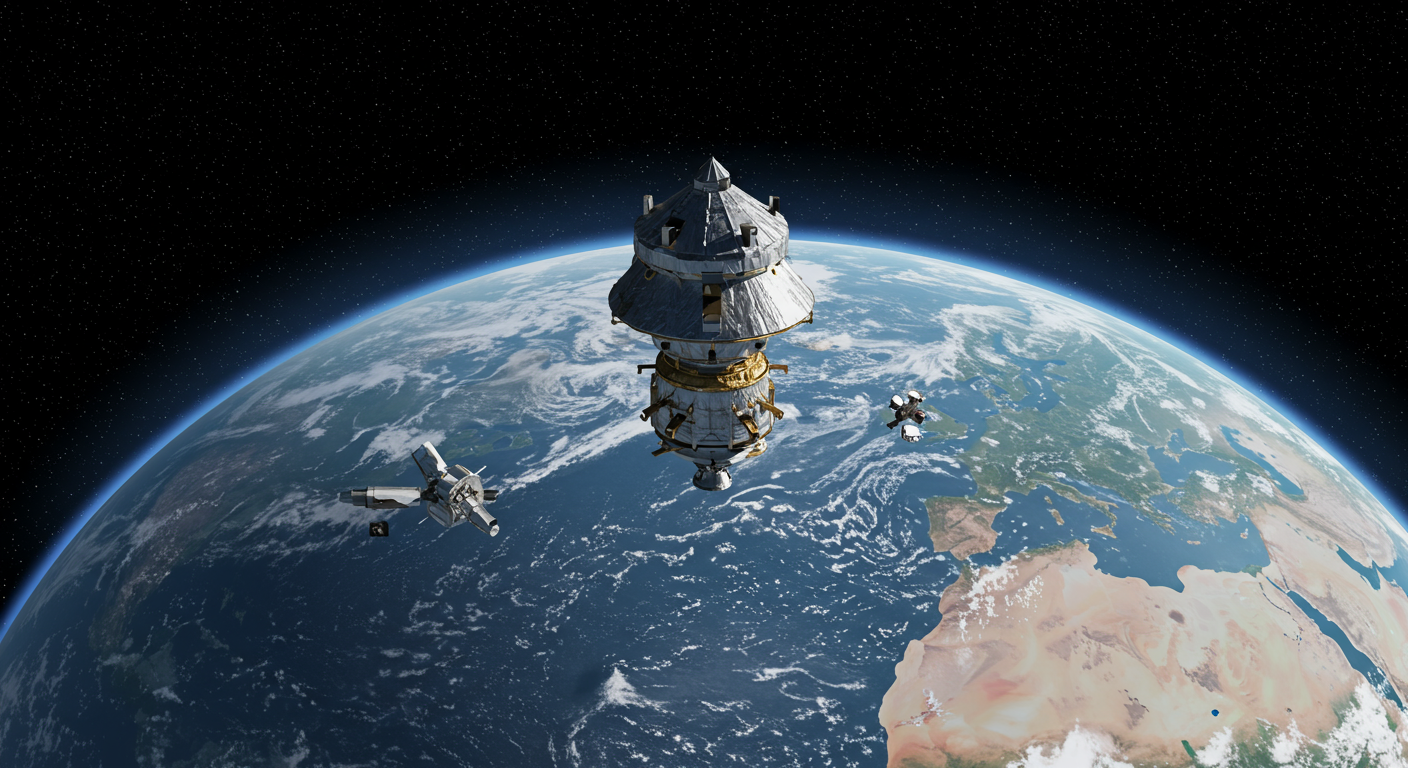
Beyond the atmospheric threat, the proliferation of satellites and debris creates a hazardous environment in low-Earth orbit. This region, below 2,000 kilometers in altitude, is becoming increasingly crowded. Since the launch of Sputnik 1 in 1957, more than 20,000 objects have been launched into space, and as of summer 2025, over 14,000 active or defunct satellites were in orbit. This growing field of debris travels at incredibly high speeds—averaging 7 kilometers per second—where even a tiny fragment can inflict catastrophic damage upon impact with an operational spacecraft.
The International Space Station (ISS) already faces this danger, with advisors stating that space trash is now the greatest risk to its safety. The station must perform avoidance maneuvers at least once a year to dodge tracked debris. The fear is that a collision could trigger a chain reaction, known as the Kessler syndrome, where each crash creates more debris, leading to more collisions. Such a scenario could render entire orbits unusable for satellites that provide critical services like GPS, weather forecasting, and communications.
Wider Environmental Consequences
The atmospheric consequences of satellite re-entries extend beyond ozone depletion. The accumulation of metallic oxides and black carbon, or soot, from burning spacecraft could alter the upper atmosphere’s temperature and chemical balance. These particles absorb sunlight, which can warm the surrounding air. A modeling study from the University of Colorado Boulder simulated a future with 60,000 satellites and found it could warm the mesosphere by up to 1.5°C.
Although these changes may seem minor, scientists warn that even small disruptions in the upper atmosphere can have cascading effects on global climate patterns, wind circulation, and cloud formation. This issue is attracting growing attention from researchers and policymakers, who draw parallels to the early days of discovering the threat CFCs posed to the ozone layer. The European Space Agency is now funding research to better quantify the atmospheric chemistry of re-entry pollution, acknowledging that what happens in space does not stay in space.
The Path Toward Mitigation
Addressing these converging threats requires a multi-faceted approach involving technological innovation, international regulation, and a shift in how satellite operations are managed. Experts are calling for new standards that make the quantitative evaluation of atmospheric impacts a requirement for launch certification. This would compel operators to account for the entire lifecycle of their satellites, from launch and operation to their final disposal.
Developing Sustainable Solutions
On the technological front, researchers are exploring the design of satellites made from materials that produce fewer harmful residues upon re-entry. Other proposals include developing better shielding for spacecraft to protect them from small debris impacts and improving AI-powered collision avoidance systems. For disposal, instead of letting satellites burn up uncontrollably, some advocate for standardized methods of controlled re-entry that would allow them to be brought down over uninhabited ocean areas, minimizing atmospheric contamination. This strategy, however, does not fully eliminate the problem of atmospheric pollution. Ultimately, preventing the accumulation of new space debris through responsible end-of-life disposal strategies is considered the most critical step toward ensuring the long-term safety and sustainability of space operations.