New research reveals that buoyant plastic waste will continue to pollute the ocean’s surface for more than 100 years, even if all plastic pollution were to stop immediately. A study led by scientists at Queen Mary University of London used a new model to simulate the lifecycle of plastic debris, finding that its slow breakdown and fragmentation process creates a long-term legacy of contamination that will persist for generations.
The findings provide a comprehensive look at the fate of plastics that float, a journey that sees large items slowly degraded by sun and waves before sinking to the seafloor as microplastics. This gradual process means that a significant reservoir of plastic will remain in the upper ocean for decades to come, continuously shedding smaller particles into the marine environment. According to the researchers, this persistence explains why surface cleanup efforts alone are insufficient to address the full scope of the problem.
A Persistent Contamination Timeline
The modeling study, published in Philosophical Transactions of the Royal Society A, projects that after an entire century, approximately 10 percent of the original mass of buoyant plastic could still be found floating at the ocean surface. This research is the final part of a trilogy of papers exploring the long-term fate of ocean microplastics. Dr. Nan Wu, the study’s lead author from Queen Mary University of London, highlighted the misconception that ocean plastic simply disappears. “People often assume that plastic in the ocean just sinks or disappears,” Wu stated. “But our model shows that most large, buoyant plastics degrade slowly at the surface, fragmenting into smaller particles over decades.”
The simulation indicates a predictable, albeit slow, decay rate. Researchers calculated that large plastic items lose about 0.45 percent of their mass each month. Following this timeline, a third of an item’s original mass is gone within ten years, and almost two-thirds has been converted into microplastics after 30 years. This slow but steady fragmentation is the critical factor limiting the speed at which the ocean surface can clear itself of plastic waste.
How Surface Plastic Reaches the Seafloor
The journey of plastic from the surface to the deep sea is a complex, multi-stage process. It begins with physical degradation and ends with a ride on a natural, organic “elevator.”
From Macroplastic to Microplastic Fragments
Initially, large, floating plastic items like bags, bottles, and fishing gear are exposed to sunlight and constant wave action. This environment makes the plastic brittle, causing it to break apart into progressively smaller pieces. The model shows that this fragmentation process is the primary bottleneck in removing plastic from the surface. The slower the breakdown, the longer the plastic lingers in the upper layers of the ocean, where it can harm marine life and coastal ecosystems. The researchers tested various scenarios and found that the degradation rate was the key variable controlling the plastic’s residence time at the surface.
The Marine Snow Elevator
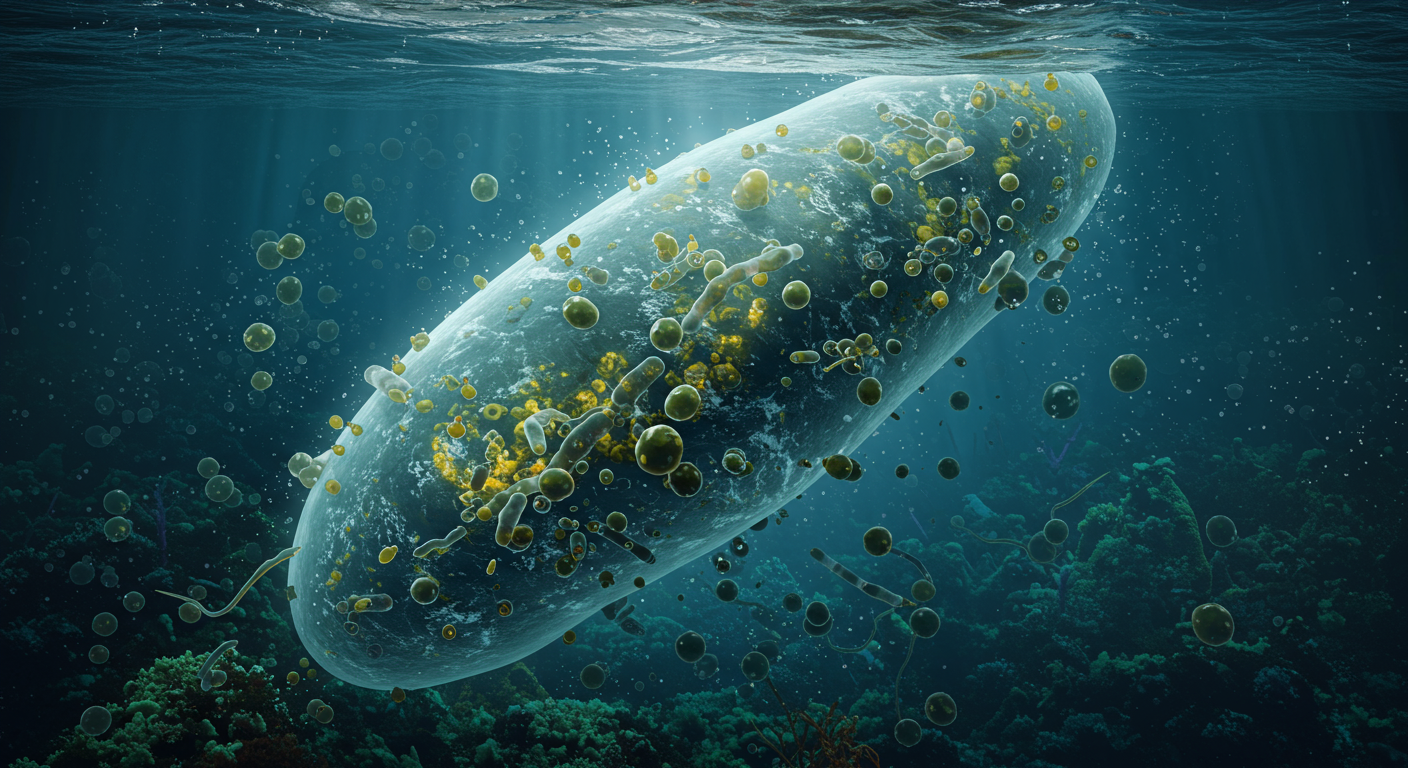
Once plastic fragments become small enough, typically in the micrometer range, they can be transported to the deep ocean. This occurs when they attach to “marine snow,” which is a continuous shower of sticky organic material, such as dead algae and fecal matter, sinking from the upper waters. These plastic-laden aggregates are heavier than water and sink. The process is not always direct; particles may move in a “stop-and-go” pattern, sinking with marine snow and then rising again if the organic material decays before it reaches the bottom. Eventually, the microplastics become small enough to remain trapped in deeper water or settle permanently on the seafloor. This mechanism helps explain why the vast quantity of plastic entering the ocean does not remain indefinitely at the surface.
Solving the ‘Missing Plastic’ Puzzle
For years, scientists have grappled with the “missing plastic” problem, where the amount of plastic observed floating on the ocean surface is significantly less than estimates of what has entered the marine environment. This new research provides a powerful explanation for this discrepancy. The plastic is not missing, but has been transformed and transported. The model demonstrates that the slow fragmentation over decades allows the buoyant plastic to eventually become small enough to join the marine snow elevator and sink into the deep sea. The study shows that the plastic is scattered throughout the water column, from the surface to the seafloor sediments, just in a different form than expected.
An Intergenerational Challenge
The century-long persistence of plastic pollution underscores that it is an intergenerational problem. Professor Kate Spencer, a co-author on the study, noted that future generations will continue to deal with the consequences of today’s plastic waste. The findings reveal that even the most effective surface-level cleanup technologies cannot capture the vast majority of plastic, which exists as tiny, sinking fragments. The research highlights the necessity of long-term strategies that go beyond surface removal and focus on reducing plastic production and improving waste management to prevent it from reaching the ocean in the first place.
Broader Ecological Risks
The enormous scale of plastic pollution, with an estimated 170 trillion plastic particles already circulating on the ocean surface, poses a significant threat to marine ecosystems. Researchers warn that the increasing concentration of microplastics could eventually overwhelm the ocean’s biological carbon pump, a critical system that transports carbon and nutrients from the surface to the deep sea and regulates global climate. Furthermore, these plastic fragments have been found in the food chain, with humans who consume seafood potentially ingesting elevated levels of microplastics. The discovery of micro- and nanoplastics in human tissues has been linked to a variety of health problems, adding another layer of urgency to the global pollution crisis.