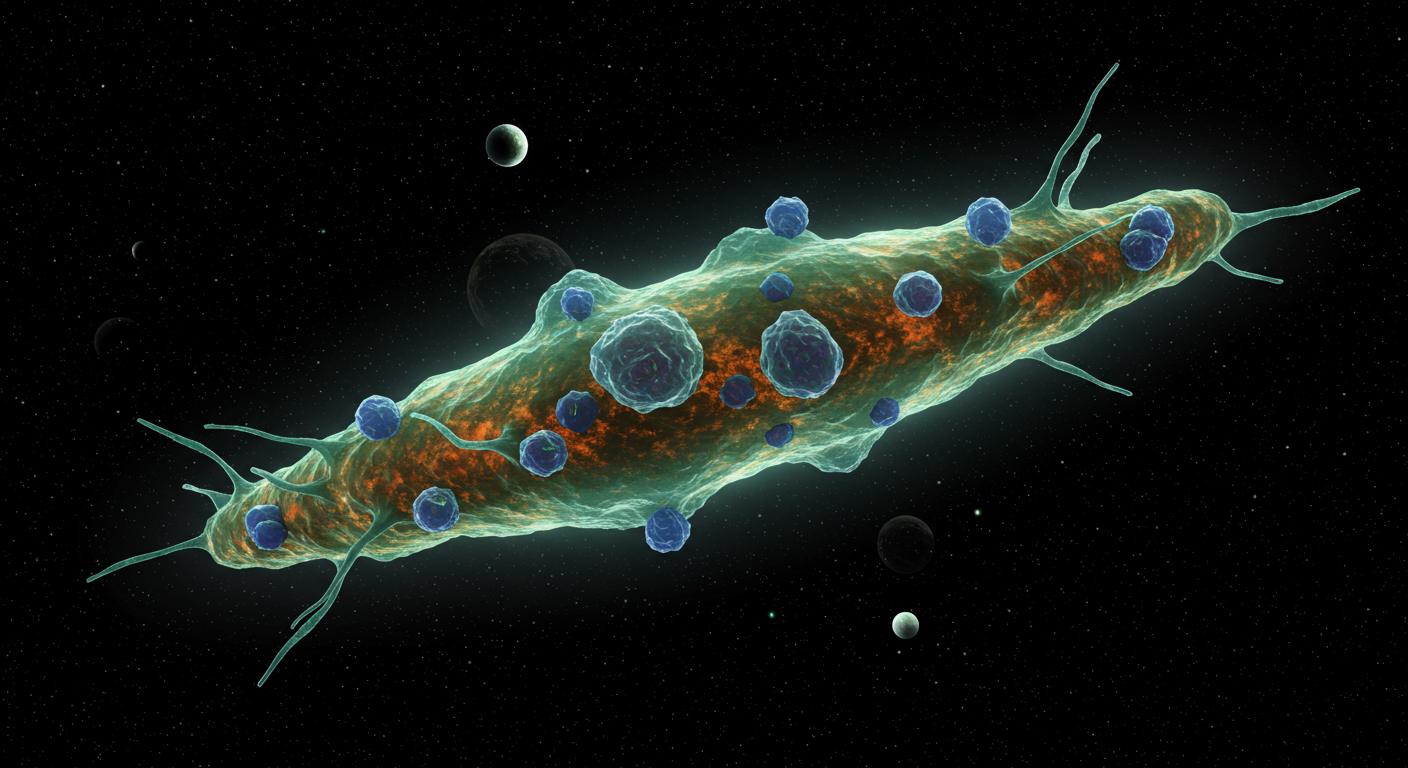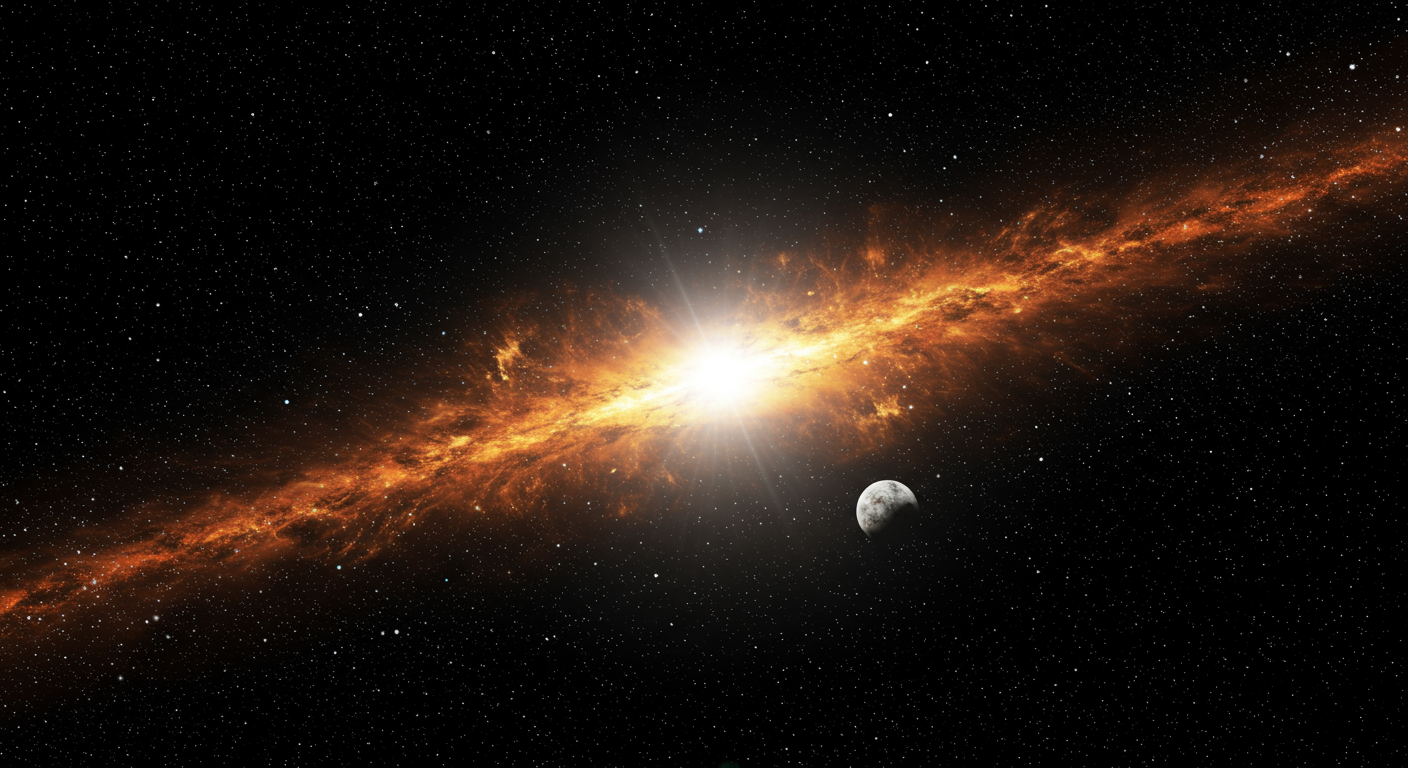
A new theoretical model suggests that dark matter, the elusive substance thought to make up most of the universe’s mass, may play a direct role in the death of certain stars. Researchers have found that the presence of dark matter inside a star can trigger a premature core collapse, leading to a weaker-than-expected supernova explosion and the birth of an unusually lightweight neutron star.
This finding, developed by a team at INFN-Pisa and the University of Pisa, provides a new framework for understanding stellar evolution and offers a novel, indirect method for detecting dark matter. By studying the remnants of specific stellar explosions known as electron-capture supernovae, astronomers may find signatures of dark matter’s influence. The study focuses on a hypothetical type called asymmetric dark matter (ADM), proposing that its gravitational effects inside a star’s core can significantly alter the timeline and outcome of its demise.
Rethinking Stellar Collapse
Electron-capture supernovae are the explosive end for stars with initial masses about 8 to 10 times that of our sun. These stars develop dense cores rich in oxygen, neon, and magnesium. Under immense pressure, atomic nuclei in the core begin capturing their own electrons, a process that removes the internal pressure supporting the core against its own gravity. This loss of support triggers a catastrophic collapse, a subsequent rebound explosion, and the formation of a dense neutron star.
The new research introduces dark matter as a key player in this process. The scientists modeled ordinary matter and dark matter as two separate, intermingling fluids that interact with each other only through gravity. This “two-fluid formalism” allowed them to calculate how a concentration of dark matter particles within the stellar core would change its fundamental properties. This represents the first self-consistent stellar model to explore how ADM directly impacts the structure of these massive stars before they go supernova.
The Dark Matter Trigger Effect
The study’s central finding is that dark matter can make a star’s core unstable sooner than previously thought. Even a modest amount of accumulated dark matter can significantly increase the central density of the core, effectively compressing it.
Lowering the Mass Threshold
This added compression means the core does not need to reach the standard critical mass to initiate the electron-capture process. The ADM gravitationally squeezes the core, bringing it to the brink of collapse at a lower mass than conventional models would predict. This suggests that some stars might explode as electron-capture supernovae when they otherwise would not have, altering the expected population of such events in the cosmos.
Fainter Explosions, Lighter Stars
A major consequence of this premature collapse is a less energetic supernova. Because the core collapses with less mass, the resulting explosion is weaker. The remnant left behind is also changed: a neutron star with a gravitational mass potentially well below the canonical minimum. The research indicates these dark-matter-induced processes could form neutron stars with masses significantly less than one solar mass. This is a profound claim, as the lightest neutron star observed to date is approximately 1.174 solar masses.
A New Probe for an Invisible Universe
By connecting the properties of dark matter to observable astrophysical events, the research opens a new avenue for its detection. The model provides concrete, albeit indirect, signatures that astronomers can search for. The discovery of a population of very low-energy supernovae or neutron stars lighter than the established minimum could be interpreted as evidence for the presence of asymmetric dark matter within stellar objects.
This approach reframes stellar explosions as natural laboratories for fundamental physics. Traditionally studied through the lens of nuclear and particle physics, supernovae can now be seen as probes for the properties of dark matter. According to the researchers, this perspective offers a powerful astrophysical tool to investigate one of the most significant mysteries in modern physics.
From Theory to Observation
The inspiration for this theoretical work came from a 2021 study that presented the first strong observational evidence of a real electron-capture supernova, SN 2018zd. That event renewed interest in this class of stellar explosion and prompted the Pisa-based team to consider how dark matter might affect the process.
The team’s detailed model, published in the Journal of High Energy Astrophysics, uses a general relativistic framework to accurately simulate the intense gravitational environment inside the star’s core. By numerically solving the complex equations for various dark matter particle masses and concentrations, they were able to map how a progenitor star’s composition directly links to the mass and energy of its remnants. This provides a clear theoretical basis for future observational searches that could confirm or constrain the intriguing role of dark matter in shaping the lifecycle of stars.