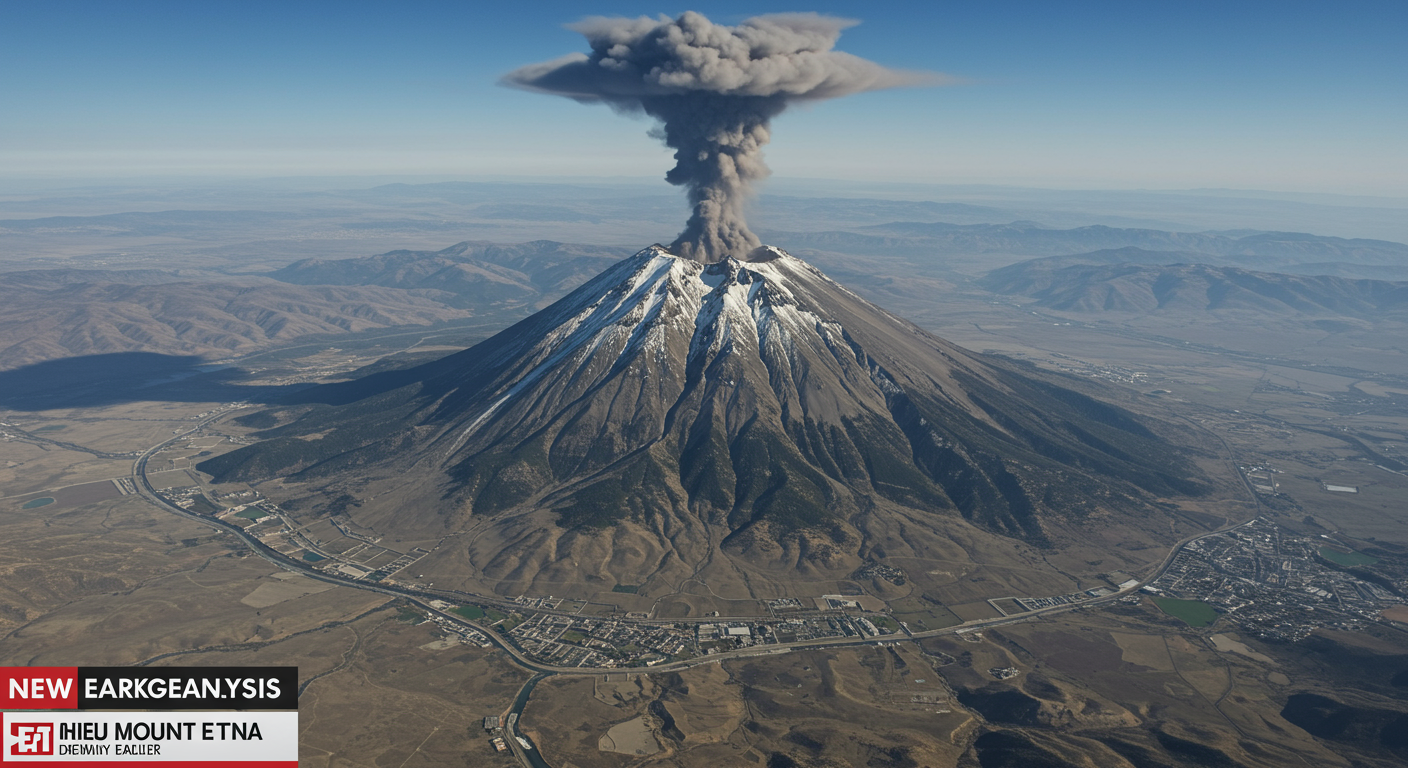
A new analysis of seismic data from Mount Etna provides a powerful new method for forecasting eruptions, potentially offering months of warning before the Sicilian volcano erupts. Researchers from Italy’s National Institute of Geophysics and Volcanology (INGV) have identified a specific pattern in earthquake activity that tracks magma as it moves from deep within the Earth’s mantle toward the surface. This breakthrough offers a significant advance over current methods, which typically provide only short-term alerts based on magma movement in the shallow crust.
The study, published in the journal Science Advances, centers on a seismological parameter known as the “b-value,” which describes the proportion of small earthquakes to large ones in a specific area. By analyzing two decades of seismic records from Mount Etna, the scientific team discovered that this ratio changes in a predictable way as magma ascends through different parts of the volcano’s plumbing system. This innovative approach could be integrated into existing monitoring systems to create a more robust, long-term forecasting model, giving authorities and nearby communities substantially more time to prepare for volcanic crises.
A New Paradigm in Volcanic Forecasting
For centuries, predicting the behavior of Mount Etna, one of the world’s most active volcanoes, has been a monumental challenge. Traditional forecasting methods have provided essential, but limited, insight into its activity. Scientists currently rely on a combination of seismic, geological, and geochemical data to monitor the volcano, with a primary focus on tracking magma as it accumulates in the upper crust. While effective for identifying immediate precursors to an eruption, this approach often leaves a narrow window—sometimes only days or hours—between an official alert and the event itself. This short lead time creates significant challenges for civil protection and public safety.
The new research offers a different paradigm by shifting the focus from the volcano’s shallow plumbing to its deeper roots. Instead of waiting for magma to reach the doorstep of the surface, the INGV team’s method detects the initial stages of its journey from the mantle. By interpreting subtle changes in earthquake patterns over extended periods, scientists can now identify the preliminary phases of magma recharge and ascent. This provides a medium to long-term outlook on the volcano’s state of unrest, moving eruption preparedness from a reactive to a proactive stance. The analysis of past events showed that this b-value monitoring could have successfully anticipated previous volcanic crises at Etna, underscoring its potential as a reliable forecasting tool.
Understanding the ‘b-value’ Parameter
Seismic Fingerprints of Magma
The core of this new forecasting method lies in the “b-value,” a well-established parameter in seismology that measures the relative occurrence of small-magnitude earthquakes versus high-magnitude ones. The researchers found that the b-value acts as a sensitive geological pressure gauge, changing in response to stress variations in the crust caused by moving magma. When magma rises from deep reservoirs, it increases stress in the surrounding rock, which tends to favor larger earthquakes and consequently lowers the b-value. Conversely, as the magma continues its ascent into shallower, more fractured parts of the crust, the stress is relieved, leading to a spike in smaller quakes and a corresponding increase in the b-value.
This dynamic relationship provides a seismic fingerprint of magma’s location and direction of travel. A decreasing b-value can signal that a deep magma reservoir is being loaded and pressurized, an early sign of a future eruption. An increasing b-value can then track that magma’s migration toward intermediate and shallow storage areas. By continuously monitoring these fluctuations, volcanologists can paint a far more detailed and time-lapsed picture of the processes building toward an eruption, effectively tracking the pulse of the volcano.
Two Decades of Seismic Data
To validate their hypothesis, the researchers conducted a retrospective analysis of seismic data collected at Mount Etna over a 20-year period, from 2005 to 2024. This extensive dataset provided a robust foundation for correlating changes in the b-value with the volcano’s known eruptive history. The team’s statistical model revealed a “very strong” correlation between the b-value and the volcano’s activity, confirming that these seismic signals were not random noise but were directly tied to the magmatic processes preceding eruptions.
Mount Etna’s location at the collision zone between the African and European tectonic plates creates a complex geological environment with a vertical strike-slip fault beneath the volcano, which facilitates magma’s rise. This unique setting, combined with the high frequency of eruptions and continuous, high-quality seismic monitoring, makes Etna an ideal natural laboratory for developing and testing such advanced forecasting models. The successful application of the b-value analysis to two decades of data demonstrates its reliability and its potential for integration into standard, real-time monitoring operations.
From Deep Mantle to Surface Eruption
The research provides a clear, sequential model of how magma’s journey is reflected in seismic activity. The process begins deep beneath the volcano, at depths around 11 kilometers, where magma recharge from the mantle builds stress in the host rock. This phase is characterized by a decrease in the b-value, indicating a shift toward larger-magnitude earthquakes. This initial signal is a critical early warning that the volcanic system is becoming more active, long before any surface-level signs appear.
As the magma ascends to intermediate storage areas, typically between 3 and 7 kilometers deep, the stress field changes again. The upward movement of magma unloads the deeper crustal rock, causing the b-value to rise as smaller earthquakes become more frequent. This secondary signal confirms that the magma is not only present but actively migrating toward the surface. The final stage involves the magma’s movement into the shallow plumbing system, just above sea level, which can be tracked by a further evolution of the b-value in the days leading up to an eruption. By identifying each of these stages through seismic data, scientists can create a timeline that helps forecast not just if an eruption will happen, but on what timescale.
Implications for Global Volcano Monitoring
While this groundbreaking method was developed and refined at Mount Etna, its potential applications extend to other active volcanoes around the world. The underlying principles—that moving magma alters crustal stress and that these changes are reflected in earthquake size distribution—are fundamental to volcanology. Therefore, the b-value analysis could be adapted for use at other restless volcanic sites, such as those in Hawaii or Japan, to improve their eruption forecasting capabilities.
However, the successful implementation of this technique is contingent on specific conditions. It requires high-quality, continuous seismic monitoring from a dense network of sensors around the volcano. Furthermore, the method is most effective in areas with a sufficient number of earthquakes to allow for robust statistical analysis. This means its application may be limited to more active volcanic regions where a steady stream of seismic data is available. For volcanoes that meet these criteria, integrating b-value analysis into their multiparametric surveillance systems could revolutionize their monitoring efforts, providing a more comprehensive and forward-looking assessment of volcanic unrest.

