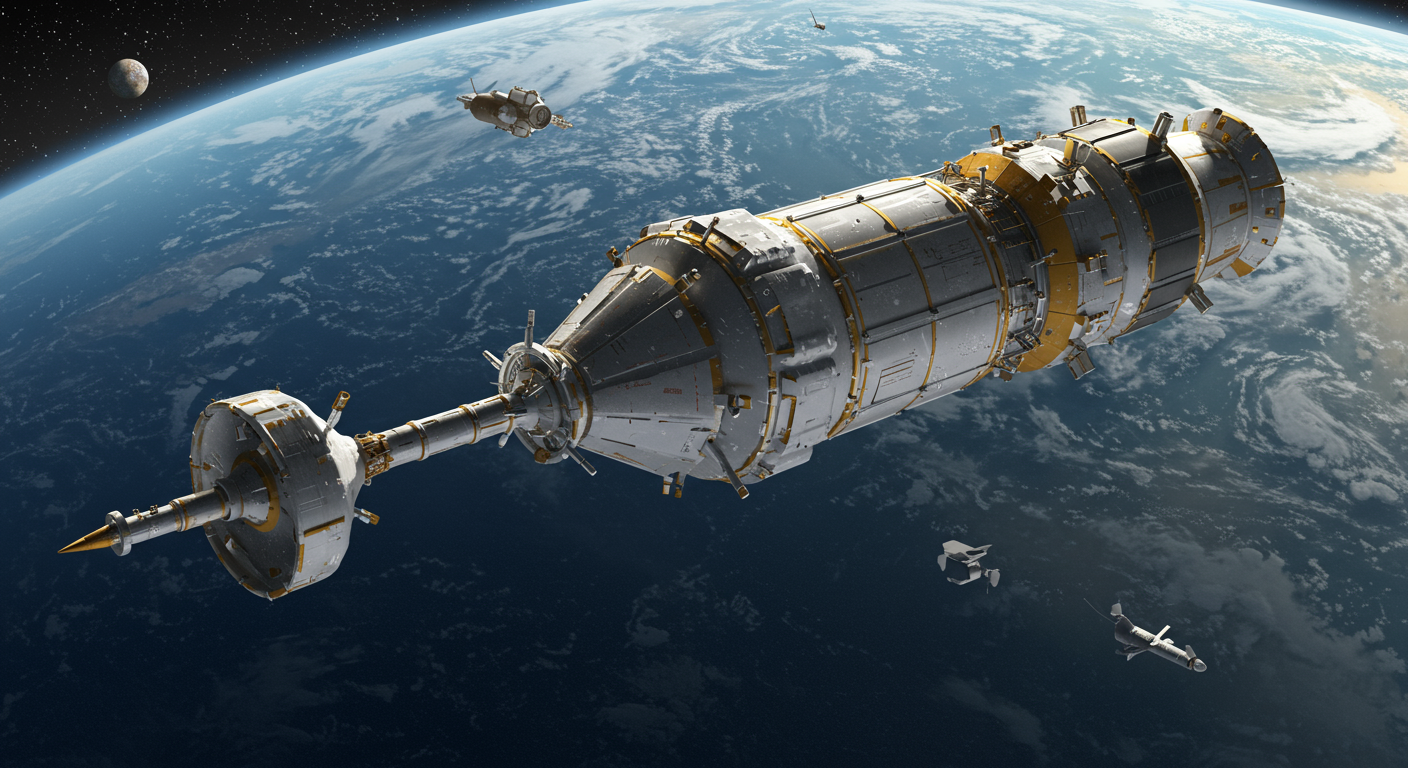
China’s Tianwen-2 spacecraft, currently speeding through deep space on a complex sample-return mission, has transmitted a striking self-portrait that captures the probe with a distant Earth in the background. The image, released by the China National Space Administration (CNSA) on October 1st, was taken to coincide with the country’s National Day celebrations and serves as both a technical milestone and a public display of the mission’s progress. Captured from approximately 43 million kilometers (26.5 million miles) away, the selfie showcases the spacecraft’s hardware, the Chinese flag, and the faint blue marble of our home planet all in a single frame.
The photograph is more than a celestial postcard; it confirms the successful deployment and operation of a monitoring camera mounted on the probe’s robotic arm, one of many systems being tested during its long journey. Tianwen-2 is embarking on a decade-long expedition that represents China’s first attempt to retrieve samples from an asteroid and its first mission to explore a comet. The probe is currently in good health and operating smoothly, having already completed a series of in-orbit checks on its sampling equipment and electronic systems while gathering data on the near-Earth space environment.
An Ambitious Dual-Target Mission
The Tianwen-2 mission is defined by its ambitious, multi-phase itinerary targeting two distinct celestial bodies. The probe is undertaking a years-long journey to a near-Earth asteroid before embarking on an extended mission to a main-belt comet, a flight plan that will test the endurance and adaptability of the spacecraft and its mission controllers.
Phase 1: Asteroid Sample Return
The primary objective is to rendezvous with 469219 Kamoʻoalewa, a small near-Earth asteroid. The spacecraft is scheduled to arrive at the asteroid around June or July of 2026. Upon arrival, it will spend several months conducting detailed reconnaissance and analysis of the asteroid’s surface before attempting to collect approximately 100 grams of material. Once the sample is secured in a return capsule, the probe will depart and send the capsule back toward Earth. The precious cargo of asteroid regolith is expected to land on Earth in late 2027, providing crucial material for scientific analysis.
Phase 2: Comet Exploration
After releasing the sample capsule, the main Tianwen-2 probe will not power down. Instead, it will perform a gravity-assist maneuver, slingshotting around Earth to alter its trajectory for the mission’s second deep-space destination. The spacecraft will then begin a long journey toward the main asteroid belt to intercept the comet 311P/PANSTARRS. The rendezvous is projected to occur around the year 2035. Once it arrives, Tianwen-2 will conduct in-situ measurements and scientific observations of the comet for at least one year, gathering data on its composition and behavior.
Technical Operations and In-flight Tests
The recent selfie is a product of rigorous in-flight testing designed to ensure every component of the Tianwen-2 spacecraft is ready for its demanding tasks. Since its launch in May 2025, the probe has been methodically powering up and evaluating its various subsystems. According to CNSA and Chinese state media reports, these checks have included the successful deployment of the complex sampling devices that will be used at Kamoʻoalewa. Self-checks of the probe’s electronic devices have also been completed, confirming that the core systems are functioning normally after the stresses of launch and in the harsh environment of interplanetary space.
The image itself was captured by a small monitoring camera affixed to a robotic arm, demonstrating the arm’s articulation and the camera’s imaging capabilities. This system is vital for providing visual feedback to mission controllers on Earth, allowing them to monitor the health of the spacecraft and oversee critical operations like the sample collection. Earlier in the mission, on May 30th, the probe used its Narrow Field of View Navigation Sensor to capture a “lookback” image of Earth as another functionality test. These activities build confidence in the hardware and software that will be essential for the mission’s success millions of kilometers from home.
The Scientific Importance of Kamoʻoalewa
The choice of 469219 Kamoʻoalewa as the primary target is scientifically significant. This asteroid is classified as a quasi-satellite of Earth, meaning its orbit is highly unusual and closely tied to our planet’s path around the Sun. Some researchers have theorized that Kamoʻoalewa may be a fragment of the Moon, ejected into space following a major impact event in the distant past. The samples returned by Tianwen-2 could provide the first direct evidence to confirm or refute this hypothesis. Analysis of the material will offer insights into the formation of the Earth-Moon system and the dynamics of asteroids in our solar system.
By studying this unique object, scientists hope to better understand the composition of near-Earth asteroids, which is crucial for planetary defense and for understanding the resources they may hold. The mission aims to shed light on the formation and evolution of the early solar system, as asteroids are considered primitive remnants from that era. The data collected will complement findings from other asteroid sample-return missions, such as NASA’s OSIRIS-REx and JAXA’s Hayabusa2, contributing to a more complete global understanding of these celestial bodies.
A Demonstration of Growing Capabilities
The Tianwen-2 mission is a key part of China’s rapidly expanding and increasingly sophisticated space exploration program. It follows the successful Tianwen-1 mission, which placed an orbiter, lander, and rover on Mars in 2021, and the Chang’e series of lunar missions that included returning samples from the Moon. This latest endeavor into deep space pushes China’s technological boundaries further, requiring precise navigation over vast distances and the execution of complex, autonomous operations like landing, sampling, and returning to Earth.
Successfully completing a dual-target mission that involves both an asteroid sample return and a comet rendezvous would be a major technical achievement. It demonstrates a long-term strategic vision for space exploration and establishes China as a leading player in interplanetary missions. The selfie, featuring the Chinese flag prominently against the backdrop of space, underscores the national pride associated with these ambitious undertakings and signals the country’s intent to continue pursuing challenging scientific goals in the solar system.