A revolution in medicine is facing a thick problem. Monoclonal antibodies, a class of powerful drugs that can target diseases from cancer to autoimmune disorders with high precision, are often too viscous to be administered easily outside of a hospital setting. This high viscosity at the concentrations needed for effective treatment creates a major bottleneck in drug development and manufacturing, limiting patient access to therapies that could otherwise be self-injected at home, similar to insulin. The challenge has spurred a deep investigation into the molecular forces that cause these antibody solutions to thicken, as researchers seek to engineer better, more easily delivered biologic medicines.
The core of the issue lies in the preferred method of administration. Subcutaneous injection, or an injection into the fatty tissue under the skin, is convenient for patients but can only accommodate a small volume of liquid, typically no more than two milliliters. To fit a therapeutic dose into such a small volume, the antibody drug must be highly concentrated, often over 100 or 150 milligrams per milliliter. At these high concentrations, many antibody solutions become exceptionally thick, sometimes resembling honey. This makes it difficult to withdraw the drug from a vial and painful or impossible to inject using a standard syringe, with formulations often needing to remain below a viscosity of 20 to 50 millipascals per second (mPa·s) to be viable. This hurdle forces many treatments to be delivered via lengthy intravenous infusions in clinics, placing a heavy burden on both patients and healthcare systems.
The Challenge of Molecular Crowding
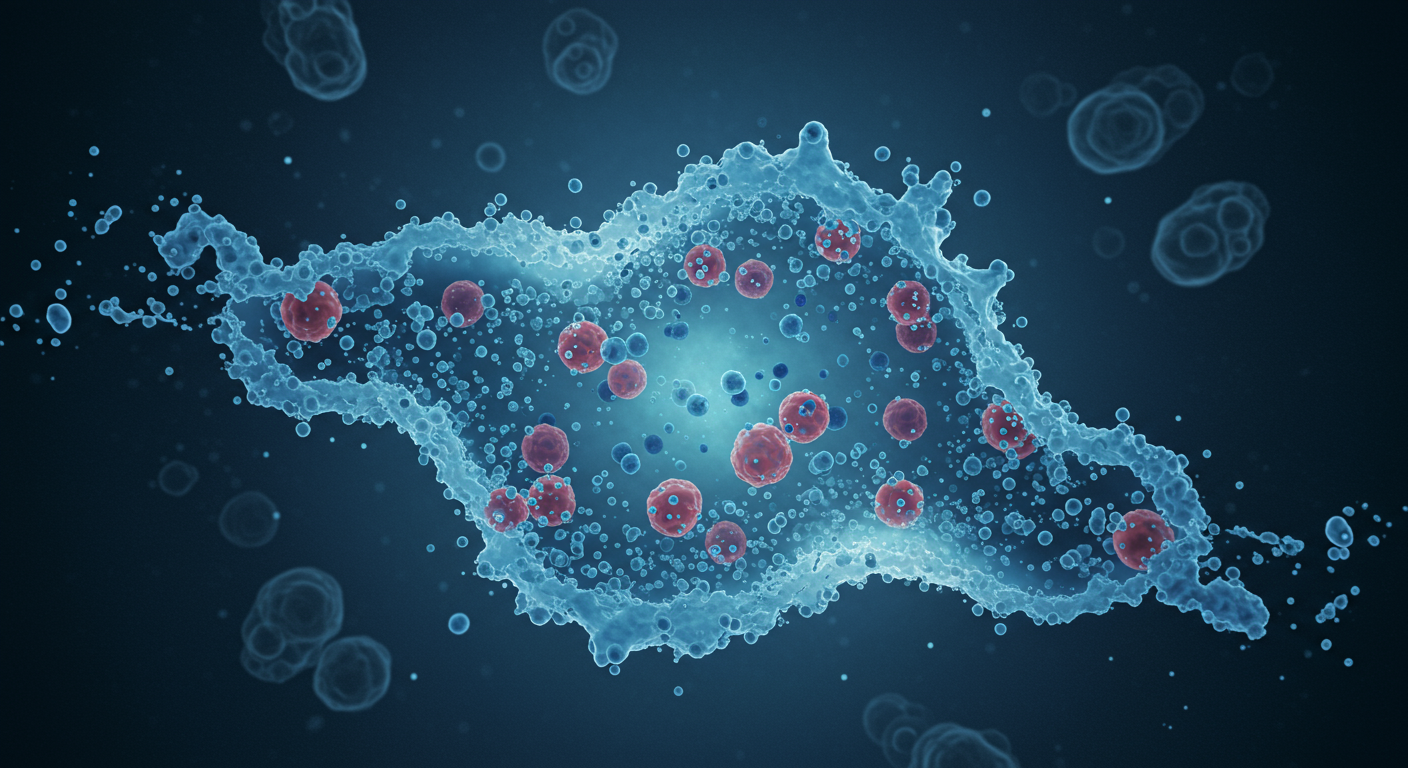
The dramatic increase in viscosity is not a simple property of individual antibody molecules but rather an emergent phenomenon of their collective behavior. At low concentrations, the molecules move freely in solution. But as the concentration increases, they become intensely crowded, leading to a dramatic rise in protein-protein interactions (PPIs). These interactions, which can be both attractive and repulsive, cause the antibodies to transiently stick to one another. This reversible self-association can lead to the formation of small clusters, and eventually, extensive molecular networks that resist flow. These networks impart “solid-like” properties to the solution, which is the direct cause of the high viscosity observed.
Researchers have identified two main types of forces driving these interactions: electrostatic and hydrophobic. Electrostatic interactions are driven by the distribution of positive and negative charges on the surface of the antibody. Hydrophobic interactions occur when non-polar, water-repelling regions of the molecules associate with each other to avoid contact with the surrounding water. The interplay of these forces is complex and highly specific to each individual antibody, meaning a solution that works for one drug may fail for another. Scientists study these forces using metrics like the second virial coefficient (B22), which helps predict whether the net interactions between molecules are attractive or repulsive at lower concentrations.
Pinpointing the Source of Stickiness
An antibody is a Y-shaped protein with two main regions: the constant fragment (Fc), which is the same across many antibodies of the same class, and the variable fragment (Fv), which is unique to each antibody and contains the structure that binds to its specific target. While the entire molecule contributes to its behavior, research has increasingly shown that the Fv region is the primary driver of viscosity issues. The unique amino acid sequences in the Fv region create distinct charge and hydrophobicity profiles on the molecular surface. These unique surface patches are often the “hotspots” for the intermolecular interactions that lead to self-association and thickening.
Because the Fv region is also responsible for the antibody’s therapeutic function—binding to a virus or a cancer cell—modifying it is a delicate balancing act. The very structures that make an antibody an effective drug can also make it a difficult one to formulate. Studies have shown that antibodies with different Fv regions but identical Fc regions can have wildly different viscosity profiles under the exact same conditions, confirming that the variations originate in the target-binding part of the molecule. Understanding the specific surface topography of the Fv region is therefore crucial to predicting and controlling viscosity.
Engineering for Better Formulations
Designing Smarter Antibodies
One of the most promising strategies to combat high viscosity is to re-engineer the antibody itself. Using advanced computational modeling and experimental techniques, scientists can identify the specific amino acid residues that form the problematic “sticky” patches on the Fv surface. With this knowledge, they can perform site-directed mutagenesis—swapping out a problematic amino acid for a different one—to disrupt the unwanted interactions. For example, research has shown that neutralizing a negatively charged surface patch can significantly reduce viscosity without compromising the drug’s stability or its ability to bind to its target. This rational design approach allows for the creation of new antibody variants that are inherently less prone to thickening at high concentrations.
The Rise of Predictive Tools
To accelerate this process, researchers are developing in-silico tools, including machine learning and deep learning models, to predict viscosity directly from an antibody’s sequence. By training these models on large datasets of antibodies with known viscosity measurements, these tools can identify sequence patterns and molecular features that are likely to cause problems. One such model, DeepViscosity, demonstrated high accuracy in classifying antibodies as either low- or high-viscosity based solely on sequence data. These predictive tools enable drug developers to screen hundreds of potential antibody candidates early in the discovery phase, prioritizing those with the best formulation properties long before expensive and time-consuming laboratory work begins.
The Role of Solution Chemistry
Beyond altering the antibody, viscosity can also be managed by carefully designing the solution it is formulated in. The chemical environment, including the pH and the presence of additives known as excipients, can have a profound effect on protein-protein interactions. Adjusting the pH of the formulation can alter the charges on the antibody’s surface, potentially increasing electrostatic repulsion between molecules and preventing them from sticking together.
Specific excipients can also act as viscosity-reducing agents. Amino acids, particularly arginine, have been shown to effectively lower the viscosity of some antibody solutions. Salts are another common additive used to modulate interactions, though their effects can be complex; while they can screen electrostatic attractions and lower viscosity, they can sometimes promote hydrophobic interactions that lead to other problems, such as aggregation or the formation of an opaque gel. Finding the optimal combination of pH and excipients for each unique antibody remains a central challenge in formulation science.
A Path to More Accessible Medicines
The deep dive into the molecular mechanics of antibody solutions is paving the way for a new generation of biologic drugs. With over 150 monoclonal antibodies already approved or in regulatory review, and hundreds more in development, solving the viscosity problem is a critical priority for the pharmaceutical industry. Success in this area promises to shift more treatments from the clinic to the home, empowering patients with the ability to manage their own care through simple subcutaneous injections. By combining rational protein engineering with sophisticated formulation strategies, scientists are making these revolutionary medicines not just more effective, but also more accessible to the people who need them most.